
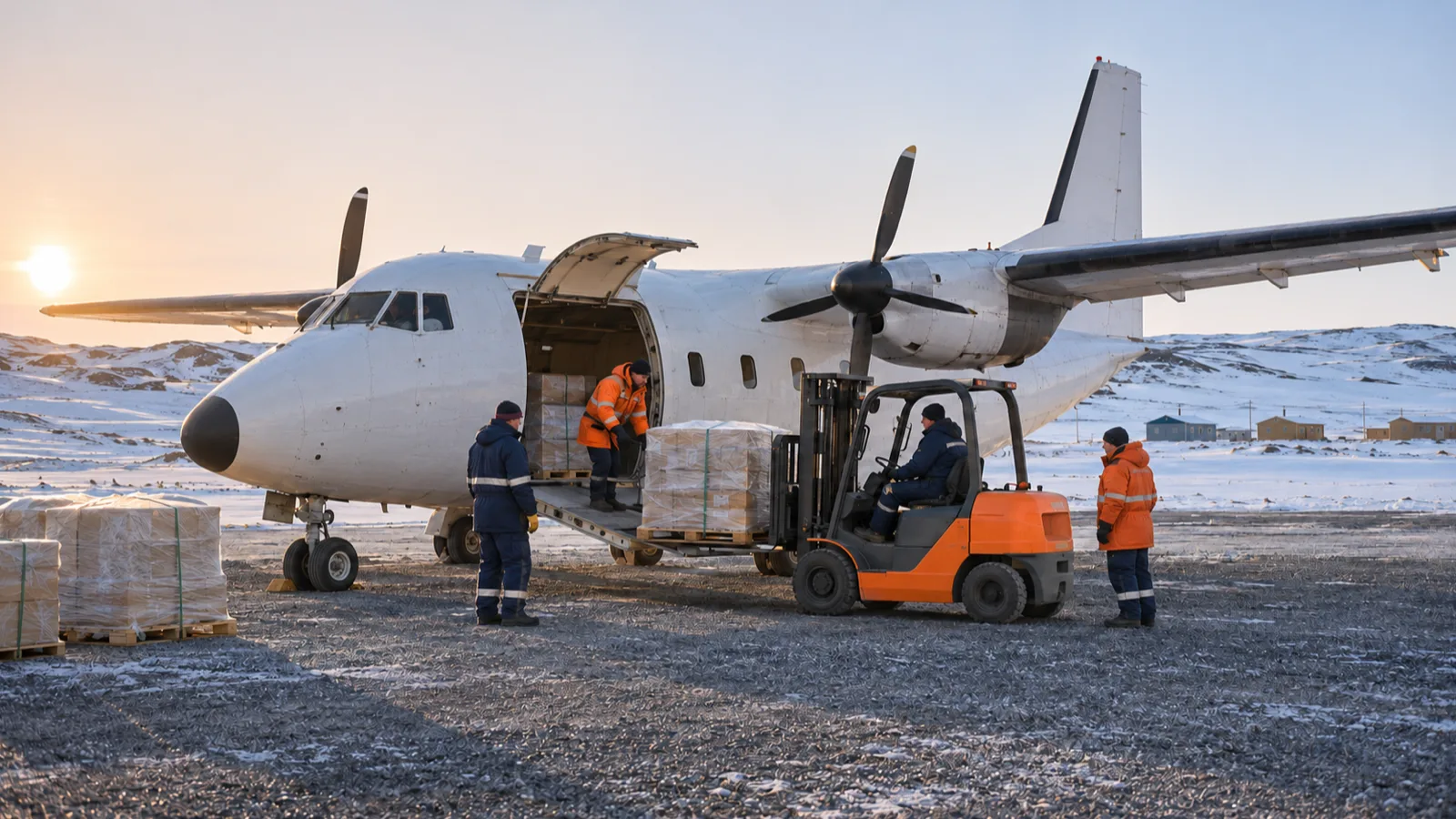
A pharmacy supplier gets an order from a health centre in a fly-in community in northern Ontario. A small online retailer receives a holiday order from a customer in Nunavut. A mining company needs a replacement pump at a remote camp before the weekend. In each case, there is no road to drive on, or at least not this time of year. The shipment has to fly.
Air cargo is the year-round link between southern Canada and hundreds of remote communities and work sites. It carries fresh food, medicine, mail, spare parts, retail goods and almost anything that cannot wait for the short winter road season or the annual sealift. It is also the most expensive and capacity-constrained way to move freight in the country, so knowing how it works can save money and prevent frustrating delays.
This guide walks through how freight reaches remote Canada by air, what limits shipments, and how to prepare cargo so it arrives on time and intact, especially during the busy holiday season and the cold months ahead.
Which communities depend on air
Many communities in Canada have no permanent road connection to the rest of the country. They include:
- All communities in Nunavut
- Most communities in Nunavik, the northern region of Quebec
- Many communities in the Northwest Territories and some in Yukon
- Numerous First Nations communities in northern Ontario and northern Manitoba
- Remote communities in northern Saskatchewan, Alberta and British Columbia
- Coastal communities in Labrador during parts of the year
Some have seasonal road access by winter road, and Arctic coastal communities receive heavy goods by sealift. For everything else, air is the only option.
How freight gets there: the hub and spoke model
Air cargo to remote Canada typically moves in two or more stages. Freight first travels from its origin to a southern or regional gateway city by road, rail or air. From there, northern airlines carry it onward, sometimes through a second regional hub, to the destination community.
Common gateways include:
- Montreal and Ottawa for Nunavik and the eastern Arctic, including Iqaluit
- Winnipeg for the Kivalliq region of Nunavut and northern Manitoba, often via Thompson or Churchill
- Edmonton and Yellowknife for the western Arctic and the Northwest Territories
- Thunder Bay, Sioux Lookout, Timmins and Moosonee for northern Ontario communities
- Whitehorse for parts of Yukon
For shippers in the south, the first step is usually getting freight to the right gateway in time for the airline's cut-off. That leg might be LTL freight for pallets or small parcel service for cartons. Choosing the wrong gateway can add days and cost.
What limits air cargo
Aircraft size
Northern airlines use a range of aircraft, from larger jets and turboprops that serve regional hubs to small planes that land on short gravel strips in small communities. Many flights are combi operations that carry passengers and cargo together. Cargo door sizes, floor strength and cabin dimensions limit how large and heavy each piece can be. Something that fits easily in a truck may not fit through the door of a small aircraft. Always check maximum dimensions with the airline before shipping large items.
Capacity
Cargo space is limited, and priority often goes to mail, medical supplies and perishable food. During busy periods such as the weeks before Christmas, backlogs can build at gateway airports. Book early and expect some delays.
Weather
Northern flights are frequently delayed by fog, blizzards, ice and extreme cold. Gravel strips may be closed after heavy snow until they are cleared. Build buffer time into any shipment with a deadline.
Weight and dimensional pricing
Air cargo is priced on the greater of actual weight or dimensional weight, and rates per kilogram to remote communities are high. Bulky, light items are particularly expensive. Packaging that is even slightly larger than necessary adds real cost. Our guide on package dimensions and shipping costs explains how dimensional weight is calculated.
Shipping perishable food
Fresh food is one of the most important things flown north. Communities rely on air cargo for produce, dairy, meat and bread. The federal Nutrition North Canada program provides a subsidy to registered retailers and suppliers for eligible perishable, nutritious foods shipped by air to eligible isolated communities, to help reduce the cost to consumers. Suppliers who want to participate need to understand the program's requirements.
Perishables need careful handling at every step:
- Use insulated packaging with gel packs or other refrigerants sized for the expected transit time, including possible delays.
- Protect against freezing as well as heat. In winter, fresh produce can freeze on a cold tarmac while waiting to be loaded.
- Label clearly as perishable and keep refrigerated or keep from freezing as appropriate.
- Coordinate with the receiver so someone collects the shipment as soon as it lands.
For suppliers of frozen and chilled goods, ShipCarte's cold chain fulfillment can prepare and pack orders correctly before they leave for the gateway.
Shipping medical supplies and healthcare products
Health centres in remote communities rely on air cargo for medications, vaccines, medical devices and supplies. Many of these products are temperature sensitive and must stay within strict ranges, which is challenging when flights are delayed or freight sits on a cold ramp. Suppliers should use validated packaging, include temperature monitoring where appropriate, and work with carriers that understand healthcare requirements. ShipCarte's temperature-sensitive product services support this kind of shipment preparation.
Dangerous goods by air
Many common items are regulated as dangerous goods when shipped by air, including lithium batteries, aerosols, fuel, propane cylinders, paints, some cleaning chemicals and certain medical products. Air transport rules are strict, and items allowed by road may be restricted or forbidden on aircraft, particularly on passenger flights. Shippers must classify, package, mark, label and document dangerous goods correctly, and staff preparing them need appropriate training. Undeclared dangerous goods can result in rejected shipments and penalties. When in doubt, ask the airline before shipping.
Packing tips for northern air cargo
- Right-size boxes. Eliminate empty space to reduce dimensional weight.
- Use sturdy packaging. Freight may be handled several times and stacked with other cargo in tight spaces.
- Protect against cold. Liquids, electronics, batteries and many products can be damaged by extreme cold. Insulate where needed and mark "Protect from freezing".
- Keep pieces manageable. Smaller, lighter pieces fit more aircraft and are easier to load by hand.
- Label clearly. Include the consignee name, community, phone number and any reference numbers. Many small communities do not use street addresses the way southern cities do.
- Include documentation inside and out. A packing list inside the box helps if the outer label is damaged.
Ecommerce orders to remote Canada
Online shoppers in remote communities often face high shipping costs, limited options, or retailers that refuse to ship to their postal codes. Businesses that serve these customers well can earn loyal buyers. A few practical steps help:
- Offer carrier options that reach remote postal codes and display realistic delivery estimates.
- Be transparent about shipping costs before checkout.
- Pack efficiently to keep dimensional weight down.
- Avoid shipping restricted items by air without proper handling.
- Communicate proactively about holiday cut-offs, which are earlier for remote destinations.
ShipCarte's ecommerce fulfillment and shipping platform help online sellers compare carrier options and pack orders efficiently for destinations across Canada.
Addresses, consignees and the last few metres
Delivery in a small northern community rarely looks like delivery in Toronto or Calgary. Many places have no door-to-door freight service. Air cargo is often held at the airline's cargo office at the community airstrip, and the consignee is called to pick it up. That changes what a good shipment looks like:
- A reachable phone number is essential. If the airline cannot reach the consignee, freight can sit in a cold cargo shed for days, which is a problem for anything perishable or temperature sensitive.
- Name the right organisation. For deliveries to a band office, health centre, school or co-op store, use the organisation's exact name and a named contact, not just a street address.
- Check storage at destination. Some community cargo facilities have limited heated or refrigerated space. Ask before shipping large volumes of anything that cannot freeze.
- Agree on who pays. Freight may be shipped prepaid or collect. Confusion over charges at the destination can delay release.
Planning around the holiday rush
The weeks before Christmas are among the busiest of the year for northern air cargo. Families order gifts, stores stock up, and organisations try to deliver supplies before the holiday shutdown. Gateway warehouses fill up and freight can wait for space on a flight. If you are shipping to remote Canada during this period, send as early as you can, tell customers that holiday cut-offs for remote destinations are earlier than for southern cities, and avoid sending anything truly urgent on the last flights before the holiday. The same advice applies at other peaks, such as the start of the school year and around major community events.
Choosing between air, winter road and sealift
For organisations supplying remote communities regularly, the most cost-effective approach usually combines modes. Heavy, non-urgent goods move by sealift or winter road when available, while air handles perishables, urgent orders and anything needed between seasons. Planning annual needs and shipping the heavy items by surface saves air capacity, and money, for what truly needs to fly.
Get your freight to the gateway on time
Air cargo to remote Canada works best when the southern leg is reliable. ShipCarte can pick, pack and ship your goods to the right gateway city, coordinate with carriers, and keep you updated along the way. For more on how parcels differ from freight on these routes, see our article on freight versus small package shipping. Request a quote and tell us where your shipments need to go.