
An online gallery sells a large oil painting to a collector in St. John's. A hobby shop in Winnipeg lists a rare graded trading card that sells to a buyer in Victoria. An estate dealer in Montreal ships a set of antique porcelain figurines to a client in Calgary. In each case, the object is worth far more than a typical parcel, it may be impossible to replace, and the person shipping it is responsible for making sure it arrives exactly as it left.
Shipping art and collectibles in Canada brings together several challenges at once: fragile or irregular objects, high values, long distances, harsh winters, and carrier liability rules that were never designed for one-of-a-kind items. Many disappointing outcomes trace back to two avoidable mistakes: packing that does not match the object, and insurance that does not match the value.
With galleries, auction houses and collectibles shops now making a large share of their sales online, more valuable objects move through parcel and freight networks than ever before. This guide covers how to choose the right level of packing, how to think about insurance, and what Canadian rules apply.
Start with the object, not the box
Every packing decision starts with a few questions about the piece itself:
- What is it made of? Canvas, works on paper, glass, ceramics, bronze, wood, textiles and mixed media all react differently to pressure, vibration, humidity and temperature.
- What is its weakest point? A frame corner, a protruding element on a sculpture, a glazed surface, a slabbed card's case.
- How big and heavy is it? Size determines whether parcel carriers will accept it and whether it needs freight.
- What is it worth, and can it be replaced? A limited edition print can sometimes be replaced. An original painting cannot.
- What is its condition now? Photograph it from every angle before packing. That record matters if there is ever a claim.
Three levels of packing
Most art and collectibles shipments fall into one of three broad packing levels. Choosing the right one is the single biggest factor in a safe arrival.
Level 1: Soft pack and double box
Suitable for smaller, robust or lower-value items such as unframed prints, books, sports memorabilia in cases, coins and many smaller collectibles. The item is wrapped in a protective layer, cushioned in an inner box, and floated in a larger outer box with at least a few centimetres of cushioning on every side. This is the same principle covered in our guide to packing fragile items, applied with more care.
Works on paper should be kept flat between rigid boards or rolled in a sturdy tube only if the medium allows it. Trading cards and comics belong in rigid holders, then sleeved, then boxed, never loose in an envelope.
Level 2: Cardboard crate or travel frame
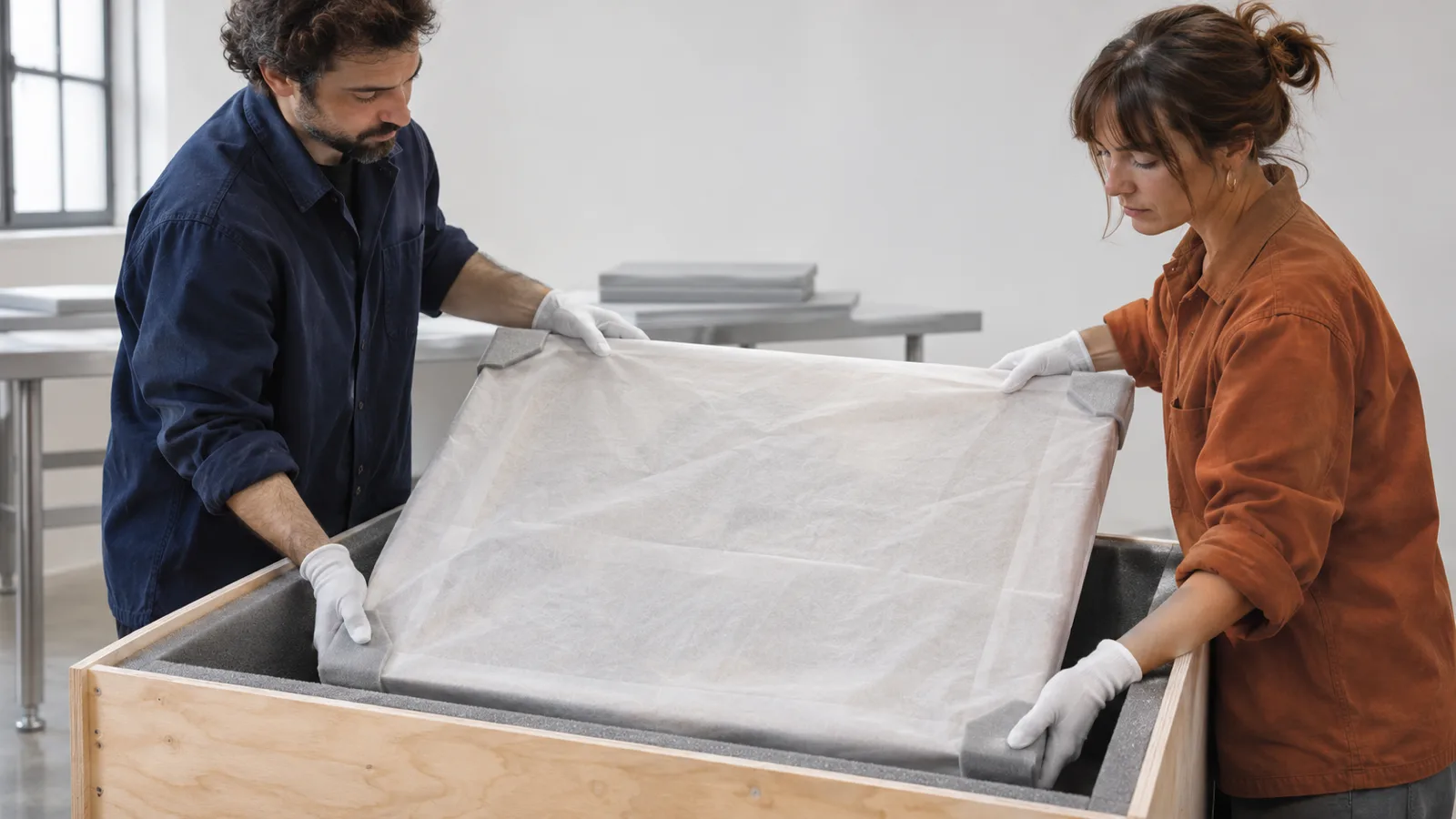
Suitable for framed paintings and prints of moderate value, smaller sculptures and decorative objects. The piece is wrapped in a non-abrasive barrier, such as glassine for paintings, given corner protectors, and placed in a custom-built corrugated or foam-lined box. For framed works with glass, taping an X across the glass, or using acrylic glazing for shipping, reduces the risk of shards damaging the artwork if the glass breaks.
Level 3: Wooden crate
Suitable for high-value paintings, large or heavy sculpture, antique furniture and anything irreplaceable. A crate built from plywood with a timber frame, lined with foam, and sized to the object provides structural protection against impact and puncture. Some crates suspend the piece in foam so that shocks are absorbed before they reach it. Crates add weight and cost but are often the only responsible choice for valuable work.
Note that solid wood packaging used for international shipments must meet ISPM 15 standards, with heat treatment and a stamp, to avoid problems at the destination border. Plywood is generally exempt, which is one reason it is common for art crates.
Canadian climate and art
Canada's winters are hard on art in transit. A shipment from Toronto to Edmonton in February may spend time in trailers and terminals where temperatures fall far below freezing. Extreme cold can make paint layers brittle, cause adhesives to fail and crack some ceramics. Rapid temperature changes when a cold crate is opened in a warm room can lead to condensation on surfaces.
A few precautions help:
- Use insulated packing or crates for sensitive works in winter, and consider temperature-controlled storage or transport for especially vulnerable pieces.
- Avoid shipping late in the week, so objects do not sit in unheated depots over a weekend.
- Advise the recipient to leave the crate or box closed for several hours, ideally a day, so the contents warm up gradually before unpacking.
- Choose services with fewer handoffs and shorter transit times for valuable items.
Summer brings its own risks: heat and humidity can affect works on paper and some media. The principle is the same: limit exposure and transit time.
Parcel or freight?
Smaller items within carrier size and weight limits can travel as parcels. Many carriers, however, place restrictions on fine art, antiques and collectibles, either excluding them from coverage or capping liability at a low amount regardless of declared value. Read the carrier's terms closely before shipping anything valuable by parcel.
Larger crates usually move as freight. LTL freight is economical but involves terminals and transfers between trucks. For very valuable or delicate pieces, an exclusive-use truck or a specialised fine art shipper with climate-controlled vehicles reduces handling. Whatever the mode, specify inside delivery or white-glove service if the recipient cannot handle a heavy crate themselves.
Insurance: carrier liability is not the same as insurance
This is where many shippers are caught out. When a parcel or freight carrier accepts a shipment, its liability for loss or damage is limited by its terms and, for freight, by the regulations governing carriage. In many provinces, uniform conditions of carriage limit a carrier's liability to a set amount per kilogram unless a higher value is declared and paid for. For a lightweight but valuable object, that limit may cover only a small fraction of its worth.
There are a few ways to close that gap:
- Declared value with the carrier. Paying to declare a higher value increases the carrier's liability, but carriers often cap declared value and exclude certain categories, including some art and antiques.
- Third-party shipping insurance. Cargo or shipment insurance purchased separately can cover the full value, subject to its own terms and exclusions. Our article on freight insurance in shipping explains how it differs from carrier liability.
- Fine art insurance. Galleries and collectors often hold specialist policies that cover works in transit. Check whether your policy covers the specific journey and packing method.
Whichever route you choose, document everything: condition photos before packing, photos of the packing process, the invoice or appraisal establishing value, and the bill of lading or waybill. Insurers usually expect evidence that the item was packed appropriately. A claim on a painting shipped without proper protection may be declined.
Rules for shipping art in and out of Canada
Domestic shipments within Canada do not require special permits for most art and collectibles. International shipments are a different matter:
- Cultural property export controls. Under the Cultural Property Export and Import Act, certain objects of cultural significance over specified age and value thresholds require an export permit to leave Canada. Dealers in antiques, historical documents and Indigenous artefacts should check before shipping abroad.
- Protected materials. Objects containing ivory, tortoiseshell, certain woods or other materials from protected species may require CITES permits.
- Customs declarations. Art sent to the United States or elsewhere needs an accurate description and value. Original artworks are often duty-free in many countries, but taxes may apply at the destination.
A cross-border shipping partner can help prepare documentation for international art shipments.
Storing art and collectibles between sales
For galleries, dealers and online sellers, the time a piece spends waiting for a buyer can be longer than the time it spends in transit. Storage conditions matter just as much. Keep works away from direct sunlight, exterior walls and sources of heat, maintain relatively stable temperature and humidity, and store paintings upright in padded racks rather than leaning against each other. Collectibles such as cards, comics and coins should stay in their protective holders and be inventoried individually, with photos and a location record, so they can be found and shipped quickly when they sell. Good records also make insurance and claims easier if anything goes wrong.
A pre-shipment checklist
- Photograph the piece from every angle, including any existing damage.
- Confirm the value with an invoice, appraisal or sale record.
- Choose the packing level appropriate to the object and value.
- Check carrier terms for exclusions on art, antiques or collectibles.
- Arrange insurance that covers the full value for this journey.
- Book a service with minimal handling and a sensible day of the week.
- Label the crate with orientation arrows and handling instructions.
- Share tracking and unpacking guidance with the recipient.
- Ask the recipient to inspect and photograph the piece on arrival and report any damage immediately.
Ship with confidence
Valuable objects deserve a shipping plan built around their needs. ShipCarte helps galleries, dealers and collectors across Canada choose the right carriers and services, coordinate freight for crated pieces, and store items in suitable conditions between sales. Request a quote for your next shipment, or schedule a consultation to discuss a recurring program.