
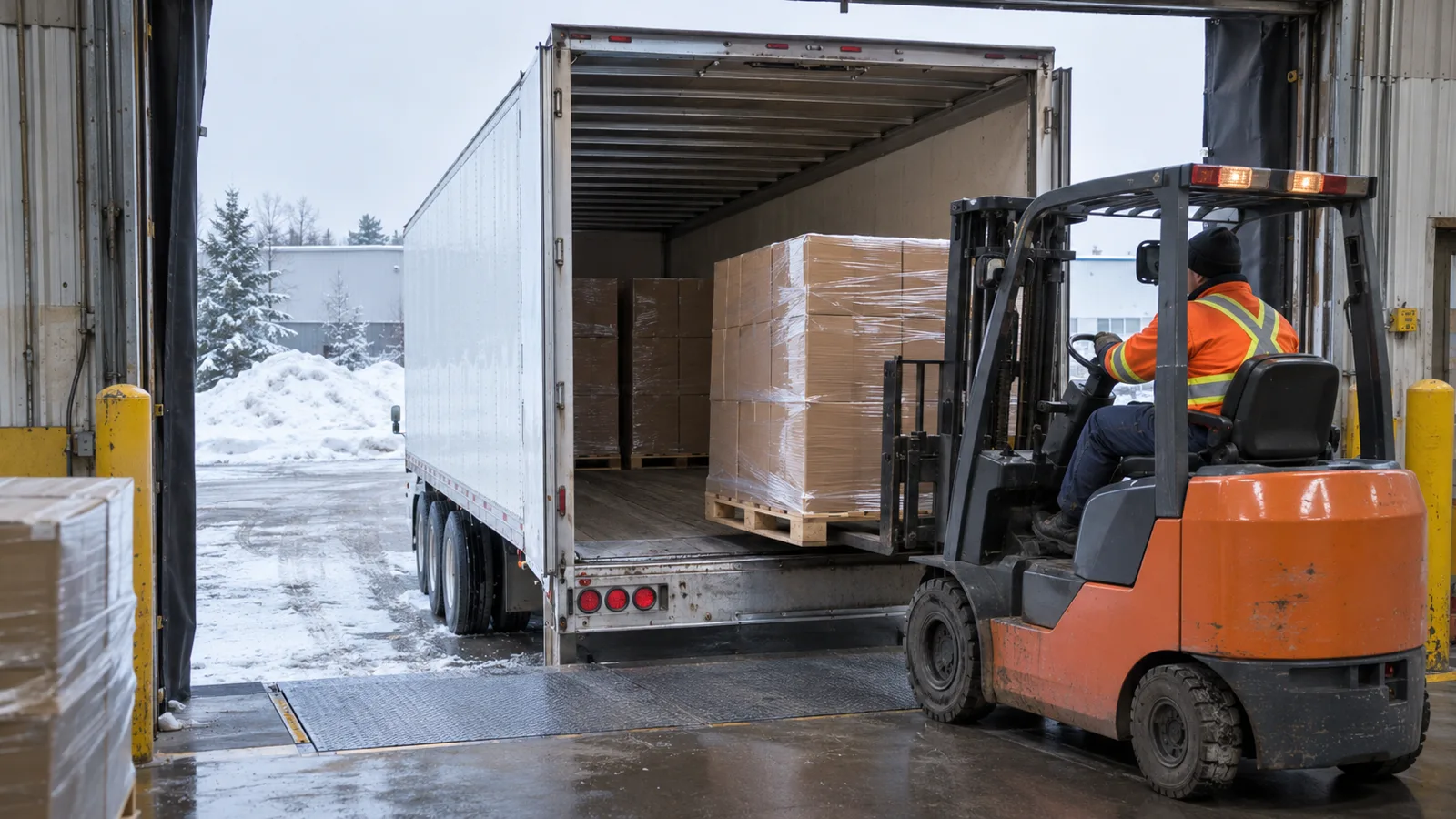
A janitorial supply distributor in Edmonton launches an online ordering portal so its customers, mostly property managers, restaurants and small offices, can reorder without phoning a sales rep. Within weeks, orders are flowing in from Red Deer, Kelowna and Regina. Then the problems start. A restaurant orders 40 cases of paper towel, and the checkout charges parcel rates on 40 separate boxes. An office building has no loading dock and refuses a 53-foot trailer. A hospital purchasing department rejects a shipment because the packing slip did not show its purchase order number.
B2B ecommerce looks like retail ecommerce on the front end: product pages, a cart, a checkout. Behind the scenes, it is closer to traditional wholesale distribution. Orders are larger and heavier, buyers have receiving rules, payment terms vary, and the cheapest way to ship a single order might be a parcel, a pallet or a full truck depending on what is in the cart.
This article looks at the shipping side of B2B ecommerce in Canada: how to pick the right mode, how to show freight costs at checkout, and how to meet the expectations of business buyers from coast to coast.
How B2B Orders Differ From Consumer Orders
- Order size: B2B orders often run to multiple cases or pallets, not single units.
- Delivery locations: warehouses, shops, job sites, offices and institutions, each with different access and receiving hours.
- Paperwork: buyers expect purchase order numbers, packing slips that match their PO, and sometimes advance shipping notices.
- Payment: many business customers buy on account with terms such as net 30, which affects how freight is invoiced.
- Repeat ordering: the same buyer orders the same products regularly, so consistency matters more than novelty.
- Pricing: customer-specific price lists, volume tiers and negotiated freight terms are common.
Choosing the Right Shipping Mode
The most important logistics decision in B2B ecommerce is when to ship as parcels and when to switch to freight. The answer depends on weight, number of cartons, fragility and destination.
Small parcel
Best for orders of a few cartons, typically when individual boxes are within carrier size and weight limits. Parcel carriers offer door-to-door delivery with tracking for each box and reach most addresses in Canada, including many rural and remote areas. The downside: each carton is billed separately, and multi-box shipments can get split up, with one box arriving a day after the others. Small parcel shipping is often the default for smaller reorders.
LTL freight
Less-than-truckload freight moves palletized goods on shared trucks. Once an order reaches a certain number of cartons or a certain total weight, putting it on a pallet and shipping LTL is often cheaper and safer than sending a stack of parcels. The goods stay together, are handled by forklift rather than conveyor, and arrive as one delivery. LTL pricing in Canada depends on factors such as weight, density, pallet dimensions, distance and accessorial services. Learn more on our LTL freight page.
Full truckload
For large replenishment orders to a distributor or retailer, or for stocking a regional warehouse, a dedicated full truckload can be the most efficient option. The trailer goes directly from your dock to the buyer's with no terminal handling in between.
A rough rule of thumb
Rather than relying on a single weight cutoff, compare parcel and LTL quotes for your typical order profiles on your main lanes, such as Toronto to Montreal, Calgary to Vancouver or Winnipeg to Thunder Bay. You will usually find a crossover point where freight becomes cheaper, and you can build that into your checkout logic. Our article on how freight differs from small package shipping explains the trade-offs in more detail.
Showing Freight Costs at Checkout
Consumer ecommerce platforms are built around parcel rates. B2B stores need more options. Common approaches include:
- Freight quoted after the order: the buyer places the order, and your team quotes freight before shipping. Simple, but slower and less transparent.
- Freight tables: pre-set charges based on order weight or pallet count and destination region. Works well when your products and lanes are consistent.
- Real-time LTL quotes: some shipping platforms can pull live freight rates into checkout based on cart weight, freight class or density and destination postal code.
- Customer-specific terms: prepaid freight above a minimum order value, freight collect for buyers who use their own carrier, or freight built into the price list.
Whatever method you choose, make sure buyers can enter delivery requirements at checkout: whether they have a dock, receiving hours, whether an appointment is needed and whether a liftgate is required.
Meeting Business Receiving Requirements
Business deliveries fail for reasons consumer deliveries rarely do. Plan for these:
Access and equipment
Many small businesses, offices and downtown shops have no loading dock. A freight delivery to these locations usually needs a truck with a liftgate and may need inside delivery. These are accessorial services that add cost, so capture them at checkout rather than discovering them when the driver arrives.
Appointments
Large retailers, distribution centres, hospitals and some institutions require delivery appointments. Missing an appointment can mean a refused delivery and redelivery fees. Our explainer on delivery appointments in freight covers the process.
Documentation
Include the buyer's PO number on the packing slip, carton labels and bill of lading. Make sure quantities shipped match the PO, and note any backorders clearly. Larger customers may require electronic advance shipping notices and specific label formats.
Labelling and language
Clear, consistent carton labels with product descriptions and quantities speed up receiving. For products sold to consumers in Canada, packaging generally needs to meet bilingual labelling requirements, and business buyers who resell your goods will expect that to be handled before the products reach them.
Serving Business Buyers Across Canada
Canada's geography shapes B2B delivery promises. Next-day freight is realistic within the busy corridor from Windsor through the Greater Toronto Area to Montreal and Quebec City, and within other major regional hubs. Shipping from Ontario to British Columbia or the Atlantic provinces by LTL can take several business days, and deliveries to the North or remote communities take longer still and may involve rail, barge or air for the final leg depending on the season.
If you have significant customer bases in more than one region, holding stock in a second distribution warehouse can shorten delivery times and cut long-haul freight on every order.
Picking and Packing for B2B Orders
B2B fulfillment usually means case picking and pallet building rather than single-item picking. Good practice includes:
- Building stable pallets with heavy cases on the bottom, no overhang, corner boards and stretch wrap.
- Labelling each pallet with the ship-to, PO number and pallet count (for example, 1 of 3).
- Photographing pallets before they leave, which helps resolve damage claims.
- Recording accurate pallet dimensions and weights so freight invoices are not adjusted after the fact.
Handling Backorders and Partial Shipments
Consumer stores usually show an item as out of stock and stop there. Business buyers are different: a restaurant ordering twelve products would rather receive the ten that are available today than wait a week for the full order. That makes split shipments and backorders a normal part of B2B ecommerce, and they need rules.
- Let buyers choose. Offer "ship complete" or "ship what is available" at checkout, or store the preference on each customer account.
- Set a freight policy for backorders. Decide whether you absorb the cost of the second shipment or charge for it, and state it clearly in your terms.
- Keep PO references intact. Each partial shipment should carry the original PO number and show which lines are still outstanding, so the buyer's accounts payable team can match invoices.
- Consolidate where you can. If a buyer orders weekly, adding backordered items to the next regular shipment may be cheaper than a separate delivery.
Accurate, real-time stock levels on your ordering portal are the best way to reduce backorders in the first place. When the warehouse and the website share the same inventory data, buyers see what can actually ship before they commit.
Measuring What Business Buyers Care About
Retail ecommerce teams watch conversion rates and average order value. In B2B, the numbers that keep customers loyal are operational. Track order fill rate (how much of each order ships complete), on-time delivery against the promised date, damage and shortage claims per hundred orders, and invoice accuracy. Review them by customer and by region each month. A slipping fill rate in Atlantic Canada or a cluster of damage claims on one LTL lane will show up here long before a customer complains.
Frequently Asked Questions
Can one warehouse handle both my B2B and B2C orders?
Yes. Many brands sell wholesale to retailers and direct to consumers from the same inventory. The warehouse needs processes for both: each-picking and parcels for consumers, case picking, palletizing and freight for business buyers. Our retail fulfillment services are built for this mix.
How should I charge GST/HST on B2B orders?
Generally, GST/HST applies to taxable sales to business customers in the same way as consumer sales, based on where the goods are delivered, and registered business buyers claim it back as input tax credits. Provincial sales tax rules for business purchases vary by province, and some buyers may be exempt for certain purchases. Confirm the details with your accountant.
What if a buyer wants to use their own carrier?
Offer a "ship on customer account" or freight collect option at checkout, capture the carrier and account number, and make sure your warehouse knows to book with that carrier.
Build a B2B Operation Buyers Rely On
Business buyers reorder from suppliers who deliver complete, accurate shipments on time and make receiving easy. With the right mix of parcel and freight, clear checkout options and disciplined pallet building, your online B2B channel can scale across Canada. ShipCarte supports B2B and B2C fulfillment, freight and warehousing for businesses nationwide. Request a quote to talk through your order profile.