
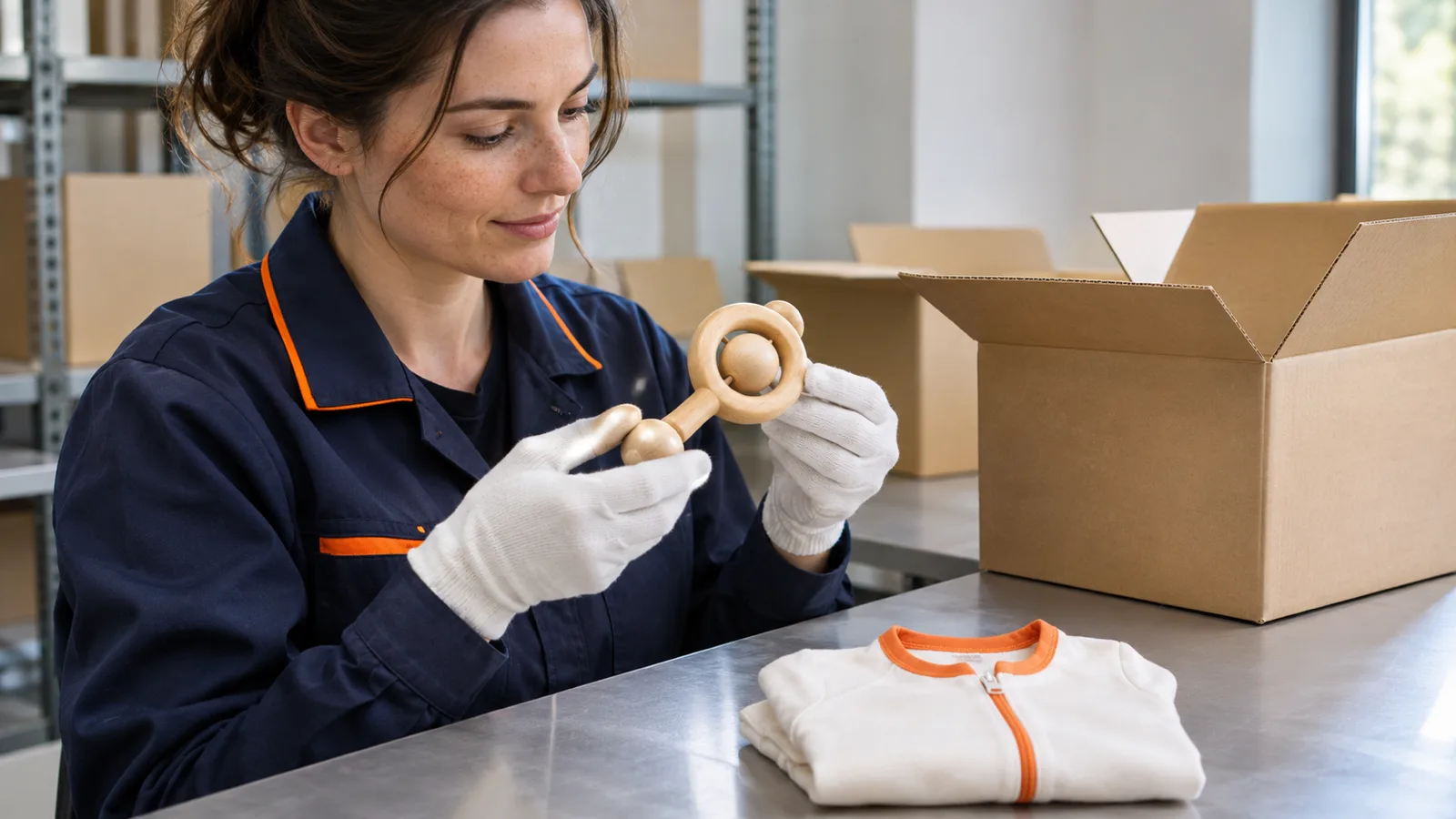
Picture a small online brand that makes organic cotton sleepers and wooden teethers. Sales are growing, a national retailer has shown interest, and the founders are ready to hand their packing table over to a fulfillment partner. Then the retailer's vendor questionnaire arrives, asking about lot traceability, incident reporting procedures and test reports for each product. Suddenly the question is not just "who will ship our orders?" but "who will help us prove our products are safe, and find them fast if something goes wrong?"
Products for babies and children are among the most tightly regulated consumer goods in Canada. Most of the rules are aimed at design and manufacturing: what materials are allowed, how much lead a coating can contain, how a crib must be built. But several of them reach directly into the warehouse and the shipping process. Record-keeping, recalls, labelling, packaging and even how you handle returned items are all affected.
This article is written for brand owners and operations managers who sell baby and children's products into Canada, whether through their own website, marketplaces or retail partners. It is a practical overview, not legal advice. Always confirm the requirements for your specific products with Health Canada's published guidance or a regulatory consultant.
The Framework: The Canada Consumer Product Safety Act
The main law covering most baby and children's products in Canada is the Canada Consumer Product Safety Act (CCPSA), administered by Health Canada. It does two important things. First, it prohibits manufacturing, importing, advertising or selling consumer products that pose a danger to human health or safety. Second, it supports a set of product-specific regulations with detailed requirements.
Regulations under the CCPSA that commonly apply to products for young children include:
- The Toys Regulations, which cover hazards such as small parts for children under three, sharp edges and points, and certain chemical limits.
- The Cribs, Cradles and Bassinets Regulations, with detailed construction and performance rules for sleep products.
- The Children's Sleepwear Regulations, which set flammability requirements for sleepwear sizes up to a certain size.
- The Surface Coating Materials Regulations, limiting lead and other heavy metals in paints and coatings.
- The Phthalates Regulations, which restrict certain phthalates in the vinyl of toys and child care articles.
- Rules on specific items such as pacifiers, rattles, playpens and children's jewellery.
Some items are banned outright. Baby walkers, for example, have been prohibited in Canada since 2004, which catches out brands and resellers who source from markets where they are still sold. Child car seats are a separate case. They fall under motor vehicle safety rules administered by Transport Canada and must carry the National Safety Mark to be sold here. A car seat that is legal in the United States is not automatically legal in Canada.
Children's clothing also falls under the Textile Labelling Act, which requires fibre content and dealer identity on labels, and almost all consumer packaging needs bilingual English and French mandatory information under the Consumer Packaging and Labelling Act.
Where Safety Rules Meet Fulfillment
Brands sometimes assume that once a product passes testing at the factory, safety is a manufacturing issue and the warehouse is just storage. In Canada, that is not quite true. Here are the points where the rules touch your fulfillment operation directly.
1. Record-keeping and traceability
The CCPSA requires businesses that manufacture, import, advertise, sell or test consumer products for commercial purposes to keep certain documents. Manufacturers and importers must be able to identify who they obtained a product from and who they sold it to. Retailers must keep records identifying where they obtained it, and the location and period of sale. These records generally need to be kept for six years.
For a direct-to-consumer brand, "who you sold it to" includes individual customers. That means your order management system and your warehouse need to link each shipment to the specific lot or batch that went into it, at least for products where lots are meaningful. If a lot of teethers later turns out to have a defect, you want to be able to identify every order that contained that lot within minutes, not by searching through packing slips.
Ask any prospective fulfillment provider how they capture lot numbers at receiving, whether they can enforce lot-specific picking, and how quickly they can produce a list of shipments by lot. Strong inventory management technology makes this routine.
2. Incident reporting
Under the CCPSA, manufacturers, importers and sellers must report certain incidents to Health Canada, and to the person they received the product from, when they become aware of an incident that resulted or could reasonably have resulted in serious adverse health effects or death. The initial report is due within two days of becoming aware, with a written report from the manufacturer or importer within ten days.
Those deadlines are short. Information about incidents often arrives through the operations side first: a returned product with a note, a customer service email about a broken toy, a carrier claim photo showing a snapped part. Your fulfillment partner should know to escalate anything that looks like a safety concern instead of simply processing it as a return. Build that into your standard operating procedures and your returns grading instructions.
3. Recalls
Health Canada can order a recall, but in practice most recalls of children's products in Canada are voluntary, carried out by the company in cooperation with the regulator. A recall involves stopping sales, quarantining stock, contacting retail customers and consumers, and arranging returns, refunds, repairs or disposal.
Operationally, the first hour of a recall is about stopping shipments. A good warehouse can place a hold on a SKU or a lot across all channels at once, so nothing else leaves the building while you assess. After that, you need reverse logistics: receiving returned units, counting them for reconciliation and disposing of them in a documented way. Our recall management page describes how structured recall processes work, and the same principles apply to consumer products.
4. Labelling and relabelling
Product labels for baby and children's goods often carry required warnings, age grading and bilingual text. If you import products packaged for another market, you may need to apply Canadian labels before sale. That work can be done in a warehouse, but it must be done accurately and must not cover other required information. Keep approved label artwork on file and do a first-article check before a team labels a full shipment. Labelling, stickering and bundling are typical value-added services, but the brand remains responsible for what the label says.
5. Returns and resale
Returned baby products are a judgement call. A sealed package of sleepers is probably fine to restock. An opened bottle, a used pacifier or a car seat with unknown history should not be resold as new. Define grading rules by product type and make sure the warehouse follows them every time. Products that cannot be resold may be donated where that is appropriate and safe, or disposed of. Items involved in any safety complaint should be quarantined and kept for investigation, not thrown away.
Packaging and Shipping Considerations
Once compliance is under control, baby and kids' products still need to be packed and delivered well. A few points come up repeatedly.
- Bulky but light items. Strollers, play yards, high chairs and bassinets are big boxes with modest weight, so dimensional weight pricing dominates their shipping cost. Ship in the manufacturer's carton where it is strong enough, rather than overboxing, and compare carriers by destination.
- Gift-giving and baby registries. Many orders are gifts sent to a different address. Packing slips without prices, gift notes and careful presentation matter more than usual.
- Product sets and bundles. Starter kits, gift sets and "new parent" bundles are popular. Assembling them requires accurate kitting and assembly with each component's lot recorded, so traceability is not lost when items are combined.
- Retail compliance. Large retailers in Canada often have strict routing guides and labelling requirements for inbound cartons. Getting these wrong leads to chargebacks.
- Remote delivery. Parents in rural Alberta, northern Ontario or the territories order online precisely because local stores are limited. Be realistic about transit times to those regions and set expectations at checkout.
A Fulfillment Readiness Checklist for Baby Brands
Before you move your inventory into a third-party warehouse, or before you launch a new product line, work through this list with your team and your provider.
- For every SKU, identify which Canadian regulations apply and keep test reports and certificates on file.
- Confirm that no item in your catalogue is banned in Canada or requires a certification mark you do not have.
- Check labels for bilingual mandatory information, age grading and required warnings.
- Assign lot or batch numbers to every production run and make sure they appear on the product or packaging.
- Set up the warehouse to capture lots at receiving and record them on outbound orders.
- Agree on a written escalation path for suspected safety incidents, with named contacts and response times.
- Run a mock recall: pick a lot and see how long it takes to produce the list of every order that contained it.
- Define return grading rules by product category.
- Decide how bundles and kits will preserve component traceability.
Mock recalls are particularly revealing. If the answer to "who received lot 2003-B?" is "give us a few days," that is a sign your systems need work before you scale.
Frequently Asked Questions
Does my fulfillment partner share responsibility for product safety?
The CCPSA places obligations on manufacturers, importers, advertisers and sellers. A warehouse that only stores and ships on your behalf usually is not the regulated "seller" in the same way you are, but it is part of your ability to comply. Contracts should spell out who does what for record-keeping, holds and recalls.
Do I need lot tracking if I only sell clothing?
It is strongly advisable. Children's sleepwear has flammability requirements, and clothing can be affected by issues like drawstrings or small decorative parts. Lot tracking costs little to set up and is invaluable if you ever need to recall a production run.
How are imports of children's products checked at the border?
The CBSA clears goods for duties and taxes, and it can refer shipments to other government departments. Health Canada also carries out market surveillance and may sample products. Being able to provide test reports quickly helps if questions come up. Our article on what happens if customs seizes your merchandise covers the general process.
Can I sell second-hand baby products online?
Second-hand products are also covered by the CCPSA, and some items, like older cribs and car seats, carry particular risks. Resellers should check Health Canada's guidance for used children's products before listing them.
What about baby food and formula?
Those are foods, regulated under food law and overseen by Health Canada and the Canadian Food Inspection Agency rather than the CCPSA. They bring their own requirements for storage, dating and traceability.
Build Safety Into Your Supply Chain
Parents in Canada trust that the products they buy for their children are safe, and regulators expect brands to back that trust with records, quick incident reporting and effective recalls. The good news is that most of what compliance needs from fulfillment, such as lot tracking, holds, clear return grading and accurate labelling, is also what makes a well-run operation.
ShipCarte provides ecommerce fulfillment and warehousing for consumer brands across Canada, including categories where traceability matters. If you sell baby or children's products and want a fulfillment setup that supports your compliance obligations, schedule a consultation with our team.