
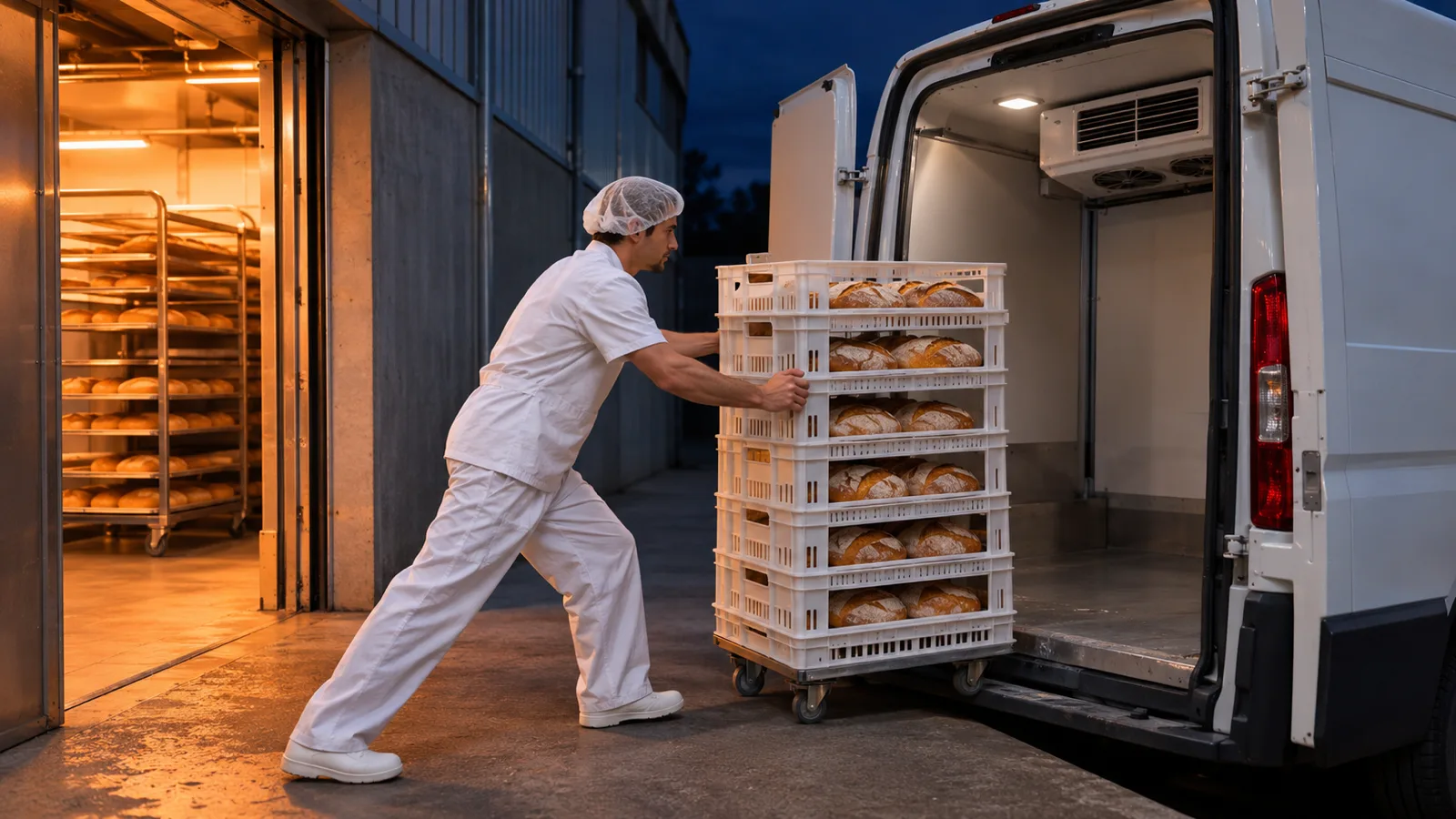
At three in the morning, most of Mississauga is asleep, but a bakery in an industrial unit off Dixie Road is at full speed. Loaves are coming off cooling racks, croissants are being boxed for cafés, and a driver is waiting to load a van with orders for a grocery store in Port Credit, two coffee shops near Square One and a restaurant in Streetsville. Every one of those customers wants product on the shelf before they open. A late van is not just an inconvenience; it is a day of lost sales for a product that will not be sellable tomorrow.
Bakery distribution is one of the least forgiving jobs in food logistics. Fresh bread has a shelf life measured in days, sometimes hours for certain pastries. Delivery windows sit in the dark before dawn. Order quantities change daily based on what sold yesterday. And unlike a pallet of canned goods, bread cannot sit in a warehouse waiting for a better truck.
This article follows a typical bakery's day, from order cut-off to the empty tray coming back, and looks at where Mississauga bakeries can tighten their distribution, cut waste and decide which parts of the operation to keep in-house.
A day in bakery distribution, hour by hour
Early afternoon: orders close
Most wholesale bakeries set a daily order cut-off for the next morning's delivery. Customers place standing orders that can be adjusted up or down. The cut-off has to give production enough time to plan mixing, proofing and baking, which is why it often falls in the early afternoon. When customers send late changes, production either scrambles or the change waits a day.
Where to tighten: Put standing orders and daily adjustments into one system rather than a mix of texts, emails and phone calls. The same order data then feeds production planning, route planning and invoicing. A shared ordering portal or EDI connection with larger grocery customers removes a lot of re-keying.
Evening: production and the pick list
As the bake progresses, product is staged by customer or by route. Small bakeries often assemble orders straight into the delivery trays. Larger operations build route-sequenced staging lanes so the first stop's trays load last and come off first.
Where to tighten: Route-sequenced staging sounds obvious, but in a busy bakery it is often the first thing to slip. A printed or on-screen load list sorted in reverse stop order, combined with tray labels that show the customer and stop number, reduces the time drivers spend searching the back of the van in the dark.
Pre-dawn: loading and departure
Vans and straight trucks load between roughly midnight and early morning, depending on route length. A route serving the downtown Toronto core from Mississauga has to leave earlier than one covering Meadowvale and Erin Mills, because even at night, construction closures and ramp work on the Gardiner, QEW and 427 can add time.
Where to tighten: Build routes around delivery windows, not just geography. A cluster of cafés that open at 6 a.m. and a grocery store that receives until 9 a.m. should not be treated as equal stops. Customers with dock-receiving hours, which is common at larger grocery stores, need the route planned around their windows; arriving early can mean waiting outside a locked receiving door.
Early morning: delivery and proof of delivery
Many bakery drops are unattended. Drivers have keys or codes to back doors, or leave trays in a secured area. That trust relationship is valuable, but it also creates disputes when a café says three dozen croissants arrived and the invoice says four.
Where to tighten: Use electronic proof of delivery with a photo of the delivered trays and a timestamp. It is quick for drivers and settles most shortage claims before they become arguments.
Mid-morning: returns, stales and trays
Some bakeries operate on a guaranteed-sale or returns basis with retail customers, taking back unsold product. Every bakery has to recover its plastic trays and dollies, which are surprisingly costly to replace when they disappear into customers' back rooms.
Where to tighten: Track trays as an asset, by customer. Record stale returns by product and store; that data is the single best input for adjusting standing orders and reducing waste.
Shelf life is the constraint behind every decision
The reason bakery distribution is so time-sensitive is that freshness drives value. A good approach treats different product types differently:
- Fresh, same-day products such as crusty breads and many pastries must go from oven to customer within hours. These justify direct, pre-dawn routes.
- Packaged sliced breads and buns often carry a few days of shelf life and can tolerate a short stop at a distribution point, which opens up more efficient delivery patterns.
- Frozen dough, par-baked and fully baked frozen goods behave like other frozen foods. They can move through a cold chain, be stored for weeks or months under the right conditions, and be baked off at the customer's site.
Many growing bakeries add frozen lines specifically because they escape the overnight-route bottleneck. A Mississauga bakery that sells fresh bread to local cafés can sell frozen croissant dough to customers in Ottawa, Montreal or Windsor, shipped by refrigerated freight. That changes distribution from a nightly sprint into a more conventional warehouse-and-ship model. If you go this route, read our piece on flash freezing and how it protects product quality.
Food safety and labelling basics
Bakeries selling across provincial lines or into larger retail chains generally fall under federal food rules administered by the Canadian Food Inspection Agency, including Safe Food for Canadians requirements around licensing, preventive controls and traceability for many businesses. Prepackaged products need bilingual labelling with the required information, and allergen declarations are especially important in a category that commonly involves wheat, eggs, milk, nuts and sesame. Check your obligations with CFIA guidance or a food regulatory advisor; the rules depend on what you make and where you sell it.
From a distribution standpoint, traceability is the piece that matters day to day. If a flour supplier issues a recall, you need to know which batches used that flour and which customers received them. Lot coding on cases and a record of which lots went on which route make that question answerable.
Keep distribution in-house, or bring in a partner?
Most bakeries run their own early-morning routes, and for fresh product serving nearby customers that usually makes sense. The bakery controls timing, knows its customers, and the drivers often double as relationship builders. The calculation changes as the business grows.
Signs your own fleet is the right fit
- Your customers are mostly within a short radius of the bakery, in Mississauga, Oakville, Brampton and the western edge of Toronto.
- Products are fresh, same-day items where every hour matters.
- Routes are stable and drivers have long-standing keyed access to customer premises.
Signs outside support could help
- You are adding frozen or longer-life lines and want to sell beyond the GTA.
- A retail chain wants deliveries to its distribution centre with strict appointment and labelling rules.
- You are running out of freezer space at the bakery and storing inventory in rented reefer trailers.
- You want to sell online direct to consumers, which brings parcel packaging and insulated shipping into the picture.
In those cases, a partner with temperature-controlled warehousing and food and beverage logistics experience can hold frozen inventory, build retailer orders and ship them on schedule, while your own vans stay focused on the fresh local routes. ShipCarte also supports cold chain fulfillment for brands selling frozen bakery products direct to consumers.
Practical ways to cut bakery waste in distribution
- Use returns data to adjust standing orders weekly. If a store returns bagels every Monday, its Monday quantity is too high.
- Shorten the gap between bake and departure. Re-sequence production so the earliest routes' products come out of the oven first.
- Protect product in transit. Covered trays, secured stacks and temperature-appropriate vans prevent crushed and dried-out product.
- Move slow-turning items to frozen formats where quality allows, so they are baked only when needed.
- Rotate stock at the customer. Drivers who pull older product forward on the shelf (where the customer agrees to it) reduce stales.
Why Mississauga works as a bakery distribution base
A bakery in Mississauga sits in reach of a huge concentration of grocery stores, cafés, restaurants, hotels and institutional kitchens. The 401, 403, 410 and 427 connect the city to Toronto, Brampton, Vaughan and Halton in every direction, and overnight traffic is lighter, which is what makes pre-dawn routes workable. Food distribution centres for several large grocery chains operate in and around Peel Region, which makes the city a natural base for bakeries supplying both independents and chains. For frozen products heading farther afield, the same highway network, plus proximity to the US border crossings, supports regional and cross-border freight. Our broader guide to handling perishable goods in fulfillment covers more of the cold chain side.
Talk to ShipCarte about bakery logistics
Whether you are trying to get frozen lines into retail distribution centres, need cold storage overflow, or are exploring online sales, ShipCarte can help plan the parts of bakery distribution that do not have to run off your own loading dock. Schedule a consultation to talk through your product range, or request a quote for storage and delivery support.