
A pallet bound for Victoria looks, on paper, like any other delivery in British Columbia. It is a short distance from the Lower Mainland, the destination is a provincial capital, and the receiving business has a proper loading dock. Yet that pallet can easily take longer and cost more than one going several hundred kilometres inland to Kamloops or Kelowna.
The reason is the water. Vancouver Island, the Gulf Islands, the Sunshine Coast and much of BC's northern and central coast are not connected to the mainland highway network. Everything that reaches them by road has to cross by ferry, and ferries add schedules, reservations, fares, weather and capacity limits to an otherwise simple trip.
If you ship to coastal BC regularly, or are about to start, understanding how ferry freight works will save you money and a lot of explaining to customers. Below, we answer the questions shippers ask most often.
How does freight actually get to Vancouver Island?
There are two main ways for trucked freight to reach the island.
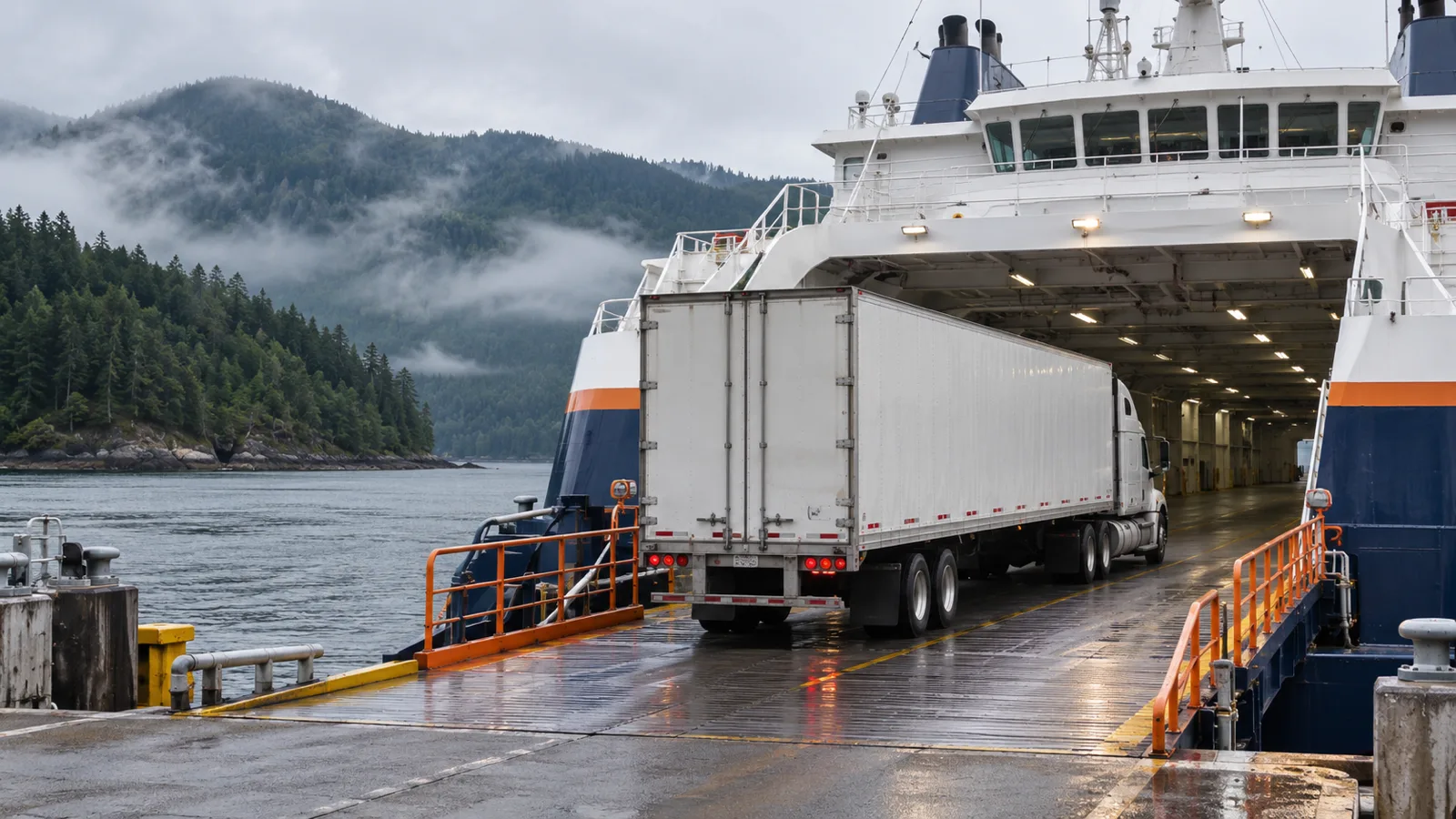
The first is on BC Ferries' major routes from the mainland. Trucks can travel between Tsawwassen, south of Vancouver, and Swartz Bay near Victoria, or between Tsawwassen and Duke Point near Nanaimo, as well as on the Horseshoe Bay to Departure Bay route into Nanaimo. Commercial vehicles generally pay fares based on their length and can reserve space on many sailings. The Tsawwassen–Duke Point route is widely used by commercial traffic heading to central and northern Vancouver Island.
The second is dedicated commercial vessel service. A commercial ferry operator runs drop-trailer service between terminals in the Lower Mainland and terminals on Vancouver Island near Victoria and Nanaimo. With drop-trailer service, the trailer is delivered to the terminal, loaded onto the vessel without a driver, and picked up by a tractor on the island side. Many LTL and truckload carriers use this kind of service for scheduled island linehaul because it frees drivers and tractors from riding the ferry.
Air cargo is a third option for urgent, light shipments, with service into Victoria, Nanaimo, Comox and other island airports, but it is rarely economical for anything heavy.
What about the Sunshine Coast, the Gulf Islands and the north coast?
The Sunshine Coast, including Gibsons and Sechelt, is reached by ferry from Horseshoe Bay to Langdale, even though it is on the mainland. Powell River requires a second ferry crossing or a sailing from Vancouver Island. The southern Gulf Islands, such as Salt Spring, Galiano, Mayne and Pender, are served by smaller BC Ferries routes with less capacity and fewer sailings.
Further north, Prince Rupert is the starting point for ferry service to Haida Gwaii, and the Inside Passage route links Port Hardy on northern Vancouver Island with Prince Rupert. Communities on the central coast have limited, sometimes seasonal service. Freight to these areas often moves on a mix of road, ferry and specialized coastal barge services, and transit times can stretch to a week or more depending on sailings.
For these destinations, the key question to ask a carrier is not just "do you deliver there?" but "how, and how often?" A carrier that serves Salt Spring Island twice a week through a partner is a very different proposition from one that serves Nanaimo daily.
Why does shipping to the island cost more?
Several cost drivers stack up on ferry freight:
- Ferry fares. Carriers pay to put trucks or trailers on vessels, usually based on vehicle length. These costs are passed on either in the base rate or as a separate ferry surcharge.
- Time. A ferry crossing, plus terminal waiting and loading time, ties up drivers and equipment for hours that are not spent driving.
- Lower density. Island and coastal deliveries are spread over smaller communities, so trucks often run with fewer stops per hour than in the Lower Mainland.
- Imbalance. Much more freight flows onto the island than off it, so trailers often return partly empty.
When you compare quotes, check whether the ferry charge is built into the rate or listed separately. Two quotes that look different may be close once all the charges are included, or a quote that looks cheap may add a significant ferry surcharge at invoicing. Our article on types of shipping surcharges explains how these extra charges typically appear.
How long should I tell customers it will take?
For parcels, many couriers deliver to Victoria and Nanaimo within a day or two of the Lower Mainland, with longer times for northern Vancouver Island, the Gulf Islands and remote coastal communities. For LTL freight, island deliveries generally add at least a day compared with similar mainland distances, sometimes more depending on the carrier's island schedule.
The safest approach is to treat coastal BC as its own delivery zone in your planning and your customer communications. Avoid promising the same timeline you would for Burnaby or Surrey. If you ship from outside BC, for example from Ontario or Alberta, add the cross-country time to the ferry time; the result is often longer than customers expect, so say so upfront.
How is coastal BC different from other island shipping in Canada?
Vancouver Island is not the only place in Canada where freight has to cross water, but it is one of the busiest. Prince Edward Island has a fixed link in the Confederation Bridge, so most freight there moves by road without a ferry booking. Newfoundland, by contrast, depends on Marine Atlantic's ferry service across the Cabot Strait, with its own commercial schedules and weather exposure. Coastal BC sits somewhere between the two: frequent sailings and several competing routes to the island's southern half, but thinner and less frequent service as you move north or out to the smaller islands. Shippers who serve more than one of these regions should treat each as its own lane with its own lead times and costs, rather than applying a single "island surcharge" mindset across the country.
What can delay a ferry shipment?
Weather
Strong winds in the Strait of Georgia can cancel or delay sailings, particularly on smaller routes. Winter storms can disrupt service for a day or more, and a backlog of commercial traffic can take time to clear.
Capacity and reservations
Summer weekends and holiday periods bring heavy passenger traffic. Commercial reservations help, but sailings can still fill up, and missed sailings ripple through delivery schedules. Over the past year, pandemic-related changes to sailing schedules and capacity have also affected some routes.
Dangerous goods restrictions
Passenger ferries have restrictions on the type and quantity of dangerous goods they can carry alongside passengers. Some dangerous goods may need to travel on specific sailings or by commercial vessel. If you ship products regulated under Transport Canada's Transportation of Dangerous Goods (TDG) regulations, such as certain aerosols, flammable liquids or batteries, confirm with your carrier how they move them to the island. Failing to declare dangerous goods properly is a safety issue and can result in refused or delayed shipments.
Delivery site issues
Many island and coastal businesses operate from small sites, older buildings or residential properties without loading docks. Booking liftgate service or an appointment in advance avoids a failed delivery that then has to wait for the next truck, and possibly the next ferry.
Should I hold inventory on the island?
For most businesses, no. The Lower Mainland is close enough that shipping from there works well. But for brands with significant island demand, such as building supply companies, regional retailers or food distributors serving Victoria, Nanaimo and the Comox Valley, a small stock position on the island can reduce the number of ferry crossings and speed up deliveries. As with any second location, the trade-off is inventory cost and management complexity.
An intermediate step is consolidation. Rather than sending several small LTL shipments to island customers throughout the week, you can consolidate them onto a scheduled truck or trailer that crosses on set days. This works well for retail replenishment or business customers who can accept a fixed delivery day. Distribution services that combine consolidation and scheduled delivery are one way to put this into practice.
What about ecommerce parcels?
Online orders to Vancouver Island and coastal communities move through the same couriers and Canada Post as the rest of BC, but the ferry still matters. Rates to island and remote coastal postal codes can be higher, and some couriers apply remote area surcharges to certain communities. Rate shopping by destination, through a multi-carrier shipping platform, lets you choose the best service for each order rather than defaulting to one carrier for all of BC.
Remember that BC charges its own provincial sales tax, administered separately from the GST, so online sellers registered in BC need to apply both correctly to island orders as they would elsewhere in the province.
Quick checklist for coastal BC shipments
- Confirm how your carrier reaches the destination: direct, partner, BC Ferries or commercial vessel.
- Ask whether ferry charges are included or added separately.
- Set coastal BC delivery estimates separately from mainland BC.
- Declare any dangerous goods correctly and confirm ferry eligibility.
- Book liftgate, appointment or residential service in advance where needed.
- Consider consolidating frequent small shipments onto scheduled crossings.
- Watch weather forecasts and warn customers about storms affecting sailings.
Ship to coastal BC with fewer surprises
Ferry freight is a routine part of doing business in British Columbia, but it needs more planning than mainland deliveries. When you understand the routes, the costs and the common causes of delay, you can choose the right service, quote accurate timelines and keep island customers happy.
ShipCarte helps businesses across Canada move LTL freight and small parcels to every province, including Vancouver Island and coastal BC. If you have regular island shipments or a new coastal customer to serve, request a quote and we will help you find the right option.