
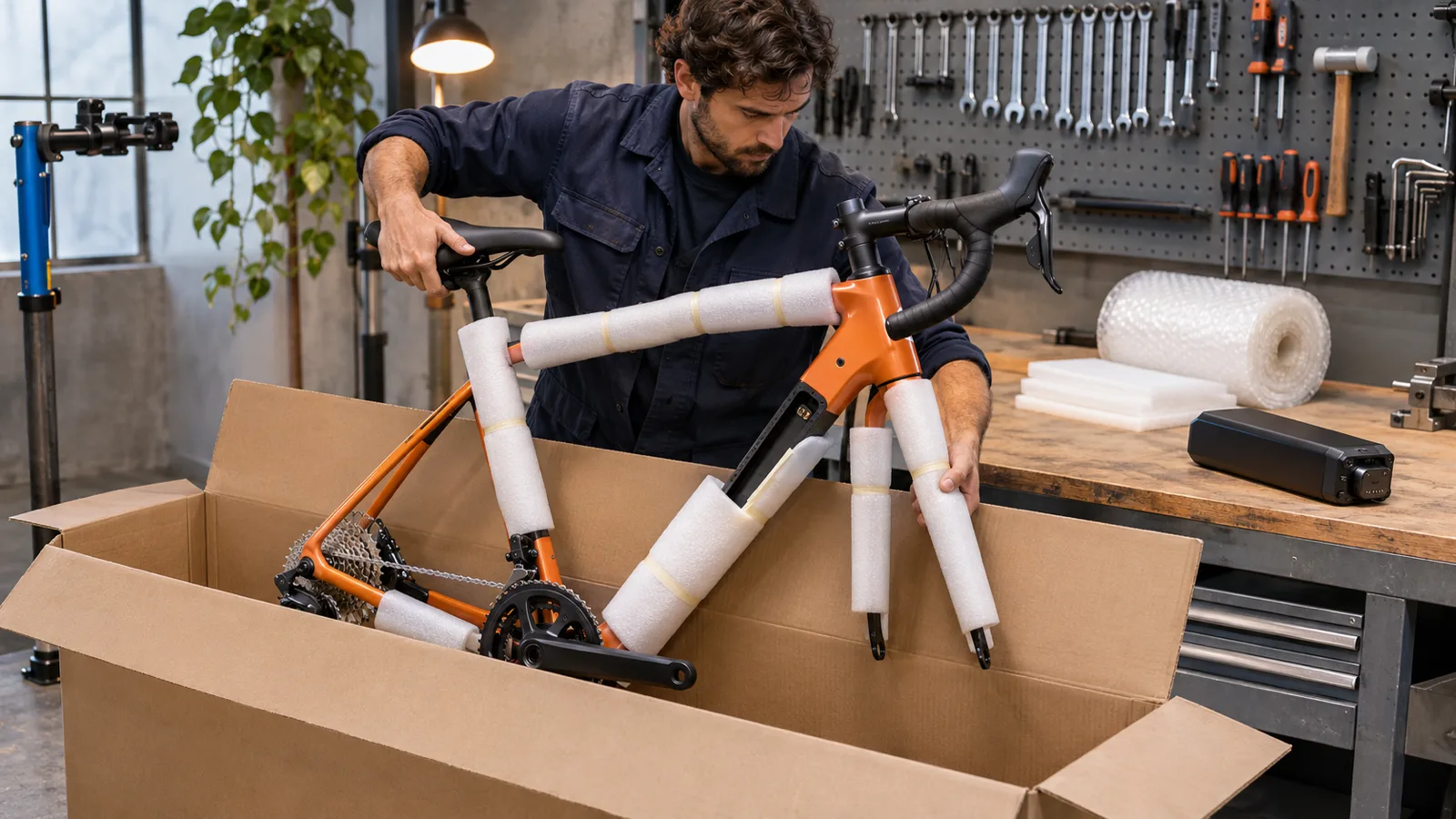
A bike shop in Streetsville sells a high-end road bike to a customer in Kelowna. The mechanic strips it down, finds an old box from a supplier delivery, and wraps the frame in whatever padding is lying around. The parcel goes out, gets charged a sizeable oversize surcharge the shop did not expect, and arrives with a bent derailleur hanger. The customer is unhappy, the shop eats the repair cost, and the profit on the sale disappears.
Now add a battery. An e-bike retailer in Mississauga lists its models online and starts getting orders from across Ontario. The first shipment is refused at the carrier counter because the lithium-ion battery was packed inside the bike box with no dangerous goods markings. Suddenly the question is not just how to pack the bike, but whether the carrier will accept it at all.
Bicycles are awkward to ship: large, light for their size, full of delicate components, and increasingly electric. This guide explains how to box a bike properly, what changes when there is a lithium battery involved, and how to decide between parcel shipping and freight. It is written for shops, brands and online sellers, but the same principles apply if you are sending a single bike to a customer or an event.
Why bikes are expensive to ship
Parcel carriers price on whichever is greater: actual weight or dimensional weight, which is calculated from the box's length, width and height. A bike box is big and mostly air, so dimensional weight usually wins by a wide margin. On top of that, bike boxes often exceed the carriers' size thresholds for "large package" or "additional handling," which carry separate surcharges. Our guide to how package dimensions affect shipping costs explains the maths.
The practical takeaway: every centimetre of box size matters. A well-packed bike in the smallest safe box can cost noticeably less to ship than the same bike in an oversized carton.
How to box a bicycle, step by step
- Get the right box. The best option is a purpose-made bike box from a manufacturer or distributor, sized for the frame. Bike shops in Mississauga often have spares from new-bike deliveries. Make sure the box is sound, without crushed corners or water damage.
- Remove the pedals. Remember that the left pedal has a reverse thread. Bag the pedals and tape the bag to the frame or put it in a small parts box.
- Lower or remove the seat post and saddle to reduce height. Mark the seat height with tape first so the customer can restore it.
- Remove the front wheel and, if needed to fit the box, the rear wheel. Insert plastic spacers into the fork dropouts and rear dropouts so the frame cannot be crushed if the box is squeezed. For disc brake bikes, insert a pad spacer between the brake pads so the levers cannot be squeezed closed.
- Turn or remove the handlebars. Rotate them parallel to the frame, or remove them from the stem and secure them alongside the top tube, padded so the levers do not scratch the frame.
- Protect the rear derailleur. It is the most vulnerable part on most bikes. Shift to the smallest cog to tuck it in, and consider removing it from the hanger and wrapping it separately, attached to the chainstay.
- Pad the frame. Wrap tubes with foam tubing or bubble wrap and secure it with tape or ties. Cover any spots where the frame touches the wheels or the box walls.
- Secure the wheels to the sides of the frame with straps or ties so they cannot slide. Release some tire pressure, though not all of it.
- Fill voids with cardboard or padding so nothing moves when the box is shaken.
- Seal and label the box with strong tape on all seams. Include an inside label with the order number and contact details in case the outer label is damaged.
Take photos of the bike and the packed box before sealing. If there is a damage claim, photos of the packaging are often the first thing a carrier will ask for. Our general article on packing fragile items has more tips that apply here.
E-bikes: the battery changes everything
Most e-bikes use lithium-ion batteries, which are regulated as dangerous goods in transport. In Canada, ground shipments fall under the Transportation of Dangerous Goods (TDG) Regulations, and air shipments under international air rules. Lithium-ion batteries are classed as Class 9 miscellaneous dangerous goods, and the specific requirements depend on whether the battery is shipped on its own (UN3480), packed with equipment (UN3481), or contained in equipment (also UN3481), as well as the battery's watt-hour rating and condition.
E-bike batteries are typically large enough that the simplified rules for small consumer batteries do not apply. That generally means proper classification, approved packaging, the correct marks and labels, shipping documents where required, and staff who have the appropriate training for the tasks they perform. Rules are detailed and change from time to time, so check the current TDG Regulations and your carrier's own dangerous goods requirements, and get help from a qualified dangerous goods trainer or consultant if you ship regularly.
Practical points for e-bike shippers
- Check carrier acceptance first. Not every carrier or service accepts large lithium batteries, and some require a dangerous goods contract or account set-up before you can ship them at all.
- Air is often off the table. Large lithium batteries face significant restrictions on air transport, and passenger aircraft are especially limited. Plan for ground shipping, which affects transit times to Western Canada and other distant destinations.
- Never ship damaged or recalled batteries under normal rules. Damaged and defective batteries have stricter requirements and may need specialized handling.
- Know the state of charge rules that apply to your mode of transport and follow the manufacturer's guidance.
- Protect terminals against short circuits and secure the battery so it cannot move inside its packaging.
- Keep documentation from the battery manufacturer, including test summaries that carriers may request.
Many e-bike brands find it simpler to ship by freight, where carriers experienced with dangerous goods handle the shipment on pallets, rather than by small parcel. That leads to the next decision.
Parcel or freight?
When parcel makes sense
- Single conventional bicycles going to individual customers.
- Boxes within the carrier's maximum size and weight limits.
- Customers who expect home delivery and tracking from a familiar carrier.
Rate-shop carefully. Different carriers treat large boxes differently, and the cheapest option for a small box may not be the cheapest for a bike. ShipCarte's small parcel shipping and shipping platform compare services side by side, including surcharges.
When freight makes sense
- Several bikes going to the same destination, such as a dealer, rental fleet or event.
- E-bikes, where dangerous goods requirements make parcel shipping difficult or impossible.
- High-value bikes where you want fewer touches than a parcel network involves.
Boxed bikes can be stacked upright on a pallet, strapped and wrapped, and shipped as LTL freight. For residential deliveries, remember that liftgate and residential fees may apply, so book them up front.
Insurance, claims and declared value
Standard carrier liability is usually limited, and it rarely covers the full value of a quality bicycle, let alone a premium e-bike. Check what coverage is included with the service you choose and whether declared value or third-party shipping insurance makes sense for your price range. Read the exclusions carefully: some policies exclude improperly packed items or certain categories of goods, which is another reason to follow a consistent packing procedure and photograph every bike before the box is sealed.
When damage does happen, report it within the carrier's time limit, keep the box and packing materials, and ask the customer for photos straight away. A clear repair estimate from a bike mechanic strengthens the claim considerably.
Shipping bikes across the border
Sending bikes from Mississauga to US customers is common, especially with the Peace Bridge and Lewiston-Queenston crossings a short drive away. You will need accurate commercial invoices, correct tariff classifications and country of origin details. Bikes and parts that qualify as originating under CUSMA may receive preferential treatment, but many bicycles are manufactured in Asia, so origin rules need checking. E-bikes add dangerous goods requirements on both sides of the border. ShipCarte's cross-border shipping team can help organize paperwork for these lanes.
For bike brands: should you outsource?
If you sell bikes online, packing each one in-house ties up skilled mechanics and floor space. Some brands ship bikes from their own workshops after a final build check, while others ship factory-boxed bikes straight from a fulfillment centre and let customers do the final assembly. If you go the second route, a warehouse can store boxed inventory, handle accessories and parts, and ship them alongside the bikes. ShipCarte's e-commerce fulfillment and returns management cover the full cycle, including inspecting bikes that come back.
Mississauga is a good base for this kind of operation. Carriers serving the whole country have hubs nearby, the 401 and 407 connect to the rest of Ontario and Quebec, and riders across the GTA, from the Waterfront Trail through Port Credit to the trails in Brampton, form a large local market for next-day delivery.
Ship your next bike with confidence
Whether you are sending one carbon road bike to a customer in BC or a pallet of e-bikes to a dealer in Ottawa, the right packing and carrier choices make the difference between a happy rider and a damage claim. Request a quote for bicycle shipping from Mississauga, or schedule a consultation to plan an ongoing program for your shop or brand.