
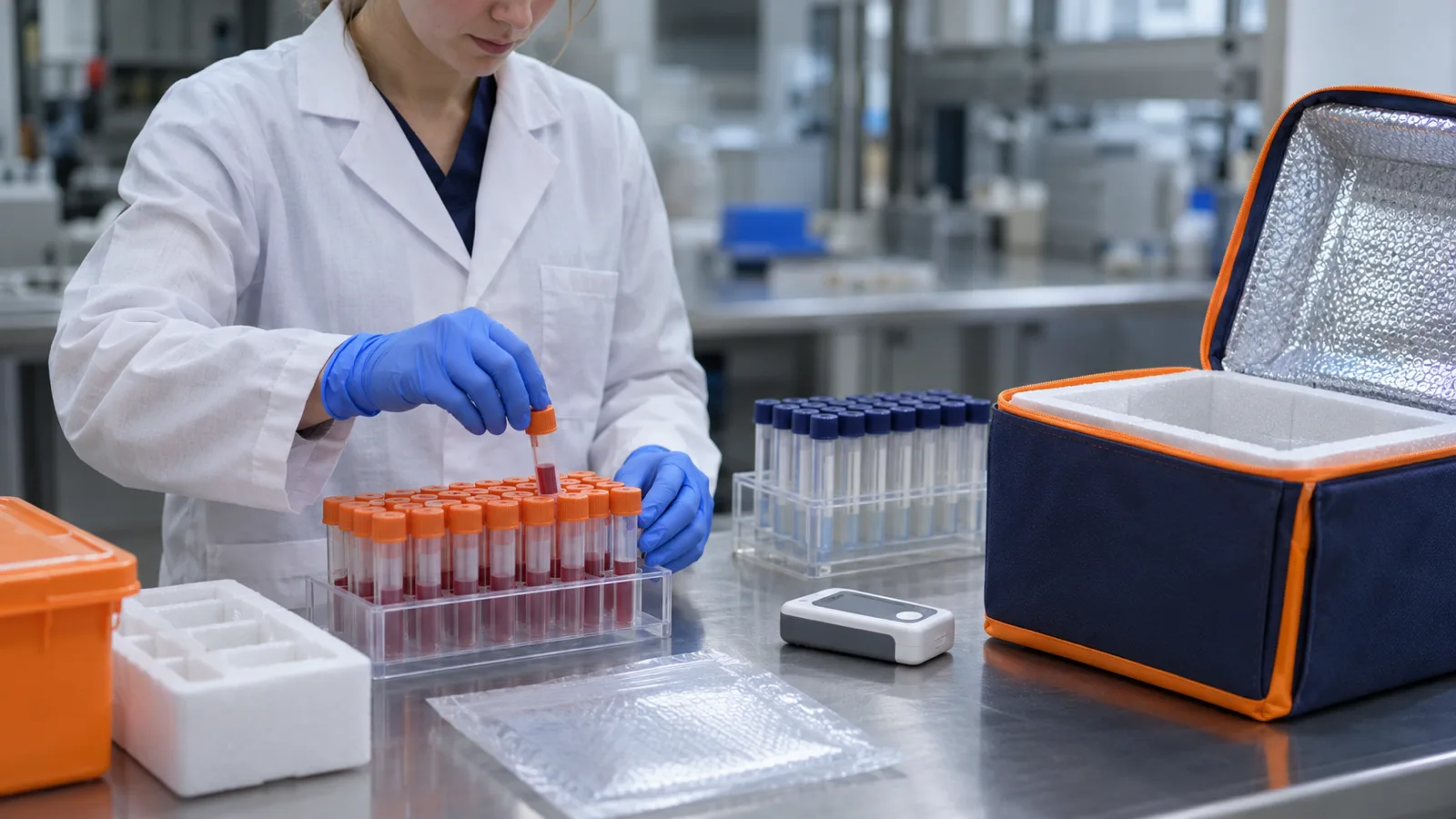
A clinical trial can be designed by world-class scientists, approved by Health Canada and a research ethics board, and staffed by dedicated site coordinators, and still stumble over a box. A lab kit that arrives at a hospital in Halifax a day after a patient's scheduled visit means a missed sample. A cooler of investigational product that sits at a closed receiving dock in Saskatoon on a long weekend can mean doses quarantined and a dosing schedule thrown off. In a study with tight visit windows, logistics problems become data problems.
Canada hosts a large number of clinical trials, with research hospitals and site networks in cities such as Toronto, Montreal, Vancouver, Edmonton, Calgary, Hamilton, Ottawa and Halifax, as well as community sites in smaller centres. Sponsors and contract research organizations running multi-site studies have to supply all of them, collect samples from all of them and keep a record that would satisfy an auditor years later.
This article breaks clinical trial logistics into its main material flows and explains what good practice looks like for each, with a focus on temperature control and chain of custody across Canada.
The Regulatory Backdrop
Clinical trials of drugs in Canada are governed by Part C, Division 5 of the Food and Drug Regulations, and sponsors generally file a Clinical Trial Application with Health Canada before starting. Trials are expected to follow Good Clinical Practice as described in the internationally harmonized ICH guidelines, which Health Canada has adopted. Medical device studies have their own pathway under the Medical Devices Regulations. Investigational products must be handled, stored and shipped in a way that preserves their quality, and records must show what happened to every unit.
For logistics teams, this translates into three requirements that come up again and again: keep the product within its specified conditions, know where every unit is, and be able to prove both.
Flow 1: Investigational Product to Sites
Investigational product is the drug, biologic or device being studied, along with any comparators or placebo. It is usually labelled specifically for the trial and may be blinded, so neither the patient nor the site knows which treatment a kit contains.
What makes it different from commercial distribution
- Small, frequent, unpredictable shipments. Sites receive initial stock at activation, then resupply as patients enrol. Resupply is often triggered by an interactive response system rather than a planner.
- Kit-level tracking. Each kit has a unique number. The warehouse ships specific kit numbers to specific sites, and those numbers must match the randomization system.
- Blinding. Packaging, labels and shipping documents must not reveal which treatment is inside. Even the weight or shape of a package can unblind a study if active and placebo kits differ.
- Labelling requirements. Trial labels must carry required information, and in Canada sponsors need to think about bilingual labelling for sites and participants, particularly in Quebec.
- Import requirements. If product is manufactured outside Canada, imports must clear the CBSA and meet Health Canada requirements for clinical trial material, so documentation needs to be prepared before the shipment leaves the manufacturer.
Temperature control
Most investigational products are stored at controlled room temperature, refrigerated or frozen. Each condition needs mapped and monitored storage at the depot and a qualified shipping configuration for each lane. A site in downtown Toronto might receive a refrigerated shipment by same-day courier, while a site in Thunder Bay or Prince George may need an overnight or two-day service with a shipper qualified for longer duration. Depots typically include a data logger in every temperature-controlled shipment, and the site records receipt conditions before placing product into inventory. Dedicated healthcare warehousing with mapped zones and continuous monitoring is the foundation for all of this.
Flow 2: Lab Kits and Ancillary Supplies
Alongside the drug, sites need collection kits for each protocol visit: tubes, needles, labels, requisition forms, shipping boxes and sometimes specific centrifuge or processing supplies. They may also need ancillary items such as glucose meters, diaries, thermometers or tablets for electronic patient-reported outcomes.
Visit-specific kits are a natural fit for kitting and assembly. Components with expiry dates, such as certain collection tubes, need lot and expiry tracking so sites do not receive kits that will expire before the visit. A good kit program balances having enough kits at each site to cover upcoming visits against the waste of kits expiring on shelves.
Flow 3: Patient Samples Back to Labs
Samples travel the other way: from sites to central or specialty laboratories, which may be in another province or outside Canada. This flow has its own rules.
Dangerous goods classification
Most routine clinical trial samples are classified under the Transportation of Dangerous Goods Regulations as Category B biological substances (UN3373), or as exempt specimens where the risk criteria allow. Category B shipments need triple packaging, absorbent material and the correct marking. Shipments on dry ice add a separate dangerous goods requirement for the dry ice itself, particularly on air services. Site staff who prepare these shipments generally need appropriate training, and the logistics provider should make the process as foolproof as possible with pre-assembled, pre-labelled shipping kits.
Timing
Some samples must reach the lab within a defined window, or be processed and frozen at the site first. Pickups need to be scheduled around site hours and courier cut-offs, and samples should generally not ship on a day when they would arrive at a closed lab. Fridays and days before statutory holidays, which vary between provinces, deserve special attention. Saint-Jean-Baptiste Day in Quebec, Family Day in some provinces and Civic Holiday arrangements in others all affect pickup and delivery planning.
Flow 4: Returns, Reconciliation and Destruction
At the end of a study, or when product expires, sites return unused and partially used investigational product. Every unit must be accounted for: what was shipped, what was dispensed, what came back and what was destroyed. Reconciliation is often where gaps in the earlier record become painfully visible.
Return shipments should follow the same temperature rules as outbound if the product may be reused or analysed. Otherwise, the main concern is security and documentation. Destruction is typically done by a qualified provider who issues a certificate, and that certificate becomes part of the trial master file. A structured returns management process, with scanning at receipt and clear status codes, makes reconciliation much less painful.
Chain of Custody: What Auditors Look For
Chain of custody is the documented trail of who had control of a shipment, when, and in what condition. In clinical trials, it covers product and samples alike. A strong chain of custody includes:
- Shipment records that list kit numbers or sample IDs, lot numbers and quantities.
- Pick and pack records showing who prepared the shipment and when.
- Carrier tracking events from pickup to delivery.
- Temperature data for the full journey, with the logger linked to the shipment.
- Receipt confirmation at the site or lab, including condition on arrival.
- Documentation of any excursion, delay or damage, and the decision taken.
The weakest link is usually a manual hand-off where nobody records anything, such as a parcel left at a hospital's central receiving dock rather than delivered to the pharmacy. Delivery instructions should specify the exact department, and sites should know to expect each shipment.
Decentralized and Direct-to-Patient Models
During the pandemic, many sponsors adapted studies so that some visits could happen remotely, and some began shipping study supplies or medication directly to participants' homes where regulations, protocol and ethics approvals allowed. These models can make participation easier for people who live far from a research centre, which matters in a country where many patients live hours from a major hospital.
They also raise new logistics questions. Patient addresses are personal health information that must be protected. Home deliveries need someone present to receive temperature-sensitive product. Return of unused product from homes needs a simple, secure method. Sponsors exploring these models should involve their logistics partner early, because the process design matters as much as the courier.
A Site Readiness Checklist
Before a site is activated, confirm the following with the site coordinator and pharmacy:
- The correct delivery address and department, plus receiving hours.
- Names of trained staff who can receive and acknowledge shipments.
- Storage capacity at the right temperatures, with monitoring in place.
- Procedures for reporting temperature excursions and who to contact.
- Courier pickup arrangements for samples, including cut-off times.
- Supplies of sample shipping kits and dry ice, if needed.
- Local statutory holidays and site closure dates for the next several months.
Choosing a Logistics Partner for Trials
Clinical trial logistics sits between pharmaceutical distribution and specialized courier work. When evaluating partners, look for temperature-controlled storage with mapping and monitoring, lot and serial-level inventory control, experience with dangerous goods for biological samples, carrier relationships that cover major centres and remote sites, and reporting that gives your study team real-time visibility. Healthcare distribution experience is a good starting point, but ask specifically about blinded kits, randomization integration and reconciliation support. For broader context on keeping product in range, see our article on moving vaccines and biologics through Canada's cold chain.
Talk to ShipCarte About Your Study
Clinical trial logistics rewards careful planning: kits ready before visits, temperatures documented on every leg and a custody trail that holds up under audit. ShipCarte supports healthcare and life sciences businesses across Canada with temperature-controlled warehousing, kitting and distribution. If you are planning a study or reviewing an existing supply set-up, schedule a consultation and we will walk through your requirements.