
It is 7:15 on a Tuesday morning at an infill townhouse project off Lakeshore Road in Port Credit. The framing crew is on site, the crane is booked until noon, and the engineered floor joists that were supposed to arrive at 7:00 are sitting on a flatbed somewhere on the QEW behind a collision. By the time the truck arrives, the crew has been standing around for two hours, the crane booking is half gone, and the site supervisor is on the phone trying to work out who pays for the lost morning.
Anyone who has managed a build in Mississauga knows that materials delivery is not a side detail. A late, short or damaged load ripples through the schedule: trades get bumped, equipment rentals get extended, and inspections slide. Getting freight to a construction site is different from delivering to a warehouse dock. There is often no dock at all, access is tight, neighbours are close, and the receiving "facility" is a patch of mud that changes shape every week.
This article is a practical checklist for suppliers, contractors and developers who move building materials into job sites across Mississauga, from high-rise work around City Centre to subdivisions in Churchill Meadows and renovations in Streetsville.
Why Job-Site Freight Is Its Own Discipline
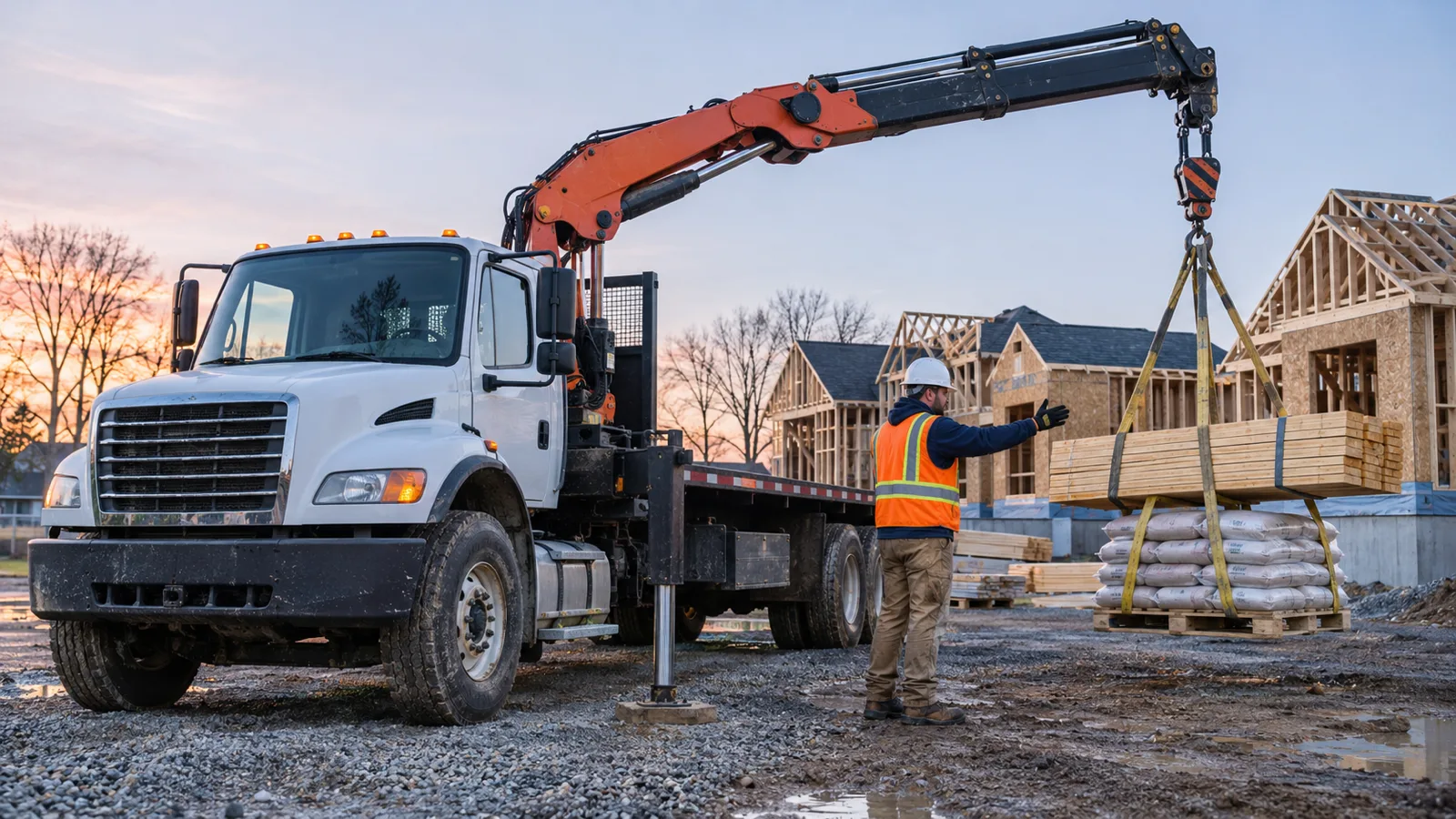
A warehouse receiving dock is built for trucks: level doors, forklifts, room to turn. A construction site usually offers none of that. Materials are often long, heavy, awkward or fragile in ways that standard freight is not, think steel studs, glulam beams, curtain wall panels, windows, rebar bundles, bagged cement and drywall. Unloading may need a truck-mounted crane, a forklift that travels with the truck, a site telehandler, or a crew doing it by hand.
On top of that, sites in Mississauga range from wide-open greenfield lots on the city's western edge to tight downtown projects next to occupied towers, where a truck may only be allowed to stop on the street during certain hours. The right delivery plan depends heavily on which of those you are dealing with.
Checklist Part 1: Before You Book the Truck
Know the material and how it will come off
- Total weight, number of pieces, and the longest and widest dimensions
- Whether pieces are banded, crated, palletized or loose
- How it will be unloaded: truck-mounted crane (boom truck), moffett-style forklift carried on the trailer, site equipment, or by hand
- Whether the material is sensitive to weather (drywall, insulation and millwork should not sit in rain)
Choose the right equipment
The trailer has to suit both the load and the site. Flatbeds and step-decks are common for lumber, steel and large components because they can be unloaded from the side or from above. Dry vans protect weather-sensitive goods but need a dock or a forklift that can reach inside. Smaller straight trucks with tailgates can be the only option for tight residential streets where a 53-foot trailer simply will not fit. If the job involves oversized pieces, provincial oversize permits and possibly escorts may be required, so involve your carrier early.
Confirm site access in writing
- The exact delivery address and gate location (large sites often have several entrances)
- Any height, weight or turning restrictions on the access route, including low wires and tree canopies
- Where the truck will park to unload, and whether that spot is on private property or the road
- Whether a road occupancy or similar permit is needed to stop on a municipal street; check with the City of Mississauga or the site's general contractor
- A named on-site contact with a working mobile number
Mind the clock and the calendar
Mississauga traffic shapes delivery planning more than most people expect. Highways 401, 403 and 410 and the QEW are all prone to heavy congestion at peak times, and a truck coming in from a lumber yard in Brampton or a steel supplier in Hamilton can lose an hour easily. Early-morning deliveries are popular for good reason. Also check local noise by-laws and any site-specific restrictions on delivery hours, particularly near residential neighbourhoods and schools. In spring, some roads in Ontario are subject to reduced load periods, so confirm with your carrier if a route might be affected.
Checklist Part 2: Preparing the Load
How the load is built at origin determines how it arrives. Suppliers can make a huge difference to the receiving crew by doing a few simple things:
- Load in install order. What the crew needs first should come off first. Nothing is more frustrating than unloading half a truck to get to the bundle on the bottom.
- Label every bundle. Clear tags with the project, floor, unit or phase prevent materials from being dumped in the wrong place and then hunted for later.
- Secure properly. Straps, edge protectors and dunnage keep materials from shifting and getting crushed. Our explainer on what dunnage means covers why the blocking and bracing between pieces matters.
- Protect from weather. Tarp anything that should not get wet, and use shrink-wrap or covered trailers for finished materials.
- Send the paperwork ahead. A bill of lading and packing list emailed before arrival lets the site check what is coming before the truck pulls up.
Some construction products, such as certain adhesives, sealants, solvents, compressed gas cylinders and fuel, are classed as dangerous goods. They must be shipped in line with Canada's Transportation of Dangerous Goods (TDG) regulations, including proper classification, documentation and placarding where required, and handled by carriers and staff trained for them.
Checklist Part 3: Delivery Day
- Morning confirmation. The driver or dispatcher confirms the estimated arrival time with the site contact before leaving. If anything has changed on site, such as a blocked gate or a crane moved, this is the moment to find out.
- Live updates. If the truck is running late, the site hears about it immediately, not when the truck fails to appear. A shipment tracking link helps everyone see the same picture.
- Safe arrival. A spotter guides the truck in. Pedestrian routes and neighbouring properties are protected.
- Inspect before signing. Count pieces and check for damage while the driver is still there. Note any shortage or damage on the delivery receipt, with photos. Signing "clean" and finding damage later makes claims much harder.
- Place it where it will be used. If possible, unload directly to the area or floor where the material is needed, which saves double handling.
Full Truckload, LTL or Staged Delivery?
Large projects often need a mix of shipping modes. Bulk materials from a single supplier, such as a full order of drywall or a structural steel package, can justify a full truckload straight to site. Smaller orders of fixtures, fasteners or specialty items may travel as LTL freight, though many LTL carriers have limitations on job-site deliveries, such as requiring a liftgate, charging accessorial fees for construction sites, or limiting delivery windows. Ask about those before you book.
For bigger developments, a staged approach often works best. Materials are received into a nearby warehouse, checked, stored and then delivered to site in smaller, scheduled drops as each phase needs them. That reduces on-site storage, which is limited and exposed to weather and theft, and lets you consolidate deliveries from several suppliers into one truck. A warehouse in Mississauga close to the 401 and 403 can reach most sites in the city and across Peel and Halton in a short run.
Imported Materials and Cross-Border Loads
Many building products, including fixtures, specialty glass, tile and some engineered components, arrive from the US or overseas. Imports need the usual commercial documentation and CBSA clearance, and the importer of record should have their CARM account set up so duties and GST/HST can be accounted for without holds. Goods that qualify under CUSMA may be eligible for preferential treatment with proper proof of origin. Build customs time into your schedule: a container sitting at a rail terminal waiting for clearance does not help a crew waiting on site. Coordinating cross-border shipping with a staging warehouse lets you clear goods ahead of need and release them to site on your timeline.
Common Mistakes and How to Avoid Them
- Booking a trailer that cannot get onto the site. Always confirm access and parking with the people who are actually there.
- No unloading plan. If nobody arranged a crane, forklift or crew, the truck waits, and waiting time is usually billable.
- Delivering too early. Materials that arrive weeks before they are needed take up space, get damaged, or go missing.
- Signing clean receipts. Inspect first, sign second.
- Relying on one phone number. Have a backup contact for the site in case the supervisor is on a roof or in a meeting.
How ShipCarte Helps With Job-Site Freight
ShipCarte coordinates freight for building product suppliers, distributors and contractors moving materials into job sites across Mississauga and the GTA. Through our carrier management network we can match the right equipment to the load and site, and our warehousing lets you stage materials close to the project and release them as each phase is ready. For more on choosing between modes, see our guide to choosing the right freight solution. When you have a project coming up, request a quote with the material list, site address and target dates, and we will help you build a delivery plan that keeps your crews working.