
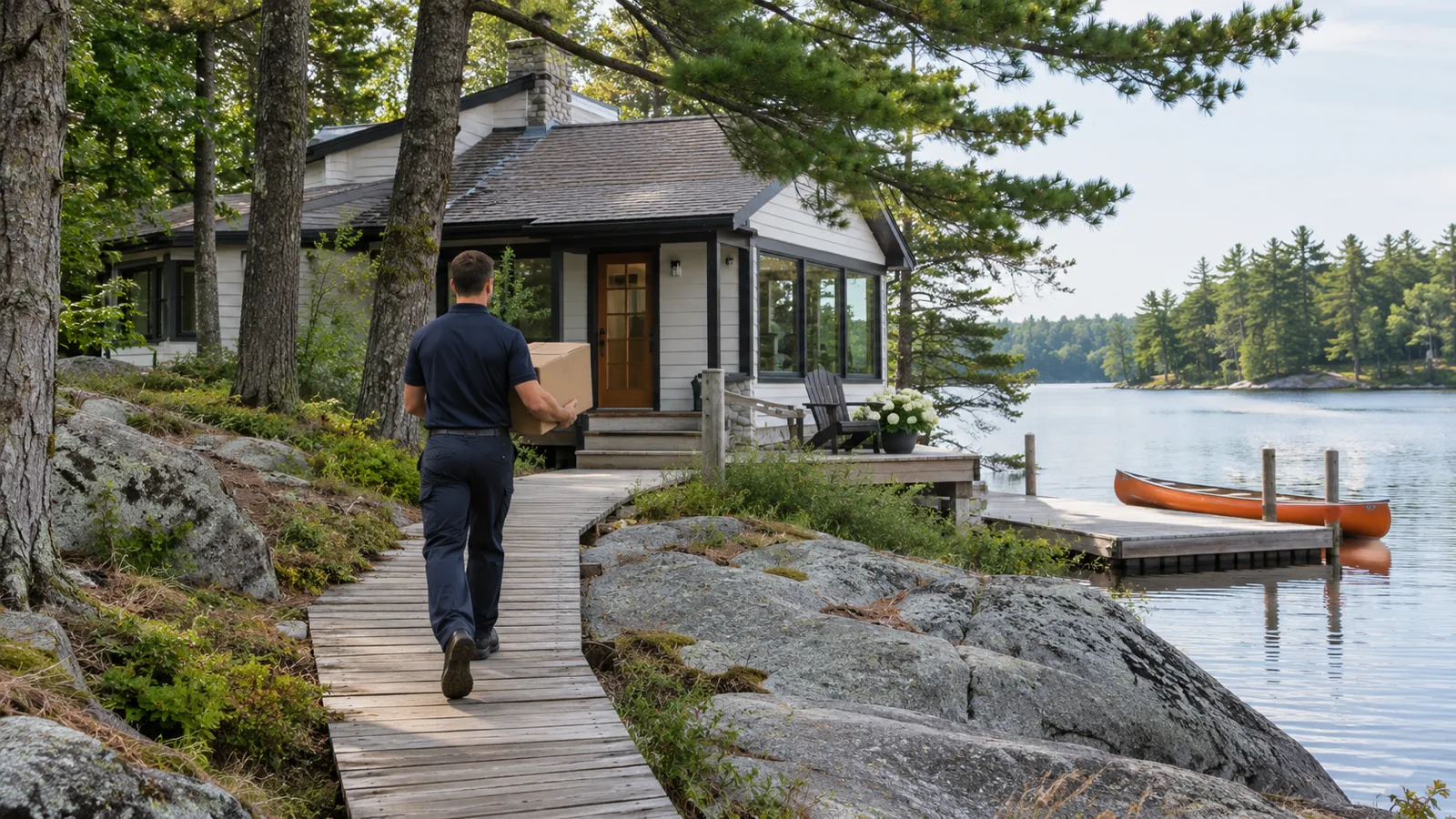
Every spring, a Toronto homeowner opens a cottage on a lake north of Huntsville, realizes the dock cushions are mouldy and the water filter has cracked, and orders replacements online from the cottage itself. The checkout form asks for a street address. The cottage has a fire number on a private road that is shared by eleven families and maintained by a road association. Three days later, the parcel is sitting at a depot in Bracebridge, marked "address not found," and the customer has driven back to the city.
Versions of that story play out thousands of times between the Victoria Day weekend and Thanksgiving. Ontario's cottage country, roughly the belt from Georgian Bay through Muskoka and Haliburton to the Kawartha Lakes, holds a huge number of seasonal properties, and their owners buy a lot online. For retailers and e-commerce brands, that is a real opportunity. It is also a reliable source of failed deliveries, extra fees and unhappy reviews if you treat a cottage like a suburban house.
Now that the season has wound down for 2019, it is a good time to look back at what went wrong this summer and set up a better approach before the May long weekend comes around again. Below, three common customer scenarios show what really happens to cottage orders, followed by a planning checklist for next year.
How cottage country differs from a normal delivery area
Cottage country is not remote in the way Northern Ontario is. Bracebridge, Huntsville, Gravenhurst, Haliburton, Minden, Fenelon Falls, Bobcaygeon and Lakefield all have regular courier and postal service, and most are within a day of the GTA. The difficulty lies in the last few kilometres:
- Private and seasonal roads. Many cottages sit on narrow gravel roads maintained by associations, not municipalities, and some are not plowed in winter.
- Fire numbers instead of street numbers. Muskoka, Haliburton and the Kawarthas use 911 civic addresses, but cottagers often give a lake name or a lot description instead.
- Water-access properties. Islands and properties with no road access cannot receive courier delivery at all. Owners use a marina or landing as their mainland address.
- Nobody home. Cottagers come and go on weekends, so a weekday delivery attempt often finds an empty property.
- Seasonal mail service. Many owners use a rural mailbox, a community mailbox or general delivery at a village post office, which are fine for small parcels and frustrating for large ones.
Scenario one: the small parcel to Muskoka
A customer at a cottage on Lake Rosseau orders a pair of sunglasses and a book. The parcel weighs under a kilogram. The seller ships with a national courier using the customer's fire number and road name. The road is private and the driver cannot find the property, so the parcel returns to the depot in Bracebridge and the customer gets an email notice.
What would have worked better: For a small, light parcel like this, Canada Post is often the stronger choice in Muskoka because its rural route and post office network is already built around seasonal residents. If the customer used the village post office in Port Carling or another nearby community, the parcel would have been waiting for them on their next trip into town. Offering a "ship to post office" or "hold for pickup" option at checkout solves a lot of these failures.
Scenario two: the bulky item to Haliburton
A customer in the Haliburton Highlands orders a 40-kilogram outdoor storage box. The cottage is down a steep gravel lane off Highway 118. The seller ships by LTL freight and books a liftgate. The truck arrives on a Wednesday, the driver decides the lane is unsafe for a 53-foot trailer, and the shipment goes back to the terminal. Redelivery is booked for the following week, with extra charges for the attempt and storage.
What would have worked better: Ask about access at checkout for heavy or oversized items: road surface, grade, turnaround space and whether a trailer can get in. For difficult properties, use a carrier with straight trucks or a local delivery partner, or arrange delivery to a nearby business, marina or a terminal pickup in Minden or Haliburton. Booking an appointment with a phone call ahead also ensures someone is on site.
Scenario three: the Kawarthas grocery and supplies order
A cottage-country general store near Buckhorn restocks weekly from a GTA wholesaler: snacks, paper goods, sunscreen, bug spray and some refrigerated items. In late June the store's sales triple, and the weekly pallet is no longer enough. The wholesaler adds mid-week courier shipments to fill gaps, which drives costs up sharply.
What would have worked better: The wholesaler could forecast the summer spike from previous years and move to twice-weekly LTL deliveries from late June through Labour Day, consolidating fill-in orders onto those runs. Refrigerated items belong on a temperature-controlled service, not in a dry courier tote that sits in a hot van. ShipCarte's food and beverage logistics can keep chilled goods in range on these routes.
Timing the cottage season
Cottage demand follows a predictable calendar, and lining up inventory and carrier capacity against it prevents most problems:
- Late April to Victoria Day: opening season. Docks, water systems, outdoor furniture, cleaning supplies and spring repairs. Watch for spring load restrictions on some municipal roads, which can limit heavy deliveries until they lift.
- June to Labour Day: peak. Watersports gear, barbecues, food and drink, boating parts, gifts and household goods. Highway 11, Highway 400, Highway 35 and Highway 115 are crowded on Fridays and Sundays.
- September to Thanksgiving: closing season. Shutters, winterizing supplies and boat storage. Some owners stay through the fall colours, but many leave after Thanksgiving.
- Winter: a smaller group of four-season cottages and snowmobile users. Unplowed roads make many properties unreachable.
For e-commerce brands, the most important date is often the start of June. Stock that arrives at your e-commerce fulfillment centre in mid-June has already missed a big share of opening-season demand.
Products that need extra care in cottage country
Some of the items cottagers order most are also the trickiest to ship. A few categories deserve their own rules in your fulfillment process:
- Propane cylinders, fuel additives and outboard oil. These are dangerous goods under the federal Transportation of Dangerous Goods Regulations. Many parcel services restrict or refuse them, and those that accept them require proper classification, packaging, labels and trained staff. Small quantities can sometimes ship under limited quantity provisions, but check before you list them online.
- Batteries. Lithium batteries for electronics, trolling motors and power tools have their own packaging and labelling rules, especially if any part of the journey is by air to a fly-in lodge.
- Food and beverages. Summer heat inside a delivery van can spoil chocolate, cheese and other perishables before they reach a cottage. Use insulated packaging and avoid shipping on Fridays when the parcel might sit over a weekend.
- Large outdoor items. Kayaks, paddleboards, docks and furniture often exceed parcel size limits and need freight or a specialized local delivery partner with the right vehicle.
Flagging these SKUs in your system means the right service is chosen automatically, rather than an order for a propane accessory kit slipping onto a standard parcel label.
Getting the address right
Most failed cottage deliveries start at checkout. A few changes to your order form help:
- Add a clear prompt for cottage addresses: fire number, road name, municipality and postal code.
- Include a free-text field for delivery notes such as "blue gate, second driveway past the marina."
- Make the phone number required, and pass it to the carrier on the label.
- Offer alternate delivery options: a village post office, a courier depot, a nearby business or the customer's home address in the city.
- Flag water-access postal codes and lake names so your team can contact the customer before shipping.
A good order management system can apply rules automatically. For example, any order to a known cottage-country postal code with a heavy item can be routed for review before it ships.
Setting honest delivery expectations
Ontario's Consumer Protection Act gives online buyers the right to cancel if a supplier does not deliver within 30 days of the specified delivery date, or within 30 days of the agreement if no date was given. Most cottage orders arrive well inside that, but the principle is worth keeping in mind: state a realistic window and honour it. A few practical points:
- Quote cottage-country delivery as one to three business days from the GTA rather than "next day."
- Explain that Saturday and Sunday delivery may not be available in rural areas.
- Send tracking links and proactive delay emails, especially after holiday weekends when depots are backed up.
- Price large-item delivery to cottages honestly, including any rural surcharges, rather than absorbing them unpredictably.
Returns from the cottage
Returns are harder from cottage country than from the city. Customers may not be near a courier drop-off, and they may want to return items after the season ends. Offering prepaid return labels that work with Canada Post, along with a longer return window for summer products, avoids friction. Behind the scenes, a reliable returns management process gets seasonal stock inspected and back into sellable inventory before it loses value.
If you ship from the Peel Region, our earlier post on shipping to cottage country from Mississauga covers lanes and carriers in more detail. For the region just south of Muskoka, see our guide to shipping into Peterborough and the Kawarthas.
Plan next summer's cottage deliveries now
The cottage season rewards sellers who prepare in the off-season: clean checkout fields, the right carrier for each postal code, inventory in place by June and a returns process that handles the fall rush. ShipCarte helps Ontario retailers and e-commerce brands set that up. Schedule a consultation to review your cottage-country orders, or request a quote for next season.