
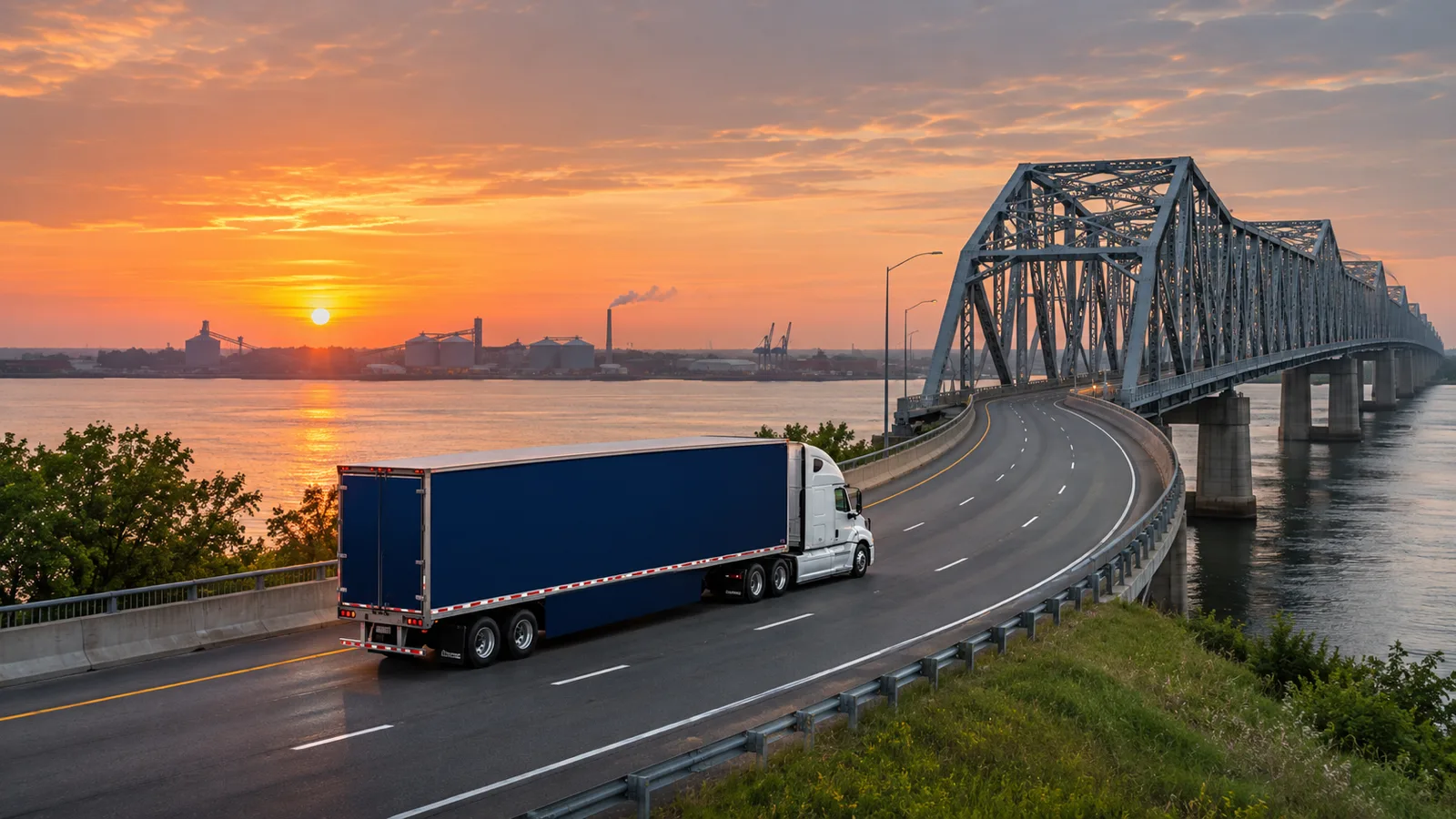
A skincare brand operating out of a unit near Dixie Road and Eglinton lands its first big US retail account. The buyer wants a pallet in a New Jersey distribution centre in two weeks, plus ongoing direct-to-consumer orders shipped to American shoppers. The founder has shipped thousands of parcels inside Canada, but the US order raises questions nobody on the team has answered before. Who clears it through customs? Who pays the duty? What happens if the truck is held at the Peace Bridge?
Mississauga is one of the best-placed cities in Canada for this kind of growth. The QEW carries trucks to the Niagara crossings in well under two hours in normal traffic, the 401 runs west to the Ambassador Bridge and the Blue Water Bridge, and Toronto Pearson handles a large share of the country's air cargo. Geography is on your side. The paperwork and planning are where most first-time exporters stumble.
This playbook breaks cross-border shipping into ten practical steps, in the order you will actually face them. Work through them once and you will have a repeatable process for every US-bound order after.
Step 1: Decide how the goods will travel
The mode you choose drives almost every other decision. There are three common options for Mississauga shippers:
- Small parcel: best for individual consumer orders and light business shipments. Courier networks handle line haul and customs clearance through their own brokerage arms, which is convenient but can come with brokerage fees that surprise your customer if you have not planned for them.
- LTL freight: for one to several pallets going to a business address, such as a retailer's distribution centre. Your pallets share a trailer with other shippers' freight and move through terminals on both sides of the border.
- Full truckload: when you fill or nearly fill a trailer, or when the freight is sensitive enough that you do not want it handled at terminals. Often the fastest and most predictable route for large retail replenishment.
Many brands end up using all three: parcel for direct-to-consumer, LTL for wholesale replenishment, and truckload during peak season. Our guide on how freight differs from small package shipping goes deeper on where the lines fall.
Step 2: Classify your products
Every product crossing the border needs a Harmonized System (HS) tariff classification. The first six digits are shared internationally; the US adds further digits in its Harmonized Tariff Schedule. The classification determines the duty rate, whether any other US agency regulates the product, and which trade agreement rules apply. Do this once for each SKU, record it in your product data, and have a licensed customs broker sanity-check anything that is not obvious. Misclassification is one of the most common causes of delays and unexpected bills.
Step 3: Check origin and trade agreement eligibility
If your goods qualify as originating under CUSMA, the importer can claim preferential treatment, which in recent years has also determined whether some Canadian goods were exempt from newer US tariffs. Qualifying is not automatic, so read our companion post on CUSMA compliance for Mississauga exporters before you promise a duty-free landed cost to a US buyer. If your products are manufactured overseas and simply stored in Mississauga, they usually keep their overseas origin and will be dutied accordingly.
Step 4: Agree who is the importer of record
Someone has to be legally responsible for bringing the goods into the US: the importer of record. For wholesale orders, that is usually your US customer, and the deal is often priced on a basis where the buyer handles clearance and duties. For direct-to-consumer orders, you have a choice:
- Delivered duty unpaid (DDU or DAP): the consumer pays any duties, taxes or brokerage fees at delivery. Simple for you, frustrating for the shopper, and a common cause of refused packages.
- Delivered duty paid (DDP): you collect or absorb those costs and clear the goods yourself, often as a non-resident importer. A better customer experience, but you take on the compliance responsibility.
The US has also changed how it treats low-value imports. The long-standing de minimis exemption that let many small parcels enter duty-free was suspended in 2025, so small consumer orders that used to cross without duty may now attract duties and formal processing. Rules in this area have changed more than once, so confirm the current treatment with your carrier or broker before you set your pricing. Our post on duties and taxes in cross-border e-commerce explains the trade-offs in more detail.
Step 5: Appoint a customs broker
A licensed US customs broker files the entry on behalf of the importer. For parcels, the carrier's brokerage service often does this by default. For LTL and truckload freight, you or your customer should choose a broker deliberately and give them a standing set of instructions: your products, classifications, values and any agency requirements. A good broker relationship is the single biggest factor in smooth crossings.
Step 6: Check for other agency requirements
US Customs and Border Protection is not the only agency that may care about your shipment. Depending on what you sell, others may be involved:
- Food and beverage, supplements and cosmetics: the US Food and Drug Administration has its own rules, including prior notice for food shipments and facility registration for many food producers.
- Medical devices and pharmaceuticals: FDA device and drug regulations apply, separate from Health Canada's.
- Consumer products: safety standards and certificates may be required for categories such as children's products.
- Wood packaging: pallets and crates must meet international phytosanitary standards and carry the appropriate treatment mark.
If any of these apply, sort it out before the first shipment. Agency holds are slower and harder to resolve than routine customs questions.
Step 7: Prepare clean documents
Documentation errors cause more held trucks than anything else. Every shipment should have:
- A commercial invoice with full shipper and consignee details, a clear plain-language description of each item, HS classification, country of origin, quantity, unit value, total value and currency, and the terms of sale.
- A packing list showing what is on each pallet or in each carton, with weights and dimensions.
- A bill of lading for freight shipments, or the carrier's waybill for parcels.
- Any origin certification or agency documents the importer needs.
"Parts" or "samples" is not a description. "Stainless steel hex bolts, 10 mm, for industrial machinery" is. Specific descriptions get through faster.
On the Canadian side, most commercial exports to the US do not require a separate Canadian export declaration, but there are exceptions for controlled, regulated or prohibited goods. If you ship anything unusual, check with the CBSA or your broker.
Step 8: Book the carrier and the pre-clearance
US-bound trucks must transmit an electronic manifest to US Customs before arriving at the border, and the shipment is typically pre-cleared using a barcode reference that your broker links to the entry. When you book a freight carrier, confirm they are set up for cross-border work and ask which crossing they normally use. From Mississauga, Niagara crossings such as the Peace Bridge and the Lewiston-Queenston Bridge are the usual choice for the US Northeast, while freight bound for the Midwest commonly heads west on the 401 to Windsor and the Ambassador Bridge or to Sarnia and the Blue Water Bridge.
Send your broker the paperwork as soon as the shipment is booked, not when the truck is already in the queue. Pre-clearance only works if it has actually happened.
Step 9: Pack and label for a longer journey
A cross-border freight shipment may pass through more handling points than a domestic run. Stretch-wrap pallets tightly, use corner boards on tall loads, and label every carton with the consignee and the purchase order number. For retail accounts, follow the buyer's routing guide to the letter. Big retailers often charge back for non-compliant labels, late arrivals or incorrect carton counts. Parcel shippers should check that their packaging can survive several sortation hubs, and should print customs documents with the carrier's label rather than tucking them inside the box.
Step 10: Track, measure and refine
Once freight is moving, keep score. Track transit time from your dock in Mississauga to delivery, the number of shipments held at the border, the reasons for each hold and the total landed cost per order. Patterns appear quickly. A product with a vague description might be stopped repeatedly, or one crossing might be consistently faster for your lanes. Fix the root cause rather than firefighting each shipment.
A short checklist before your first US shipment
- HS classification recorded for every SKU
- Origin determined and certification ready where CUSMA applies
- Importer of record agreed, and DDP or DAP decided for consumers
- US customs broker appointed and briefed
- Any FDA or other agency requirements confirmed
- Commercial invoice template reviewed for complete descriptions and values
- Carrier confirmed for cross-border work, crossing identified
- Pallets and cartons labelled to the buyer's routing guide
- A process for sending documents to the broker at booking
Where a 3PL in Mississauga helps
Some brands handle all of this in-house. Many find that once US volume grows, it is easier to hand the moving parts to a partner who already has the carrier relationships and the processes. ShipCarte's cross-border shipping service coordinates carriers and documentation for US-bound parcels and freight, while small parcel shipping and LTL freight cover the everyday volume. If you sell online, our e-commerce fulfillment team can pick, pack and label orders for both Canadian and American customers from the same inventory, and shoppers can follow their orders through our shipment tracking page.
Ready to open your US lanes?
Shipping south from Mississauga does not need to be stressful. Get the classification, origin, importer and broker decisions right up front, keep documents clean, and the border becomes a routine step rather than a gamble. If you would like help mapping out your first US shipments or tightening an existing process, request a quote or book a consultation with the ShipCarte team.