
Picture a consumer goods importer whose containers land at the Port of Montreal, travel by rail to the Brampton intermodal terminal, and then get drayed a few kilometres south to a warehouse in Mississauga. The goods sit on a rack for nine days, get picked, and leave again on trucks bound for retailers in Ottawa, London and Windsor. Nothing was wrong with the product. Nothing was changed about it. It simply waited, and the importer paid for every one of those days in storage, handling and working capital.
Cross-docking is the alternative. Instead of putting freight away and pulling it later, the goods come off an inbound trailer, get sorted on the dock floor, and go straight onto outbound trailers, often within the same shift. For many shippers in the Greater Toronto Area, it is the single most effective way to cut dwell time without adding trucks or square footage.
This guide explains how cross-docking actually works, which types of freight suit it, where it falls apart, and why Mississauga's location makes it such a natural place to run a cross-dock programme.
What Cross-Docking Really Means on the Dock Floor
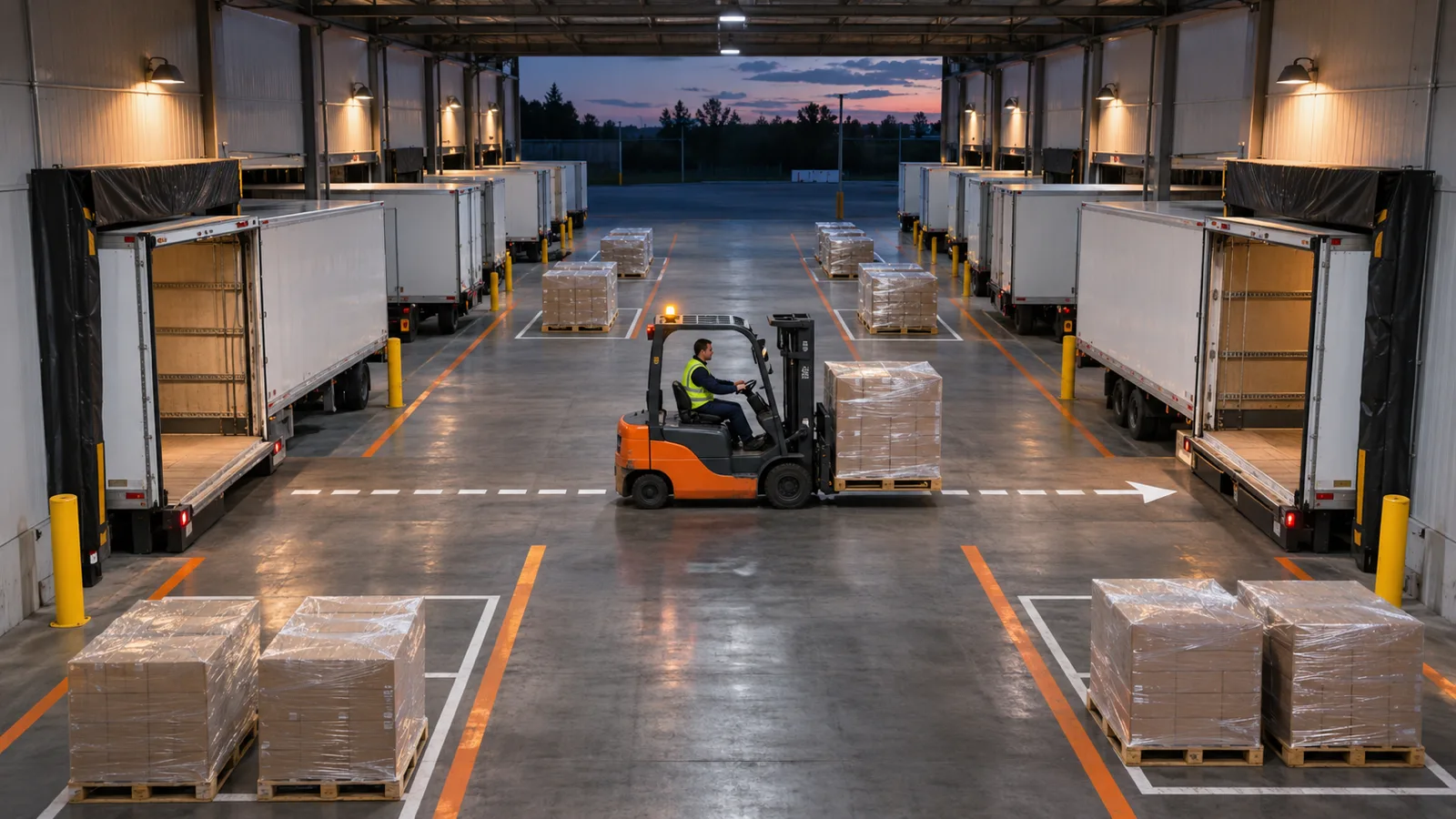
The textbook definition is simple: freight is unloaded from an inbound vehicle and loaded onto an outbound vehicle with little or no storage in between. In practice, the dock floor is where all the decisions happen. A cross-dock facility usually has doors on two sides of a narrow building. Inbound trailers back into one side, outbound trailers back into the other, and the floor in the middle is painted into staging lanes, one per outbound destination or route.
When an inbound load arrives, the team checks it against an advance shipping notice (ASN), confirms piece counts and condition, and then moves each pallet or carton to the lane for its next stop. Once a lane has everything it needs for a particular trailer, the outbound load is built and dispatched. The goal is that freight touches the floor once, for as short a time as possible.
That sounds easy, but it depends on three things being right before the truck even arrives:
- Accurate advance information. The dock team needs to know what is on the inbound load and where each piece is going before the doors open. Without that, cross-docking turns into a scramble.
- Synchronized timing. Inbound arrivals and outbound departures have to line up. If outbound trucks leave before the inbound freight shows up, goods end up sitting overnight, which defeats the purpose.
- Clear labelling. Every pallet or carton needs a label that tells the dock crew its destination at a glance, ideally scannable so the system records each move.
The Main Types of Cross-Docking
Not every cross-dock programme looks the same. The right model depends on how your freight arrives and how your customers want to receive it.
Pre-distributed (pre-allocated) cross-docking
The supplier or manufacturer already knows which store or customer each unit is going to, and the freight arrives labelled that way. The cross-dock's job is to sort and consolidate. A Mississauga-based housewares brand shipping to forty retail locations across Ontario could have its overseas factory pack and label cartons by store, then use a cross-dock to build one truckload per region. This is the fastest and cleanest form, because no decisions have to be made on the dock beyond routing.
Post-distributed (consolidated) cross-docking
Here, freight arrives in bulk and the allocation is decided at the cross-dock. Pallets may need to be broken down into cartons and rebuilt into mixed pallets for different destinations. It takes more labour and more system support, but it gives the shipper flexibility to react to what customers actually need that week rather than what was forecast months earlier.
Consolidation and deconsolidation
Some shippers use cross-docking to combine several partial loads from different suppliers into one full truckload, which can lower cost per pallet on a long haul. Others do the reverse: a single full truckload arrives from the US or another province, and the cross-dock splits it into LTL shipments or local deliveries. Both are common around Mississauga because of how much freight funnels through the area on its way somewhere else.
Why Mississauga Is Built for Cross-Docking
Cross-docking rewards locations where freight naturally converges, and few places in Canada see more convergence than the corridor around Toronto Pearson International Airport. A few reasons this matters:
- Highway access in every direction. Highways 401, 403, 407, 410 and 427 all run through or alongside Mississauga, and the QEW skirts the south end of the city. An outbound trailer can be heading east toward Montreal, west toward Windsor and the Ambassador Bridge, or south toward the Niagara crossings at the Peace Bridge and Lewiston-Queenston within minutes of leaving the dock.
- Air cargo next door. Freight arriving at Pearson can be trucked to a cross-dock in the Airport Corporate Centre, Malton or Gateway area quickly, then broken down for regional delivery.
- Rail intermodal nearby. Major rail intermodal terminals in Brampton and Vaughan handle containers arriving from ocean ports, and drayage from those yards into Mississauga is a short run.
- A deep carrier pool. Because so many carriers already operate out of the area, finding outbound capacity is generally easier than in smaller markets, which keeps the timing tight.
For a retailer or distributor serving Ontario and Quebec, a cross-dock in Mississauga can sit near the middle of a lot of delivery routes rather than at the end of one.
Freight That Suits Cross-Docking (and Freight That Doesn't)
Cross-docking works best when demand is predictable and products are ready to sell as they arrive. Good candidates include:
- Retail replenishment for stores that order on a regular schedule
- Promotional and seasonal goods that need to hit shelves on a specific date
- Perishables and short-shelf-life food, where every hour of storage eats into sellable life (provided the dock can hold the right temperature)
- Pre-labelled imports that are already allocated to customers
- Manufacturing components moving to plants on a just-in-time schedule
It is a poor fit when goods need inspection, testing, relabelling or kitting before they can ship, when demand is erratic, or when you don't yet know where the product is going. In those cases a short stay in a distribution warehouse is often the more reliable choice. Many shippers end up running a hybrid: fast-moving, pre-allocated SKUs cross-dock, while slower or uncertain SKUs go into storage.
How to Know If Cross-Docking Will Save You Money
The savings come from what you stop paying for: storage, put-away and pick labour, and the carrying cost of inventory sitting still. The costs come from tighter coordination, more frequent outbound trucks, and the risk of a missed connection. Before committing, run through these questions honestly.
- How long does your freight currently sit? If inventory turns over in a day or two already, there may be little to gain. If it sits for a week or more without any value being added, cross-docking is worth a serious look.
- Do you know the destination before the freight arrives? If allocations are only decided after receiving, you will need post-distribution cross-docking, which takes more labour.
- Are your suppliers reliable on timing? Cross-docking depends on inbound loads showing up when expected. A supplier who regularly misses windows by a day will cause outbound trucks to wait or leave short.
- Can your systems send ASNs? Without advance notice of what is on each truck, the dock cannot plan. EDI or a portal-based ASN process is close to essential.
- Do you have enough volume per destination? Building full or near-full outbound loads is where the economics work best. Very small volumes to many places may be better handled as parcel or LTL from storage.
The cost picture varies widely by freight type, lane and volume, so it is worth comparing a cross-dock quote against your current warehouse-and-pick cost per pallet rather than relying on general rules of thumb.
Technology That Keeps a Cross-Dock Moving
A cross-dock without good data is just a crowded loading dock. The systems behind it do three jobs: they tell the team what is coming, they record every move, and they let the shipper see where freight is at any moment.
A modern warehouse management system handles receiving against ASNs, assigns staging lanes, and confirms outbound loading by scan. That scan trail matters when a retailer claims a short shipment, because you can show exactly which pallets went on which trailer and when. Visibility tools such as reporting and analytics dashboards let you track dwell time per load, which is the key measure of whether your cross-dock is actually working. If average dwell starts creeping from hours to days, something upstream has changed.
Integration matters too. When your ERP or order system talks directly to the cross-dock's systems, allocations and routing instructions flow through without someone retyping them, which reduces the chance of a pallet going to the wrong lane.
Common Problems and How to Avoid Them
Inbound and outbound out of sync
The most frequent failure is timing. An inbound trailer stuck in traffic on the 401 at rush hour can arrive after the outbound truck to Kingston has already left. Build buffers into the schedule, book inbound appointments with realistic windows, and have a fallback plan, such as short-term storage, for freight that misses its connection.
Unlabelled or mislabelled freight
If cartons arrive without destination labels or with labels that do not match the ASN, the dock has to stop and investigate. Set clear labelling requirements with suppliers and enforce them. A short routing guide that suppliers sign off on can save hours on the dock.
Damaged goods with no time to deal with them
Because freight moves through quickly, damage has to be caught at receiving. Train the dock team to inspect and photograph as loads come off, and agree in advance how damaged pieces will be handled: held, returned, or shipped with a note.
Temperature-sensitive freight on an ambient dock
Food and pharmaceutical products can cross-dock very effectively, but only through a facility that can keep them in range. Ten minutes on a hot summer dock in August can be enough to compromise some products. If your goods need refrigeration, look for a temperature-controlled warehousing partner whose dock is also controlled.
Cross-Docking for Cross-Border Freight
Mississauga's distance to the US border makes it a common transfer point for freight heading south or arriving from American suppliers. A US-origin full truckload might cross at the Ambassador Bridge, clear CBSA, and arrive in Mississauga to be split into smaller shipments for customers across Ontario. Going the other way, Canadian suppliers can consolidate freight at a Mississauga cross-dock so that a single, fully documented trailer crosses at the Peace Bridge rather than several partial loads.
The paperwork has to be right for this to work. Commercial invoices, CUSMA certificates of origin where applicable, and accurate customs data all need to travel with the freight, and the importer of record should be set up in CBSA's CARM portal so that duties and taxes can be accounted for without delays. A cross-border shipping team can help coordinate customs brokers, carriers and the cross-dock so freight clears and keeps moving.
Getting Started: A Practical First Step
You don't need to convert your whole supply chain at once. A sensible starting point is to pick one lane or one customer where the freight is predictable, pre-allocated and high-volume, and run it through a cross-dock for a few weeks. Measure dwell time, on-time outbound departures, and cost per pallet against what you were paying before. If the numbers hold up, expand to the next lane.
It also helps to understand how cross-docking compares to the other options. Our guide to pallet-in, pallet-out services covers short-term storage models that pair well with a cross-dock, and why businesses need warehousing and distribution services explains where storage still earns its place.
Talk to ShipCarte About Cross-Docking in Mississauga
If your freight is spending more time sitting in a warehouse than moving toward your customers, it may be time to rethink the flow. ShipCarte offers distribution services, LTL and full truckload coordination, and warehousing in the Mississauga area, so we can help you decide which freight should cross-dock and which should be stored. Request a quote with a few details about your lanes and volumes, and we will walk you through what a cross-dock programme could look like for your business.