
A small furniture maker ships a few pallets a week to retailers in Ontario, Quebec and the Prairies. Each pallet weighs a few hundred pounds, so the owner books LTL freight on the declared weight. Then the invoices start arriving higher than the quotes, each with a line showing an adjusted weight and a note about a cubic minimum. The furniture is light, but it takes up a lot of space, and the carrier has billed it accordingly.
Situations like this are common for shippers who are new to less-than-truckload freight in Canada, and even for experienced ones whose product mix has changed. Weight alone rarely tells the full story. An LTL trailer runs out of space long before it runs out of weight capacity when it is full of bulky, light goods, so carriers price freight based on how much of the trailer it occupies as well as how much it weighs.
This article explains how density affects LTL pricing in Canada, how to calculate the density of your shipments, and what you can do to avoid unwelcome adjustments on your freight bills.
LTL basics: what you are paying for
LTL carriers combine shipments from many shippers on the same trailer, moving them through a network of terminals. Your pallets might be picked up in Montreal, cross-docked at a terminal, travel on a linehaul trailer to Toronto, be cross-docked again, and be delivered by a city truck. Each shipment uses space on trailers and dock floors and labour at every terminal.
Carriers therefore care about three things when pricing a shipment:
- Weight, which affects fuel, axle limits and handling.
- Space, measured in cubic feet or linear feet of trailer floor.
- Handling characteristics, such as fragility, stackability, and whether freight is palletized.
Density brings weight and space together into a single number.
How to calculate density
Density is weight divided by volume, usually expressed in pounds per cubic foot (PCF) in North American freight. Here is how to calculate it for a pallet:
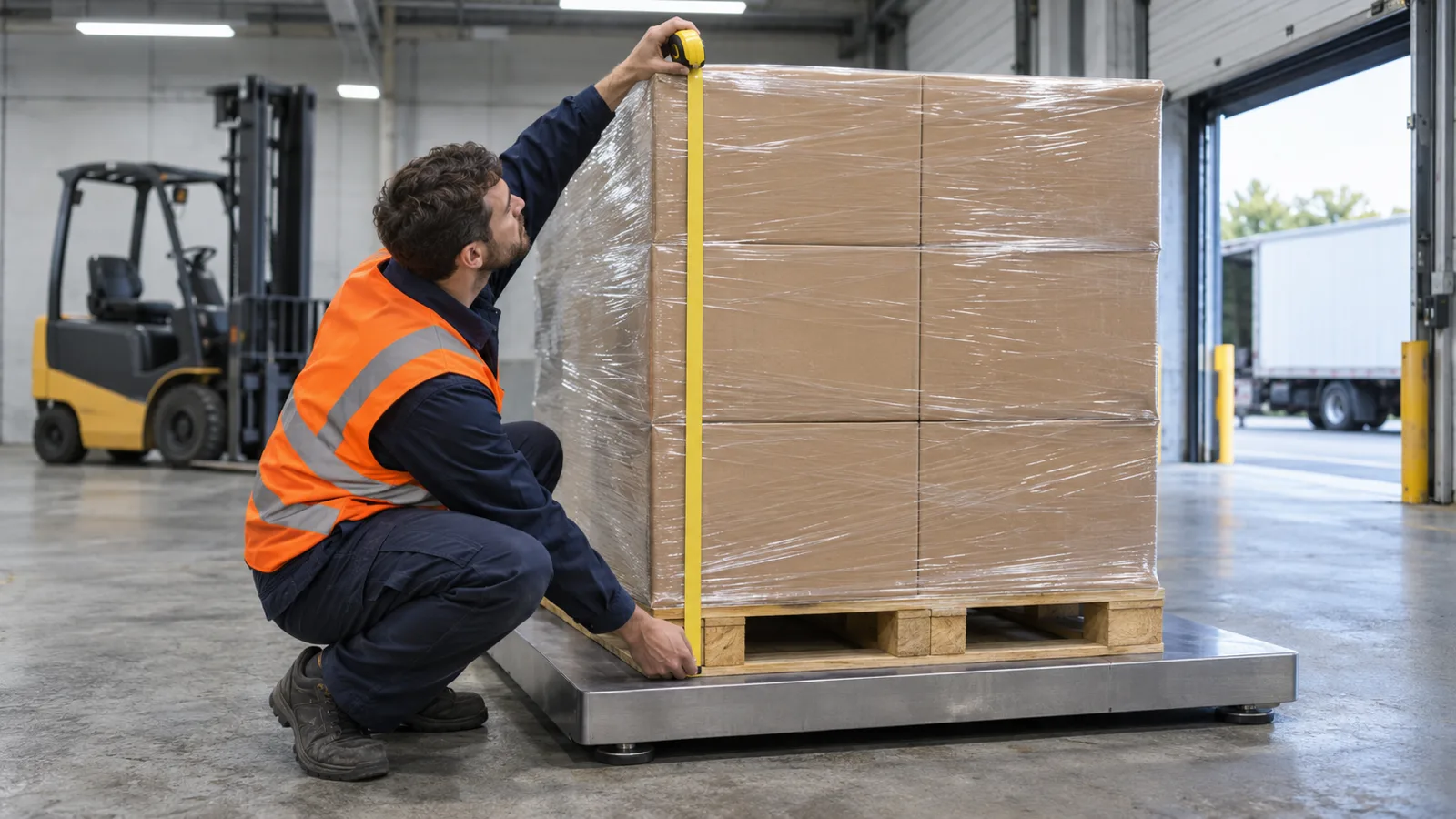
- Measure the shipment at its longest, widest and highest points, including the pallet itself and any overhang. Round up to the nearest inch, as carriers generally do.
- Calculate cubic inches by multiplying length × width × height.
- Convert to cubic feet by dividing by 1,728.
- Weigh the shipment, including the pallet, packaging and wrap.
- Divide weight by cubic feet to get PCF.
Worked example: a pallet measures 48 × 40 × 60 inches and weighs 400 lb. That is 115,200 cubic inches, or about 66.7 cubic feet. Density is 400 ÷ 66.7, or roughly 6 PCF.
Compare that with a pallet of canned goods of the same size weighing 1,600 lb: around 24 PCF. The second pallet weighs four times as much but takes the same trailer space. A carrier would naturally want to charge the first shipment more per pound than the second.
How Canadian LTL carriers use density
Pricing methods vary by carrier, and tariffs are not standardised across the industry in Canada. That said, most domestic carriers use some combination of the following approaches. Always read your own carrier's tariff and rules, because the specific numbers differ.
Weight-based rates with cubic minimums
Many Canadian domestic LTL carriers quote rates per hundredweight (per 100 lb, often written as CWT) by lane and weight break, with a minimum charge per shipment. To protect themselves against light, bulky freight, they apply a cubic minimum: a rule that converts the shipment's volume into a minimum chargeable weight. If the cubed weight is higher than the actual weight, you pay on the cubed weight.
The conversion figure is set in the carrier's tariff. Using a hypothetical conversion of 10 lb per cubic foot, the 66.7-cubic-foot pallet in our example would have a minimum chargeable weight of about 667 lb. You declared 400 lb, but you would be billed at 667 lb. Your carrier's figure may be different, so check before using this kind of calculation for your own quotes.
Linear foot rules
Large shipments, and freight that cannot be stacked, may be priced by how many linear feet of trailer floor they occupy. A tariff might specify that a shipment occupying more than a certain length of trailer is rated as though it weighs a set amount per linear foot. Non-stackable pallets often trigger these rules because they effectively claim the space above them as well.
Freight classification for cross-border moves
In the United States, LTL freight is traditionally priced using classes under the National Motor Freight Classification (NMFC), which assigns commodities to classes from 50 to 500. Density is a major factor in many class assignments, and the NMFC changes that took effect this July moved many more commodities onto density-based classes. Canadian shippers sending LTL freight to US consignees, or receiving from US suppliers, will often encounter NMFC classes on their bills of lading. Within Canada, classification is less central for many carriers, but some do use class or commodity-based tariffs.
Dimensioning and reweighs
Carriers increasingly use dimensioning equipment at terminals to measure freight automatically. When measured dimensions or weights differ from what the shipper declared, the carrier can issue a correction and adjust the invoice, often with an inspection fee. These adjustments are where many shippers first discover density pricing.
Common causes of density-related surprises
- Declaring product dimensions instead of shipment dimensions. The pallet adds height, and overhang adds length and width.
- Forgetting the pallet weight. A standard wooden pallet adds meaningful weight on its own.
- Uneven stacking. A single carton sticking up from the top of a pallet sets the height for the whole pallet.
- Overhang. Cartons hanging over the edge of the pallet increase the footprint and are more likely to be damaged.
- Marking pallets "do not stack" when they could safely carry another pallet. This can trigger linear foot or space rules.
- Estimating instead of measuring. Quotes based on guesses rarely survive a carrier's dimensioner.
How to improve your freight density
Improving density means getting more weight into less space, or simply less wasted space. Practical tactics include:
Optimise cartons
Products shipped in oversized cartons carry air. Right-sizing cartons reduces the cube of every pallet. Tools like cartonization in a warehouse management system choose the smallest suitable box automatically.
Build better pallets
Stack cartons in a tight, square pattern with no overhang. Keep the top flat so the pallet is stackable. Use corner boards and stretch wrap to stabilise the load. A well-built pallet both rates better and arrives in better shape.
Choose pallet sizes to suit the product
A standard 48 × 40 pallet is not always the best footprint. Smaller or custom footprints can suit some products and reduce wasted space, although you should confirm that the carrier and consignee can handle them.
Ship knocked down
Furniture, fixtures and displays that can ship flat-packed often achieve much higher density than assembled items. The trade-off is assembly at the destination, which may suit some customers better than others.
Consolidate orders
Several small shipments to the same consignee can often be combined into one fuller pallet, reducing both minimum charges and per-pound costs.
Scenario: the same order, built two ways
Picture a shipper sending 30 cartons of kitchenware from a warehouse in Montreal to a retailer in Winnipeg. In the first version, a busy packer stacks the cartons loosely on a standard pallet: a few cartons hang over the edge, the top layer is uneven, and one carton sits alone on top. The finished pallet measures 52 × 44 × 70 inches. In the second version, the cartons are arranged in a tight interlocking pattern with no overhang and a flat top, finishing at 48 × 40 × 58 inches.
The weight is identical, but the second pallet occupies nearly a third less cube. If the carrier applies a cubic minimum, the first pallet is far more likely to be billed above its actual weight. It is also more likely to be marked non-stackable by a dock worker, to suffer crushed corners, and to be reweighed and remeasured at a terminal. Five extra minutes at the packing station can be worth more than any rate negotiation.
A quick density checklist before you book
- Have we measured the actual shipment, including the pallet and any overhang?
- Have we weighed it on a calibrated scale, including packaging?
- Do we know our carrier's cubic minimum and linear foot rules?
- Is the pallet stackable, and is it marked accordingly?
- Would a smaller carton or a different pallet pattern cut the cube?
- If shipping to the US, do we have the correct NMFC class?
When LTL stops making sense
Sometimes the answer to density pricing is a different service. If a shipment occupies a large share of a trailer, a volume LTL quote or a partial truckload can cost less than standard LTL. If it fills most of a trailer, a dedicated full truckload may be cheaper and faster, with less handling. Conversely, very small, dense shipments may be cheaper as multi-piece parcels. Our article on how freight differs from small package shipping covers where that line usually falls.
Parcel carriers apply their own version of the same idea, called dimensional weight. The logic is similar: if a box is large and light, you pay for its size. Our guide to how package dimensions impact shipping costs explains dimensional weight in more detail.
Auditing your LTL invoices
Even careful shippers see adjustments. Keep a habit of reviewing them:
- Compare every invoice with the quote and the bill of lading.
- Look for reweigh, reclass and cube adjustments and ask for the supporting measurements or photographs where available.
- Track adjustments by product and by shipping location to find patterns.
- Correct your master data, such as product dimensions and pallet configurations, so the same error does not repeat.
- Dispute adjustments promptly if you believe they are wrong, within the time limits in the carrier's terms.
Ship smarter LTL freight
Density-based pricing is not a trick; it reflects the real cost of carrying freight that takes up space. Once you understand it, you can measure accurately, build tighter pallets and choose the right service for each shipment, which means fewer surprises and lower bills.
ShipCarte books LTL freight for businesses across Canada and cross-border, with quotes based on accurate dimensions and a range of carriers through our shipping platform. Request a quote and see how your next shipment rates.