
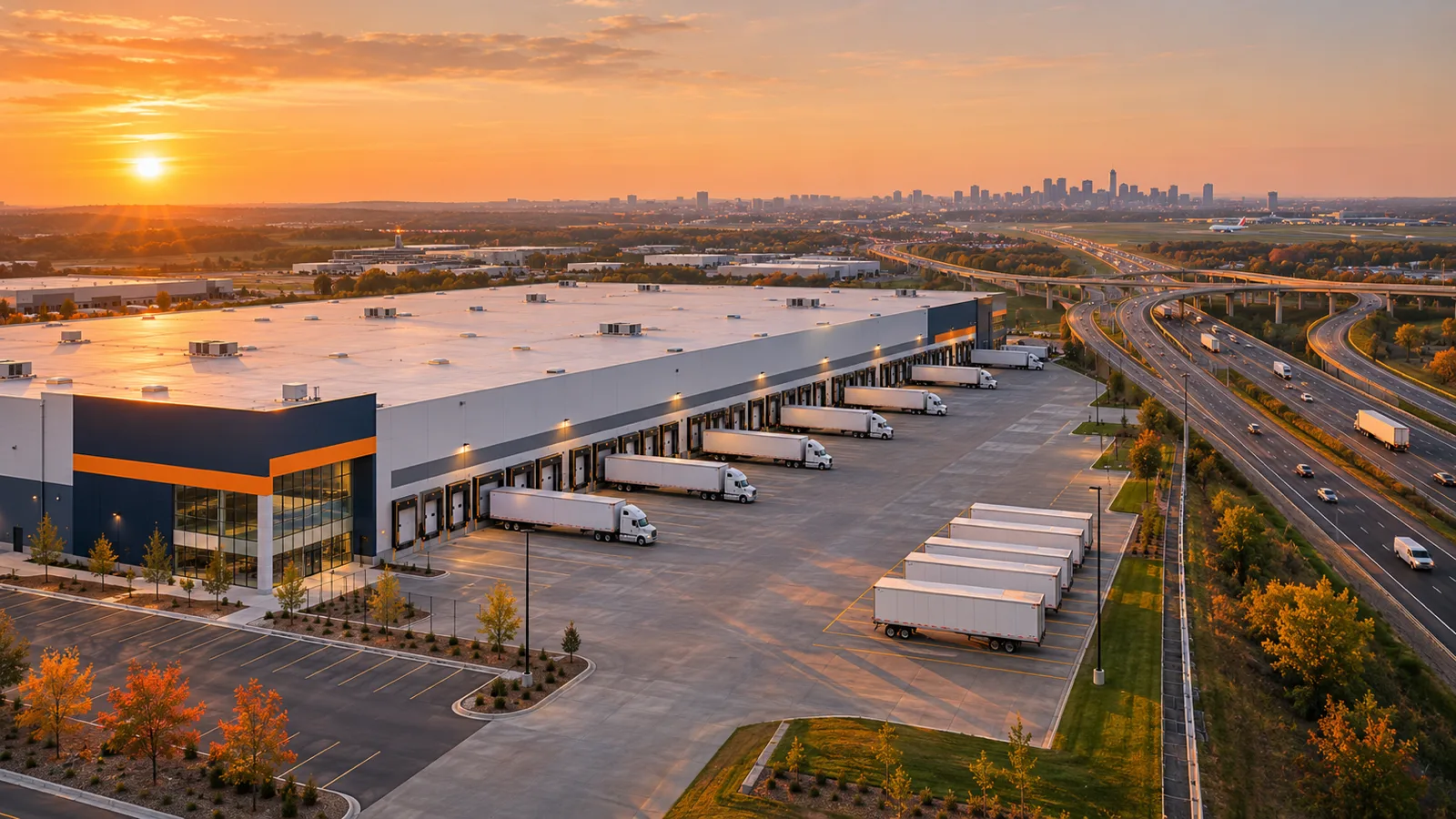
Picture a growing housewares brand that has outgrown its first warehouse in a strip unit north of the city. Orders now come from Halifax, Calgary, Buffalo and Chicago, and the founder is staring at two lease proposals: one in a cheaper rural township an hour out, and one in the industrial belt around Toronto Pearson. The rural rent looks attractive on paper. Then someone does the maths on linehaul, labour and the number of customers who can be reached in a day, and the picture changes.
That conversation happens constantly in the Greater Toronto Area, and the answer very often points to Mississauga. The city has become one of the densest concentrations of warehouse and distribution space in Canada, and not by accident. Its highways, its airport, its labour pool and its position on the main corridor between Montreal, Detroit and Buffalo make it a natural place to put inventory that needs to move quickly in several directions at once.
This article walks through the factors that make the location work, the trade-offs that come with it, and how to decide whether you should run your own building in Mississauga or plug into a third-party network that already operates there.
The geography: a crossroads, not an endpoint
Most distribution centres are judged on a simple question: how many of your customers can you reach, how quickly, and at what cost? Mississauga scores well because it sits at the junction of nearly every major road out of the GTA.
- Highway 401 runs east-west across the north of the city, linking to Kingston, Montreal and Quebec in one direction and London, Windsor and the Ambassador Bridge to Detroit in the other.
- Highway 403 and the QEW head southwest toward Hamilton, the Niagara region and the Peace Bridge and Lewiston-Queenston crossings into New York State.
- Highway 407 ETR gives a tolled but usually faster bypass across the top of the region when the 401 is congested.
- Highways 410 and 427 connect north into Brampton and Vaughan and south to the lakeshore, tying together the industrial parks that surround the airport.
The practical effect is that a truck leaving a dock in the Gateway or Airport Corporate Centre area can be on a 400-series highway within minutes and heading toward almost any major market in Ontario and Quebec. Southern Ontario and a large part of Quebec are within same-day or next-day ground reach, and many dense US markets in New York, Pennsylvania, Ohio and Michigan are commonly reachable in one to two days by ground, depending on the carrier and service level.
Why "middle of the corridor" matters
Canada's population is concentrated along a thin band near the US border, and the Windsor-to-Quebec City corridor holds a large share of it. A distribution centre at the centre of that band can serve both ends without a second building. If you locate too far east or west, you lengthen transit for half your customers. Mississauga's position near the middle of the corridor, but still on the western side of Toronto where the US crossings are closer, is a big part of its appeal.
Toronto Pearson changes the calculation
Toronto Pearson International Airport sits on Mississauga's northeastern edge and is the busiest air cargo gateway in the country. For a distribution operation, that brings two advantages.
First, it shortens the path for imports arriving by air. Goods that land at Pearson can clear customs and be at a nearby warehouse the same day rather than travelling hours by road from another gateway. Many customs brokers, freight forwarders and sufferance warehouses are clustered in Malton and the area around the airport for exactly this reason.
Second, it makes urgent outbound shipments practical. If a hospital in Winnipeg needs a replacement device tomorrow, or a retailer in Vancouver needs a rush replenishment, air options leave from a few kilometres away. Businesses in sectors like healthcare and high-value electronics often place inventory near Pearson precisely so that the overnight air option exists when it is needed, even if most volume moves by road.
Reaching the US from Mississauga
For Canadian brands selling into the United States, or US brands holding Canadian inventory, the border is the critical constraint. From Mississauga, the main options are:
- Niagara crossings (Peace Bridge, Lewiston-Queenston, Rainbow Bridge for passenger traffic) via the QEW, serving Buffalo, upstate New York and points along the I-90 corridor toward the eastern seaboard.
- Ambassador Bridge and the Detroit-Windsor corridor via the 401, serving Michigan, Ohio, Indiana and Chicago-bound lanes.
- Air cargo out of Pearson for time-critical shipments where road transit would be too slow.
Having two major land crossings within a reasonable drive gives you flexibility. If one bridge is backed up or a carrier's lane is disrupted, there is a realistic alternative. That redundancy is harder to find in other Canadian markets.
Cross-border distribution still requires paperwork discipline. Commercial invoices, accurate HS classification, CUSMA certification of origin where it applies, and a customs broker you trust all matter more than the bridge you choose. Since CBSA moved importers onto the CARM portal, Canadian importers also need their own accounts and security arrangements in order. If you are setting up a flow in either direction, our cross-border shipping team can help you plan the documentation as well as the transport, and our guide to duties and taxes in cross-border e-commerce covers the cost side.
Labour and the carrier ecosystem
A building is only as good as the people and partners around it. Mississauga and neighbouring Brampton have a large, experienced warehouse workforce, and the area's transit links, including MiWay and Brampton Transit routes to the major industrial parks, make shift work more practical than in more remote locations. That doesn't make hiring easy, especially in peak season, but the pool is deeper than in most of Canada.
The carrier ecosystem is just as important. Nearly every national parcel carrier, LTL network and truckload fleet operates terminals in or near Mississauga. That density has practical benefits:
- Later pickup cut-offs, because carriers' sortation hubs are close by.
- More competitive rates on outbound lanes, since many carriers want freight originating from the area.
- Easier recovery when something goes wrong, because a replacement truck or a second carrier is rarely far away.
- Access to specialised services such as temperature-controlled trucking, white-glove delivery and dangerous goods carriers.
A shipper using a carrier management approach can play these options against each other lane by lane instead of relying on one provider for everything.
The trade-offs you should be honest about
None of this means Mississauga is the right answer for every business. Several factors cut the other way.
Real estate cost and availability
Industrial space near Pearson and along the 401 is in high demand, and lease rates are typically well above what you would pay in smaller Ontario towns. Vacancy has swung over the years, and in tight periods good buildings with enough clear height and dock doors can be hard to find. Smaller operators may find that the minimum practical footprint is more than they need.
Congestion
The 401 through the GTA is one of the busiest stretches of highway in North America. Rush hour on the 401, 403 and 410 can add real time to local deliveries and pickups. Good operators schedule around it, use the 407 when it pays off, and plan dock appointments for off-peak windows, but congestion is a cost you have to manage rather than ignore.
Your customers may not be where you think
If most of your demand is in Western Canada, a Mississauga building alone can mean long, expensive transit to Alberta and British Columbia. Some businesses handle that with a second node in the west; others accept longer delivery windows for those regions. Look at your actual order data by postal code before deciding.
Matching the location to your operation
Different types of businesses get different things out of a Mississauga footprint. A few examples of how the fit varies:
- E-commerce brands benefit from late carrier pickups and broad next-day ground coverage across Ontario and Quebec, which helps them hit delivery promises without paying for air.
- Retail suppliers shipping to big-box distribution centres gain from short lanes to many of those DCs, which are themselves clustered in the GTA, and from easy access to LTL and truckload carriers.
- Food and beverage companies can use the region's cold storage and refrigerated carriers to keep chilled and frozen products moving within the cold chain.
- Healthcare and medical device firms value proximity to Pearson for urgent shipments and to the many hospitals in the GTA.
- Importers landing containers at the Port of Montreal or the Port of Vancouver often rail them into intermodal terminals around Brampton and the GTA, then transload close by.
Build, lease or outsource?
Once you're convinced Mississauga is the right place, the next decision is how to be there. There are three broad paths.
Leasing and running your own building
This gives you full control over layout, staffing and systems. It also means a multi-year lease commitment, racking and material handling equipment, a warehouse management system, insurance, and the job of recruiting and managing staff. It tends to make sense when volume is large and stable, and when your handling needs are unusual enough that a shared operation would struggle.
Dedicated space operated by a 3PL
A middle route is dedicated warehousing, where a logistics provider runs a defined area or building for you. You get a footprint sized to your needs and your own processes, but the provider handles labour, systems and carrier relationships.
Shared distribution warehousing
For many growing brands, the most flexible option is shared space, where you pay for the pallet positions, picks and services you actually use. Distribution warehousing in a multi-client facility lets you access the location's advantages without signing a lease, and scale up or down as demand changes.
Whichever way you go, it is worth reading our piece on why businesses need warehousing and distribution services to make sure you are comparing like with like.
Questions to ask before you commit
Whether you are touring buildings or interviewing providers, run through these questions:
- Where are my customers by postal code and ZIP code today, and where will they be in three years?
- What share of my volume is parcel, LTL and full truckload, and does the site handle all three well?
- How far is the site from the 401, 403 or 410 on-ramp, and what does traffic look like at my likely pickup times?
- Do I need temperature control, secure caged areas, or dangerous goods handling?
- What are the carrier pickup cut-off times, and how many carriers already collect from this site daily?
- How will inventory be visible to me, and does the warehouse system integrate with my store, ERP or marketplace?
- What happens in peak season: is there capacity to absorb a surge without missing ship dates?
Answering these with real data will tell you much more than a rent comparison alone. The cheapest building is rarely the cheapest operation once freight and labour are counted.
Getting set up in Mississauga with ShipCarte
ShipCarte offers warehousing, fulfillment and freight services built around the strengths of the Greater Toronto Area, with technology that gives you visibility into inventory and orders across channels. If you are weighing a distribution centre in Mississauga, or deciding whether to move from your own building to a third-party model, we can look at your order profile and lanes with you. Schedule a consultation or request a quote and we'll walk through the options that fit your volume.