
Picture a skincare brand run out of a townhouse in Churchill Meadows. For the first year, the founder packs every order at the dining table, prints labels on a thermal printer balanced on a bookshelf, and drops parcels at the post office on the way to pick up the kids. Then a single influencer mention lands 400 orders over a weekend. By Tuesday, the basement is a maze of boxes, customers are emailing about tracking numbers, and the founder has not answered a wholesale inquiry in a week.
That moment, when packing orders stops being a chore and starts being the bottleneck, is where most online brands begin looking at ecommerce fulfillment in Mississauga. The city is one of the most practical places in Canada to run inventory from: it sits beside Toronto Pearson, it is wrapped by Highways 401, 403, 407, 410 and 427, and it is a short drive from the largest concentration of consumers in the country. But location alone does not fix a messy operation. What fixes it is understanding how fulfillment actually works and choosing a setup that fits where your brand is today and where it is going.
This guide walks through the decisions in the order most growing brands face them, from knowing when to outsource to measuring whether your fulfillment partner is doing a good job.
What Ecommerce Fulfillment Actually Covers
People often use "fulfillment" to mean "shipping," but the work starts long before a label is printed. A complete fulfillment operation handles several linked stages, and a weakness in any one of them shows up later as a late order or an unhappy customer.
- Receiving: unloading inbound shipments from your manufacturer or supplier, counting units against the purchase order, and flagging shortages or damage.
- Putaway and storage: assigning each SKU to a bin, shelf or pallet location so it can be found quickly.
- Order intake: pulling orders automatically from your store or marketplace into a warehouse system.
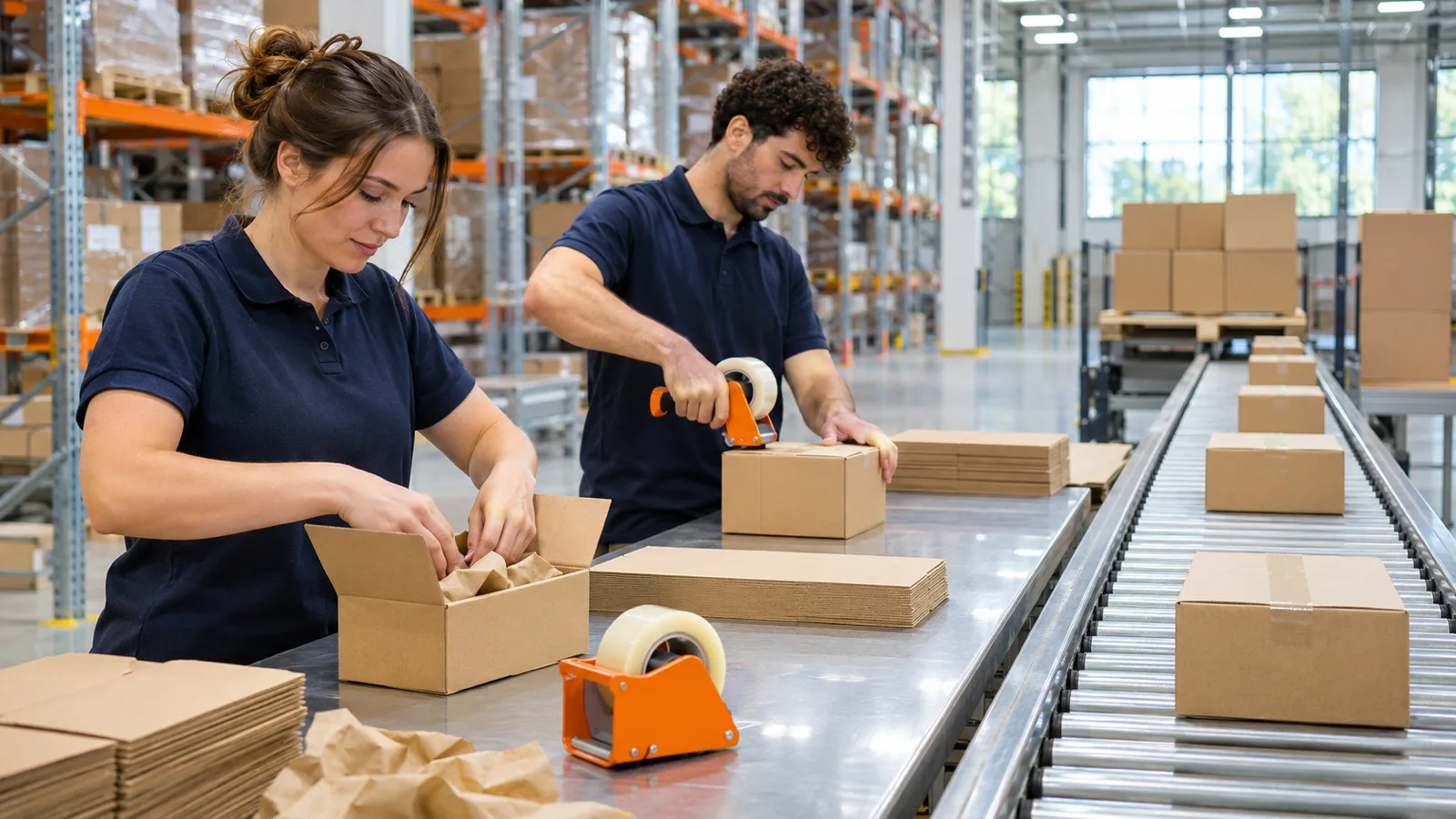
- Picking and packing: retrieving the right items, choosing the right box or mailer, adding inserts, and sealing the package.
- Shipping: rating carriers, printing labels, and handing parcels off for pickup.
- Returns: receiving items back, inspecting them, and deciding whether they go back into sellable stock.
When you outsource ecommerce fulfillment, you are handing all of these steps to a third-party logistics provider (3PL). If you want a refresher on how that relationship works in general, our post on what a 3PL does for an online business covers the basics.
Why Mississauga Works So Well as a Fulfillment Base
Brands sometimes assume they need a warehouse in downtown Toronto to reach Toronto customers quickly. In practice, a Mississauga location often reaches more of Ontario faster, because the city sits at the junction of the major highways rather than behind them.
Highway and carrier access
Industrial areas such as Gateway, Meadowvale and the Airport Corporate Centre are minutes from Highway 401 and Highway 407, with Highway 410 and Highway 427 feeding north and east. Major parcel carriers run large sortation facilities in and around Peel Region, so parcels tendered late in the afternoon can often be injected into carrier networks the same evening. For a brand selling across Ontario and Quebec, that geography helps keep ground delivery times short without paying for express services.
Airport proximity
Toronto Pearson is Canada's busiest airport for both passengers and air cargo. For brands that ship time-sensitive orders to Western Canada or that receive air freight from overseas suppliers, being close to the airport cuts out a leg of local transport and reduces the chance of a missed cutoff.
Cross-border reach
Mississauga is roughly an hour and a half to two hours from the Peace Bridge in Fort Erie and the Lewiston-Queenston Bridge in Niagara, depending on traffic, and within a day's drive of the Ambassador Bridge in Windsor. That makes it a sensible base for brands that sell into the United States as well as Canada. Our cross-border shipping team works with these routes daily.
Five Signs It Is Time to Outsource
There is no universal order volume at which outsourcing becomes the right choice. Instead, watch for these operational signals:
- Packing time is crowding out growth work. If the founder or marketing lead is spending most afternoons packing, the business is paying a very expensive hourly rate for fulfillment.
- Your space is full. Storage units, garages and spare rooms do not scale, and they usually lack proper shelving, climate control or security.
- Error rates are creeping up. Wrong variants, missing items and duplicate shipments tend to rise as volume grows and as you add helpers who do not know the product as well as you do.
- Shipping costs feel unpredictable. Small senders rarely get the parcel rates or surcharge visibility that a high-volume shipper negotiates.
- You are adding sales channels. Running a Shopify store, an Amazon listing and a few wholesale accounts from the same shelf quickly becomes an inventory-accuracy problem.
If two or more of these describe your business, it is worth getting a proper fulfillment quote, even if you decide not to switch right away. The quote process itself forces you to gather data you probably need anyway.
Getting Your Data Ready Before You Talk to a 3PL
The more accurate the information you bring to a fulfillment conversation, the more accurate the pricing and onboarding plan will be. Before reaching out, gather:
- Monthly order volume for the past 12 months, including your peak month.
- Average units per order and the most common order combinations.
- Number of active SKUs, plus dimensions and weights for each.
- How inventory arrives: loose cartons by courier, palletized LTL, or full containers.
- Packaging requirements: branded boxes, tissue paper, inserts, gift notes.
- Where your customers are located, broken down by province and, if relevant, US state.
- Your current return rate and how returns should be handled.
Do not worry if your numbers are rough. A good 3PL will help you fill gaps. But a brand that knows its average order weighs 1.2 kg and ships mostly to Ontario will get a far more useful estimate than one that says "we ship a few hundred orders a month."
How Fulfillment Pricing Is Usually Structured
Fulfillment pricing varies widely between providers, and it changes with your product mix, so be wary of any article that quotes a single number. What you can understand ahead of time is the structure. Most 3PL invoices are built from a few components:
Receiving fees
These are charged when inventory arrives, often per pallet, per carton or per hour of labour. Shipments that arrive well labelled and sorted by SKU are faster to receive, which typically keeps this line lower.
Storage fees
Storage is commonly billed per pallet position, per shelf or bin, or per cubic foot each month. Slow-moving stock is the biggest driver here, so it pays to review aged inventory regularly.
Pick and pack fees
Usually charged per order plus a smaller amount for each additional item. Custom packaging, inserts, or gift wrapping can add to this line. Our pick and pack services page explains the steps involved.
Postage
The carrier cost to deliver the parcel. Because 3PLs ship large combined volumes, many can pass along better rates than a small brand would get on its own, but postage still depends on weight, dimensions, distance and service level.
Packaging materials
Boxes, mailers, void fill and tape may be billed separately or bundled into the pick fee. If you supply your own branded boxes, clarify how they will be stored and counted.
When comparing quotes, model them against a real month of your orders rather than looking at the headline per-order fee. A provider with a slightly higher pick fee but lower storage charges can easily come out cheaper for a brand with many slow SKUs.
Integrations: The Part Customers Never See
Your customers never see the connection between your store and the warehouse, but they feel it immediately when it breaks. Before signing with any fulfillment provider, confirm how orders flow in and how tracking flows back.
For Shopify brands, look for a native connection that pulls orders automatically, syncs inventory levels back to your storefront, and pushes tracking numbers to the customer without manual uploads. ShipCarte's Shopify fulfillment service and wider integrations are built around that flow. If you also sell on Amazon, Walmart Marketplace or through wholesale EDI, ask how those channels draw from the same inventory pool so you do not oversell.
Ask, too, what visibility you will have. You should be able to log in and see stock on hand, orders in progress, shipped orders with tracking, and inbound shipments without emailing anyone.
A Walkthrough of the First 60 Days
Switching to a 3PL is less dramatic than many founders expect, but it does need a plan. Here is how onboarding typically unfolds for a brand moving inventory into a Mississauga warehouse.
Weeks 1 to 2: setup
You share your SKU list with dimensions, weights and barcodes. The store integration is connected in a test mode. Packaging rules are documented: which box for which order type, what goes inside, and any special instructions for fragile or high-value products.
Weeks 2 to 3: inbound
Inventory is shipped in. If it is coming from your home or a previous 3PL, label every carton clearly with SKU and quantity. If it is coming from an overseas factory, make sure the supplier knows the receiving requirements before the container is loaded. The warehouse counts everything and you reconcile those counts against your records.
Week 3 to 4: go-live
Orders start flowing. Expect to spend the first week checking daily: are orders shipping on time, are the right inserts going in, are tracking numbers reaching customers? Small corrections are normal here.
Weeks 5 to 8: settling in
Once the basics are running, you can start tuning. Review which box sizes are being used most, look at carrier mix and delivery times by region, and set reorder points so you are not caught short. Plan a sales promotion only after this period, not during the first week of go-live.
Metrics Worth Tracking After You Switch
Outsourcing fulfillment does not mean you stop paying attention. It means you shift from doing the work to measuring it. The most useful numbers for a growing brand are:
- Order accuracy: the share of orders shipped with the correct items and quantities.
- Dock-to-stock time: how long it takes from inbound arrival to inventory being available for sale.
- Ship-on-time rate: the share of orders leaving the building within the agreed cutoff.
- Transit time by region: how long parcels take to reach customers in Ontario, Quebec, the Prairies, British Columbia and the US.
- Inventory accuracy: how closely system counts match physical counts during cycle counts.
- Cost per order: total fulfillment and postage spend divided by orders shipped.
For a deeper list, our article on the top logistics KPIs covers more metrics and how to use them. ShipCarte clients can see much of this in the reporting and analytics dashboard rather than building spreadsheets by hand.
Common Mistakes Growing Brands Make
A few patterns come up again and again when brands move to outsourced fulfillment:
- Sending messy inventory. Mixed cartons without labels slow receiving and create count discrepancies that take weeks to untangle.
- Over-complicating packaging. Hand-tied ribbons and five different inserts look lovely but add labour on every order. Keep the unboxing special without making it slow.
- Ignoring dimensional weight. A light product in an oversized box can cost far more to ship than expected. Cartonization tools help pick the smallest suitable box automatically.
- Launching a big promotion during onboarding. Give the new setup time to stabilize before pushing volume through it.
- Forgetting about returns. Decide in advance whether returned items are restocked, inspected, refurbished or written off.
Talk to ShipCarte About Your Fulfillment
If your brand is outgrowing its packing table, a Mississauga-based fulfillment setup can give you room to grow, faster delivery across Ontario, and a clearer view of what each order really costs. ShipCarte offers ecommerce fulfillment, warehousing, parcel shipping and returns management under one roof, connected to the platforms you already sell on. Request a quote with your order history and SKU list, or schedule a consultation to walk through your operation with our team.