
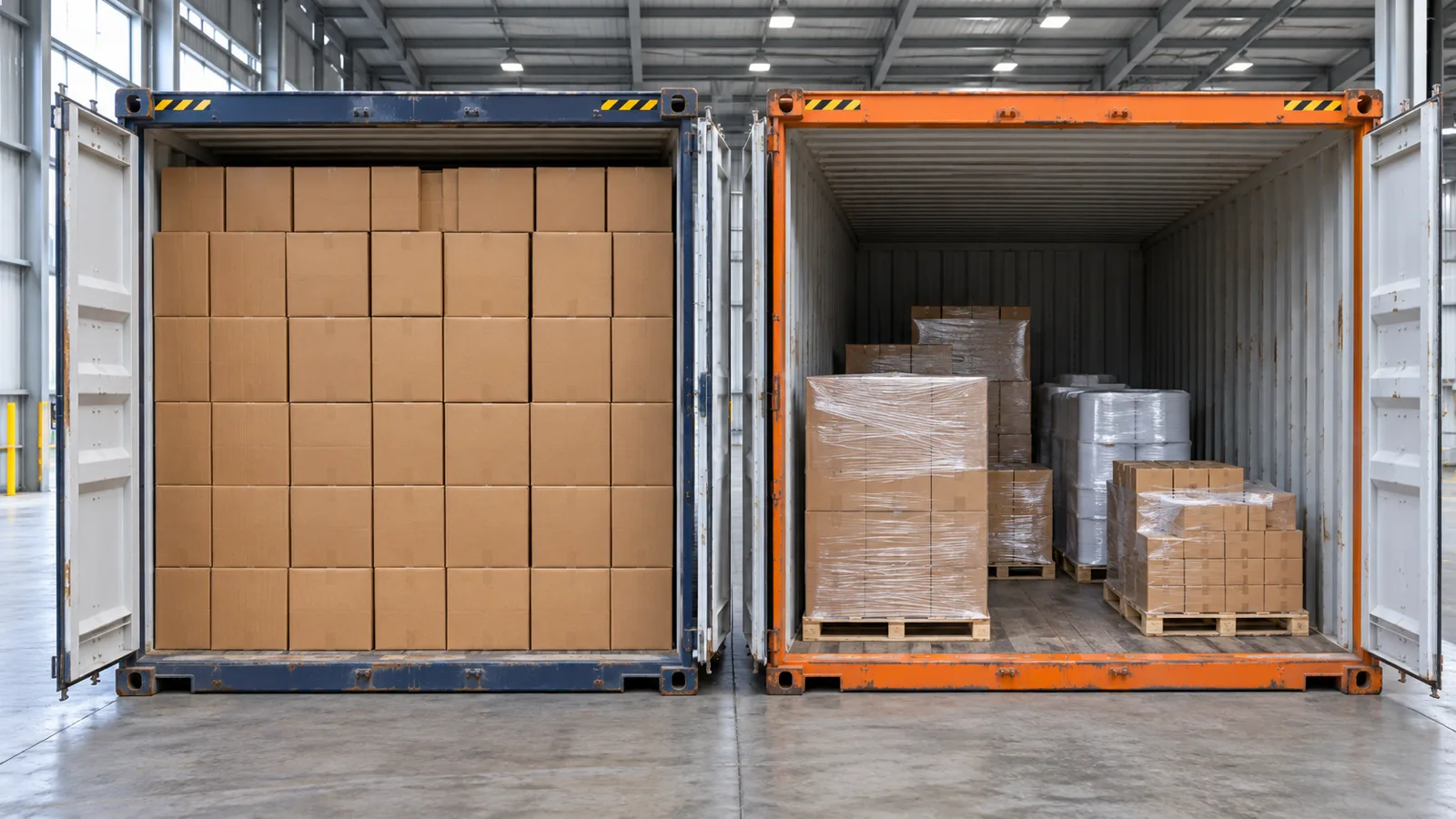
Every importer reaches the point where the purchase orders get big enough that the question becomes unavoidable. Your supplier in Ningbo or Ho Chi Minh City has twelve cubic metres ready to ship. Do you send it as a shared, less-than-container-load (LCL) consignment, or pay for a full 20-foot container even though it will travel partly empty? Next quarter it might be twenty-five cubic metres. Then forty.
The decision between full container load (FCL) and LCL is rarely just about the freight rate. For importers in Canada it is also about how long goods sit at a container freight station in Vancouver or the Greater Toronto Area, how many hands touch your cartons, what happens if a co-loaded shipment is pulled for a customs exam, and how quickly product reaches a warehouse that can actually sell it. Recent years have made the question harder still, with swings in container availability and volatile rates on many trans-Pacific lanes.
This article compares the two options side by side and offers a practical way to decide.
How Each Option Works
FCL: the container is yours
With FCL, you book an entire container, typically a 20-foot, a 40-foot or a 40-foot high cube. Your supplier loads it at their facility or a nearby yard, it is sealed, and it stays sealed until it is opened at your destination or for a customs examination. You pay a rate per container, regardless of how full it is, plus origin and destination charges.
LCL: you share space
With LCL, a consolidator, usually a freight forwarder or a non-vessel operating common carrier (NVOCC), collects shipments from several shippers at an origin container freight station (CFS), loads them into one container, and ships it under a master bill of lading. At the destination, the container goes to a CFS, where it is unloaded, or "devanned", and each shipment is released separately. You pay by volume or weight, typically per cubic metre or per 1,000 kilograms, whichever is greater, plus a range of handling fees at each end. Our explainer on master and house bills of lading covers how that documentation is structured.
Side-by-Side Comparison
Cost structure
FCL: a fixed price per box. The more you fill it, the lower your cost per unit. Fixed origin and destination charges, such as terminal handling, documentation and drayage, are spread over the whole container.
LCL: a variable price per cubic metre that looks attractive for small volumes. But LCL carries extra line items, including origin and destination CFS handling, devanning, documentation and sometimes delivery order fees, that can add up to a significant share of the total on small shipments. Those fees do not shrink much if your shipment is small.
Transit time
FCL: moves directly from the origin terminal to the destination terminal on the booked vessel, then to you by truck or rail.
LCL: adds time at both ends. The consolidator waits until the box is full or the cut-off for a scheduled sailing arrives, and at destination the container must be moved to the CFS, unloaded and sorted before your cargo is available. Depending on the lane and the CFS's workload, that can add several days or more to the door-to-door time.
Handling and damage risk
FCL: your goods are loaded once and unloaded once. If your supplier packs and braces properly, damage risk is relatively low.
LCL: your cartons are handled at the origin CFS, loaded alongside other shippers' freight, unloaded at the destination CFS and loaded again onto a truck. More touches increase the chance of crushed cartons, mixed-up pieces or shortages. Palletising and stretch-wrapping LCL cargo, and marking every carton clearly, reduces that risk.
Customs exposure
FCL: if the CBSA or another agency, such as the CFIA for food or plant products, selects your container for examination, it is your container and your cargo that are held.
LCL: a hold on any shipment in a consolidated container can delay everything in it. If another importer's cargo is flagged, the whole box may be moved for examination before it reaches the CFS, and your cargo waits. You also depend on the consolidator transmitting accurate house bill data to the CBSA under the Advance Commercial Information (ACI) eManifest requirements; marine cargo data generally must be sent 24 hours before the container is loaded at the foreign port.
Flexibility
FCL: you choose the sailing, can load multiple suppliers' goods at a single origin, and can send the container straight to your warehouse or a transload facility.
LCL: you can ship small quantities more frequently, test new suppliers or products without committing to a full box, and avoid holding excess inventory.
Finding Your Break-Even Point
The classic rule of thumb is that once a shipment fills roughly half a 20-foot container, FCL starts to compete with LCL. In practice, the crossover point varies by lane and by market conditions, and in tight markets it can move a long way in either direction. A more reliable approach is to compare the two on a fully landed basis each time you have a decision to make.
Nominal internal volumes are roughly 33 cubic metres for a 20-foot container, 67 for a 40-foot and 76 for a 40-foot high cube, but usable space is always less once you account for carton sizes, pallets and stowage. Many importers plan on loading around 25 to 28 cubic metres in a 20-foot and 55 to 68 in a 40-foot high cube, depending on how cartons stack. Our guide to types of shipping containers covers dimensions in more detail.
To compare properly, collect these figures for both options:
- Ocean freight, including bunker and any peak season surcharges.
- Origin charges: pickup, export clearance, CFS or terminal handling, documentation.
- Destination charges: terminal handling, CFS devanning, delivery order and documentation fees.
- Customs brokerage, plus duties and GST or HST on the import, which are the same either way but affect your cash flow timing.
- Inland delivery: drayage of the full container versus LTL or truckload pickup from the CFS.
- The cost of extra transit days in inventory carrying cost, and the cost of a possible stockout.
Once you have those numbers, the comparison often surprises people. For a shipment of fifteen cubic metres landing in Canada, LCL may show a lower ocean rate but a similar or higher total once destination CFS fees and LTL delivery are added. The opposite is also common: if FCL rates spike on a lane, as they did on several Asia to North America routes late in 2020, LCL can be the better choice even for larger volumes. Our post on calculating landed cost per unit walks through building those numbers into a per-unit figure.
Canadian Factors That Tip the Decision
Where your inventory needs to end up
Asian imports to Canada mostly arrive through the Port of Vancouver or the Port of Prince Rupert, with a share coming through US west coast ports or on all-water services to Montreal and Halifax, routed through the Suez Canal or around Africa depending on conditions. If your warehouse is in Ontario, Quebec or the Prairies, an FCL container can be railed inland on CN or CPKC to a terminal near Toronto, Montreal, Winnipeg, Calgary or Edmonton under one through bill of lading. LCL cargo destined inland is often devanned at a CFS in BC and moved east by LTL, or consolidated into an inland-bound container and devanned at a CFS in the GTA or Montreal. Ask your forwarder where your LCL cargo will be devanned. It makes a real difference to transit time and handling.
Winter and rail disruption
Winter weather in the Rockies and the Fraser Canyon can slow rail movements between the coast and the interior. An FCL container that is already on a railcar moves when the train moves. LCL cargo may wait for consolidation, devanning and then a truck. Neither option is immune to delays, but understanding the extra handoffs helps you set realistic lead times.
Regulated products
Food, health products, cosmetics and plant-based goods may attract additional attention from the CFIA or Health Canada. If your product is regulated, think carefully about the added complication of co-loading in LCL, and make sure your documentation is complete before the container sails.
A Decision Checklist
- Is your shipment under about 10 to 12 cubic metres? LCL is usually the practical choice.
- Is it 12 to 20 cubic metres? Get quotes for both on a landed basis.
- Is it over 20 cubic metres? FCL is usually worth serious consideration.
- Are the goods fragile, high value or easily mixed up? Lean toward FCL, or palletise carefully for LCL.
- Do you need the goods quickly after arrival? FCL generally clears and delivers faster.
- Are you testing a supplier or product? LCL limits your commitment.
- Can multiple suppliers in the same region consolidate into one box? A buyer's consolidation program could turn several LCL shipments into one FCL.
- Can your warehouse handle a floor-loaded container quickly? If not, plan for transloading or palletised loading at origin.
What Happens After the Container Arrives
Whichever option you choose, the freight is only useful once it is received, counted and available to sell. An FCL container needs a dock, labour and time to unload, and the clock is running on carrier free time from the moment it leaves the terminal. LCL deliveries arrive in smaller lots but often without much notice. A warehouse partner that offers distribution warehousing and inventory management can schedule receiving around both, and LTL freight or drayage can be arranged to match.
Plan Your Next Import With ShipCarte
Choosing between FCL and LCL becomes easier with clear landed-cost numbers and a receiving plan in place. ShipCarte helps importers across Canada coordinate inbound freight, receive and store goods, and move them on to customers or stores. To review your import volumes and options, request a quote or schedule a consultation with our team.