
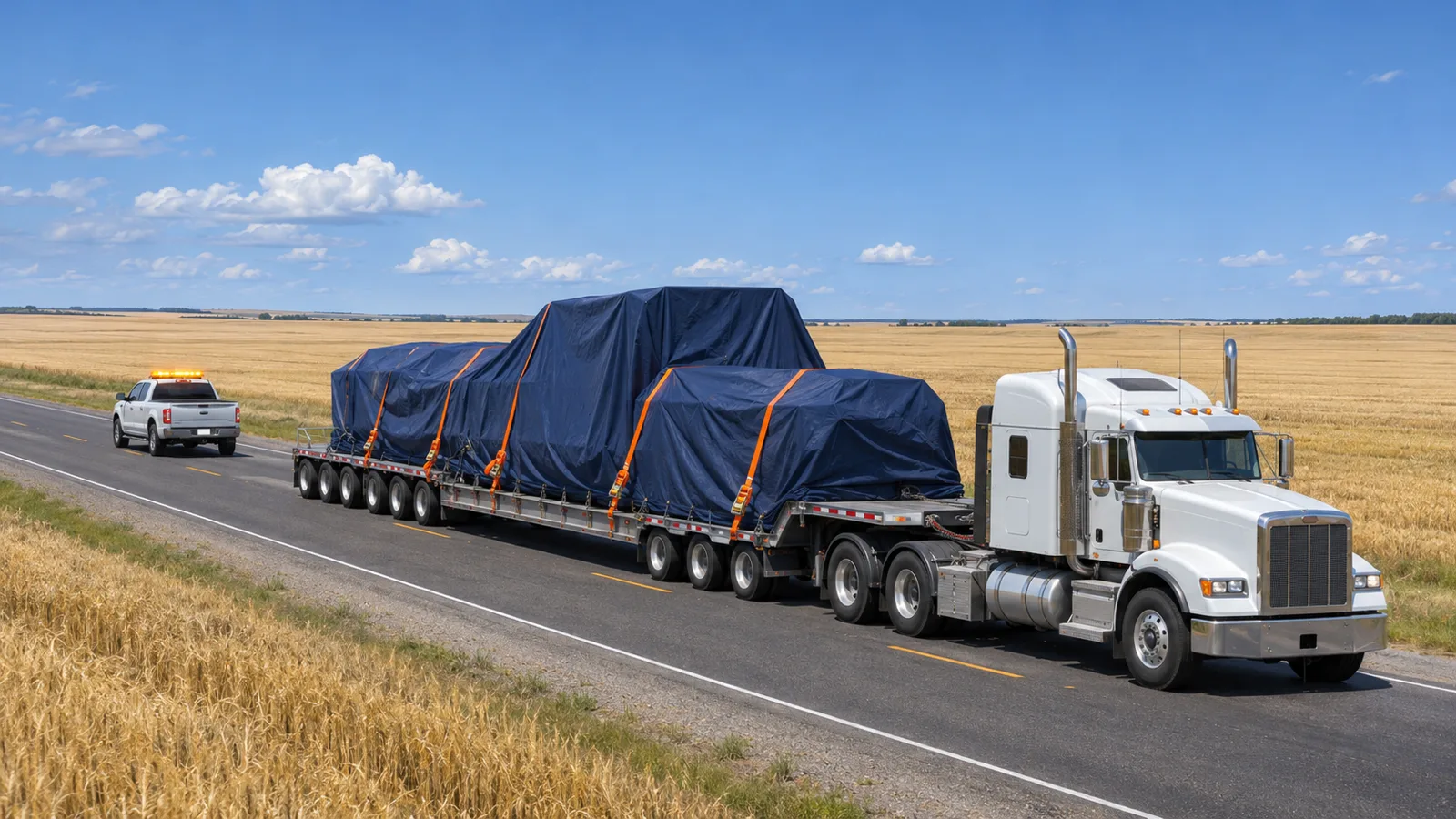
A fabrication shop in Hamilton finishes a large industrial dryer for a food processor in southern Alberta. It is too wide to fit inside a dry van, too tall to load through a standard dock door, and it needs to arrive on a specific day because a crane and an installation crew are booked at the other end. The shop has built the machine perfectly. Now someone has to get it across four provinces without a problem.
Flatbed and oversize freight is a world of its own within Canadian trucking. Loads that go beyond legal dimensions or weights need permits from every province or territory they pass through, sometimes escort vehicles, and careful route planning around bridges, overpasses, construction zones and seasonal restrictions. Done well, it is routine. Done in a hurry, it leads to missed installation dates, expensive standby charges for cranes and crews, or trucks waiting at a provincial boundary for paperwork.
This guide covers the planning sequence for open-deck and oversize shipments in Canada, from choosing equipment to understanding permits, so you know what to ask for and how much lead time to allow.
When does freight need a flatbed?
Open-deck trailers are used when freight cannot be loaded into an enclosed trailer through the rear doors, or when it is too large or heavy for one. Typical examples include:
- Industrial machinery, tanks, vessels and generators
- Structural steel, beams and long lengths of pipe
- Lumber, engineered wood and building materials
- Construction and agricultural equipment
- Modular buildings, sheds and prefabricated components
- Large crated items that must be loaded from the side or top by crane or forklift
Not every flatbed load is oversize. A load of lumber that stays within legal dimensions and weights moves without special permits, just with proper securement and often tarping.
Choosing the right trailer
The trailer determines how tall your freight can be without a permit, so it is one of the first decisions to make.
- Standard flatbed: a flat deck, typically around 48 to 53 feet long. Good for freight that is not especially tall.
- Step deck (drop deck): has an upper deck at the front and a lower main deck, allowing taller freight to stay within height limits.
- Double drop or lowboy: a very low deck between the gooseneck and the rear axles, used for tall and heavy equipment.
- Removable gooseneck (RGN): the front detaches so equipment can be driven onto the deck. Common for construction machinery.
- Extendable and multi-axle trailers: for very long or very heavy freight, with axle configurations designed to spread weight in line with provincial rules.
- Conestoga or curtain-side trailers: a flatbed with a sliding tarp system that offers weather protection while still allowing side or top loading.
A carrier with flatbed experience will recommend a trailer based on your freight's dimensions and weight. Give them exact measurements, the weight, the centre of gravity if known, and lifting points.
Understanding legal limits in Canada
Vehicle weights and dimensions in Canada are regulated by each province and territory. A national memorandum of understanding among governments has harmonised many limits for the main interprovincial routes, but there are still differences, especially on secondary highways and for specific configurations.
As a broad guide, the standard legal width for trucks and trailers in Canada is 2.6 metres, and the usual maximum height is in the range of about 4.15 metres, though limits can differ by jurisdiction and route. Legal length and axle weights depend on the vehicle configuration. If your load exceeds any of these, it becomes an oversize or overweight load and requires permits. Always confirm current limits with the jurisdictions involved or with your carrier, as rules are updated from time to time.
How permits work
Oversize and overweight permits are issued by each province and territory for travel on its roads. A load travelling from Ontario to Alberta passes through Ontario, Manitoba, Saskatchewan and Alberta, so it needs a permit from each one. Some municipalities issue their own permits for city streets as well.
Permits generally specify:
- The exact route the load must take
- Permitted travel days and times, often excluding nights, weekends and statutory holidays for larger loads
- Weather and visibility conditions under which travel is allowed
- Requirements for signs, flags and warning lights
- Whether pilot or escort vehicles are required, and how many
- Any police escort or utility line lifting requirements for very large loads
Routine oversize permits can often be issued quickly, while superloads that are exceptionally large or heavy may require engineering review of bridges and much more lead time. Your carrier normally applies for permits, but the information they need comes from you.
Escort vehicles
Once a load passes certain width, length or height thresholds, provinces require one or more pilot vehicles to travel ahead of or behind the truck to warn other road users. Thresholds and requirements differ by province, and some jurisdictions have specific certification rules for pilot car operators. Escorts add cost, so knowing whether your load crosses a threshold is valuable. Sometimes a small change, such as removing a component or using a different trailer, can bring a load below a threshold.
High-load corridors and routing
Some provinces, notably Alberta, maintain designated corridors where overhead obstacles have been raised or removed to allow taller loads to move more easily. Elsewhere, routing around low bridges, overpasses and power lines can add significant distance. The Trans-Canada Highway and major routes such as Highway 401 are generally best suited to oversize travel, but construction zones and urban areas can impose restrictions.
A planning timeline for oversize freight
- As early as possible: gather specifications. Exact dimensions, weight, centre of gravity, lifting points, and whether any parts can be removed for transport.
- Confirm loading and unloading methods. Who supplies the crane or forklift at each end? Is there space for the truck to manoeuvre? Is the ground firm enough?
- Choose the carrier and trailer. Get quotes from carriers experienced with your type of freight. Ask how they handle permits and escorts.
- Plan the route and secure permits. Allow time for permits in each jurisdiction, and longer for very large loads.
- Coordinate dates. Build in buffer for weather and permitted travel times. Remember that many permits restrict weekend and holiday travel.
- Prepare the freight. Crate or protect sensitive components, drain fluids where required, and mark lifting points.
- Load and secure. The driver is responsible for securement, following the National Safety Code cargo securement standard adopted by the provinces.
- Track and communicate. Keep the receiving site informed so cranes and crews are not waiting.
Season and weather considerations
Canadian geography adds complications that shippers in milder climates do not face:
- Winter conditions can halt oversize travel when visibility or road conditions fall below permit requirements. Mountain passes in British Columbia and routes across northern Ontario are especially prone to closures.
- Spring weight restrictions on secondary roads in many provinces reduce allowable axle weights during the thaw, which can affect heavy loads destined for rural sites. Read our guide on spring road weight restrictions.
- Daylight hours are short in winter, and many oversize permits only allow travel during daylight. That can stretch transit times considerably.
- Tarping and protection matter more when freight is exposed to road salt, snow and freezing rain on an open deck.
Cost drivers to expect
Flatbed and oversize pricing varies widely, but the main drivers are predictable:
- Distance and route complexity
- Trailer type, with specialised trailers costing more than standard flatbeds
- Permit fees in each jurisdiction
- Escort vehicles and, in rare cases, police escorts or utility crews
- Restricted travel times that extend the trip
- Tarping, securement materials and loading assistance
- Empty return miles if the trailer type is rarely needed in the destination region
Ask carriers to itemise these so you can compare quotes on the same basis.
When the freight is part of a bigger project
Oversize freight is often only one piece of a larger shipment. A machine might travel on a flatbed while its controls, spare parts and tooling move in LTL. Coordinating those flows so everything arrives together at the installation site saves time and frustration. Sometimes components need to be staged in a warehouse near the destination until the site is ready.
ShipCarte helps manufacturers and distributors coordinate this kind of multimodal move, combining full truckload and open-deck capacity through our carrier network, LTL freight for accompanying parts, and distribution warehousing for staging. Our manufacturing logistics page explains how we support producers across Canada. If you are weighing whether to book directly with a specialised carrier or through a logistics partner, our comparison of freight brokers and asset carriers may help, and our guide to freight service types covers the broader options.
Preparing the freight on your end
Carriers handle the permits and the driving, but much of what makes an open-deck move go smoothly happens before the truck arrives. Shippers can help by:
- Providing a simple drawing or photos showing dimensions, lifting points and any protrusions
- Removing or securing loose parts, doors and panels that could vibrate free at highway speed
- Protecting finished surfaces, gauges and control panels with crating or shrink wrap before tarping
- Confirming that loading equipment at the origin is rated for the weight and can reach the deck
- Sharing the delivery site's access details, including turning room, overhead wires and ground conditions
A clear handoff saves time at the dock and reduces the chance that a permit has to be amended because the real load differs from what was described.
Questions to ask before you book
- Have you moved this type of freight before, on this kind of route?
- Which trailer do you recommend, and why?
- Who applies for permits, and how long will they take for each province?
- Will escorts be needed? Are they included in the quote?
- What happens if weather or permit restrictions delay the trip?
- What cargo insurance applies, and should I declare a higher value?
Plan your next oversize move with us
Oversize freight rewards early planning more than almost any other type of shipping. Start the conversation as soon as you know the dimensions, and you will have more options and fewer surprises. Request a quote from ShipCarte with your freight specifications, origin and destination, and we will help you plan a safe, compliant move anywhere in Canada.