
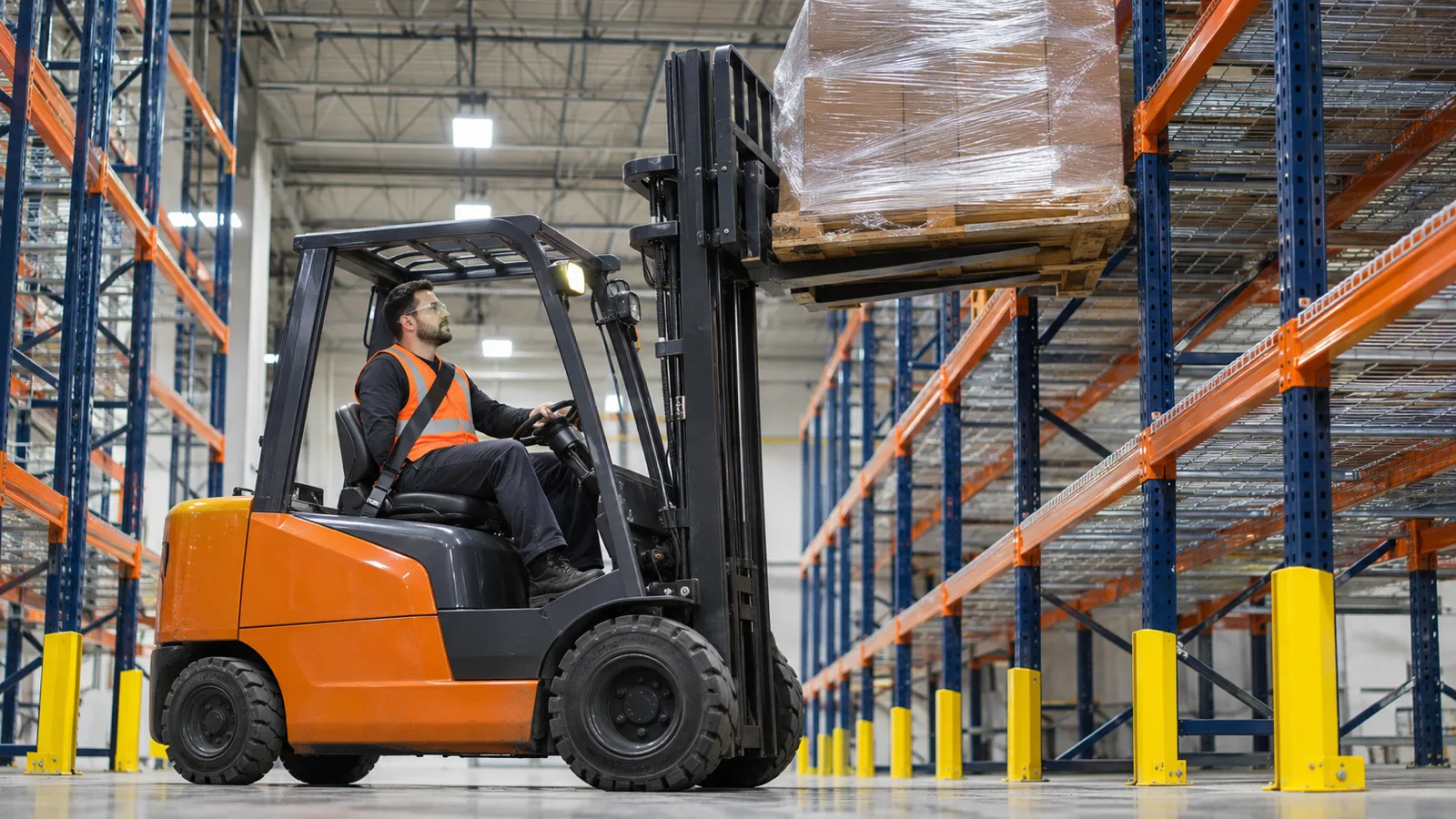
Picture a busy Monday morning in a distribution centre. A reach truck operator is putting away pallets that arrived over the weekend. He backs out of an aisle slightly too close to the upright, the forks clip the base of the frame, and he feels the bump but sees nothing obviously wrong. He carries on. Three weeks later, during a routine walk, a supervisor notices the upright is bent near the floor and the beam above is visibly sagging under a full load. Nobody reported it, and the bay has been loaded and unloaded dozens of times since.
That scenario plays out in warehouses everywhere, and most of the time nothing worse happens. But when it does, the consequences can be severe. Pallet racking holds tonnes of product above people's heads, and forklifts are heavy machines working in tight spaces alongside pedestrians. Together, they account for some of the most serious incidents in Canadian warehouses.
The good news is that most of these incidents are preventable with sound design, regular inspection, proper training and a culture where people report damage without fear. This guide covers the practical basics of racking and lift truck safety for operators across Canada.
Part One: Racking Safety
Start with the right design and installation
Racking should be designed for the specific loads, pallet sizes, building and equipment it will be used with. That means working with a reputable supplier who can provide load capacities, design drawings and installation instructions. In Canada, CSA Group publishes standards for the design and use of steel storage racks that suppliers and engineers commonly work from, and provincial health and safety rules generally require that racking be designed, installed and maintained to safely support the loads placed on it.
Some provinces have additional requirements. In Ontario, for example, installing or modifying certain racking in an industrial establishment can trigger a pre-start health and safety review by a professional engineer. Seismic considerations matter in parts of British Columbia and Quebec, where building codes take earthquake risk into account. Check with your supplier and local authorities before installing or reconfiguring racks, and keep the documentation on file.
Post load capacities and stick to them
Every rack system has a rated capacity per beam level and per bay. Post load signs clearly at the end of each run, in a format workers can read and understand. Common problems include:
- Loads heavier than the beam rating, often after a product change or a new client.
- Beam levels moved without recalculating capacity, which changes the frame's strength.
- Pallets that overhang or are placed off-centre on beams.
- Damaged or poor-quality pallets that can break and drop product.
When product mix changes, review whether the existing rack configuration still fits. A beam level that was fine for lightweight apparel may be unsafe for pallets of canned goods.
Protect the racking from impact
Most rack damage comes from lift truck impacts. Simple protection goes a long way:
- Column guards on uprights at the ends of aisles and in high-traffic areas.
- End-of-aisle barriers to protect the outer frames.
- Wire decking or pallet supports where loads might fall through.
- Back stops or netting where pallets could be pushed off the back of a rack into a pedestrian area.
- Aisles wide enough for the equipment in use, with good lighting.
Inspect on three levels
A tiered inspection approach works well for most warehouses:
- Daily or per-shift checks by operators and supervisors for obvious damage: bent uprights, dislodged beams, missing safety locks, overloaded bays.
- Periodic formal inspections, often monthly or quarterly, by a trained internal person using a checklist and recording findings.
- Expert inspections, typically at least annually, by a qualified rack inspector or engineer who can assess damage against tolerance limits and recommend repairs.
When damage is found, unload the affected bay, cordon it off, and do not reload until it has been repaired or replaced with manufacturer-approved components. Welding or straightening damaged racking without engineering approval is not an acceptable fix.
Make reporting easy and blame-free
The operator in the opening story did not report the bump because he either did not realise its significance or worried about getting in trouble. A rack impact that is reported immediately is cheap to fix. One that is hidden can become a collapse. Tell operators clearly that reporting damage is expected and will not be punished, and act quickly when they do.
Part Two: Forklift and Lift Truck Safety
Operator training and authorisation
Every province requires that lift truck operators be competent, which in practice means formal training covering theory and hands-on operation, an evaluation of the operator on the specific type of equipment they will use, and refresher training at regular intervals or after an incident. CSA Group's safety standard for lift trucks is widely referenced across Canada as a benchmark for operator training and safe operation.
Training on one type of equipment does not automatically qualify someone for another. A counterbalance forklift, a reach truck, an order picker and a powered pallet jack all behave differently. Keep records of who is trained and authorised on what, and do not let untrained workers "just move one pallet".
Pre-use inspections
Operators should inspect their truck at the start of each shift, using a checklist that covers:
- Forks, chains and mast for cracks, wear or damage.
- Hydraulic leaks and fluid levels.
- Tires and wheels.
- Brakes, steering, horn, lights and backup alarm.
- Seatbelt and operator restraint.
- Battery condition and charge, or fuel level for propane trucks.
- Data plate present and legible.
Any truck with a safety defect should be tagged out and removed from service until repaired.
Understand capacity and stability
Every lift truck has a data plate showing its rated capacity at a specific load centre and lift height. Capacity drops as the load centre moves further from the mast and as the load is raised higher. Attachments also reduce capacity. Operators need to understand that a truck rated for a certain weight at a standard load centre may not safely lift that weight if the load is long, uneven or raised to the top beam level.
Tip-overs are one of the most dangerous lift truck incidents. Most happen during turns, on ramps, or when travelling with a raised load. Teach operators to travel with forks low, take turns slowly, go up and down ramps with the load facing uphill, and always wear the seatbelt.
Separate people and equipment
Collisions between lift trucks and pedestrians are among the most serious warehouse incidents. Practical controls include:
- Painted pedestrian walkways and protected crossing points.
- Separate doors for people and equipment where possible.
- Speed limits inside the building, posted and enforced.
- Blue spot or red zone lights on trucks to warn pedestrians.
- Mirrors at blind corners and intersections.
- A rule that pedestrians make eye contact with operators before crossing.
Battery charging and fuelling
Lead-acid batteries produce hydrogen gas during charging and contain corrosive acid. Charging areas should be well ventilated, have eyewash and spill equipment nearby, and be restricted to trained staff. Propane cylinders must be changed and stored safely, away from ignition sources and exits. Make sure workers in these areas understand the hazards under WHMIS.
Winter and cold storage conditions
Canadian winters add hazards that warehouse guides written for warmer climates tend to skip. Trucks that move between a heated warehouse and a cold yard or trailer can pick up snow and ice on their tires, and meltwater on a polished concrete floor makes braking distances longer. Trailer floors may be icy or wet, and dock plates can be slick. Operators should slow down near dock doors in winter, check trailer floors before driving in, and report any wet patches so they can be cleaned up promptly.
In freezer and cooler areas, batteries lose capacity faster, hydraulic fluids thicken and condensation can form on equipment moving in and out. Trucks used in these areas should be rated for the conditions, and operators need suitable cold-weather clothing and limits on continuous exposure. Gloves that keep hands warm but still allow a firm grip on the controls are worth getting right.
Where Racking and Forklifts Meet: Layout and Slotting
Many rack impacts and handling risks come down to layout. Aisles that are too narrow for the equipment, heavy pallets stored on high levels, and fast movers placed in hard-to-reach locations all increase the chance of a mistake. Good slotting, with heavy and fast-moving pallets at lower levels and closer to the dock, reduces lift height, travel and risk at the same time. A warehouse management system can enforce slotting rules and prevent overloads by knowing the weight of each pallet and the capacity of each location.
A Monthly Racking and Forklift Checklist
- Walk every aisle and record any rack damage.
- Confirm load signs are in place and accurate.
- Check column guards and end barriers.
- Review pre-use inspection sheets for recurring defects.
- Check operator training records and refresher dates.
- Look for pedestrian walkway markings that have faded.
- Review incident and near-miss reports for patterns.
Choosing a Warehouse Partner With Safety in Mind
If you store inventory with a 3PL, your goods sit on their racks and are moved by their equipment. Ask about inspection schedules, operator training and how damage is reported and fixed. A provider that takes these seriously is protecting both its people and your product. ShipCarte's distribution warehousing and inventory management services are designed around careful handling and accurate storage. For broader context, our guide to pallet in, pallet out services explains how pallet storage is typically handled and priced.
Let ShipCarte Handle the Heavy Lifting
Running a safe warehouse takes constant attention. If you would rather focus on your business and leave storage and handling to a partner, ShipCarte works with companies across Canada on warehousing, fulfillment and distribution. Request a quote to talk about your storage needs.