
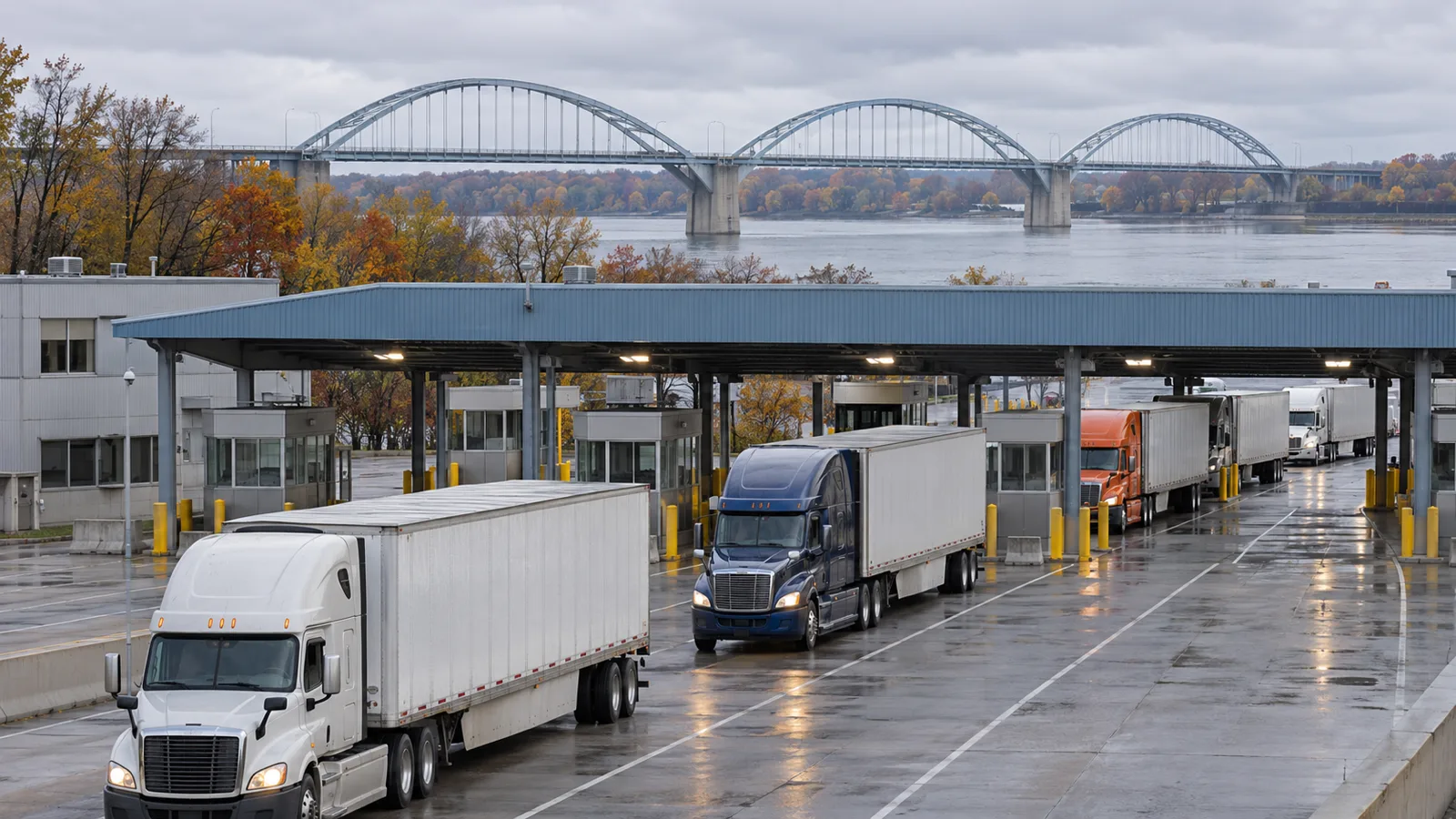
A truck leaves a warehouse in Burlington at 5:30 a.m. with a full load of packaged goods for a distribution centre outside Albany, New York. The driver runs down the QEW past St. Catharines and arrives at the Peace Bridge in Fort Erie by 7:00 a.m., expecting to be on the New York State Thruway within the hour. Instead, the truck spends three hours in secondary inspection in Buffalo because the U.S. customs broker never received the commercial invoice, and the pre-arrival entry could not be processed. The delivery appointment is missed and rebooked for the next day.
Most delays at the Peace Bridge come down to small problems like that one. The bridge itself, opened in 1927 and now one of the busiest truck crossings between Canada and the U.S., handles thousands of commercial vehicles a day, and the vast majority cross without trouble. The ones that get held are usually missing a document, filed late, or arrived at the worst possible time.
For shippers in the Golden Horseshoe, Niagara and the wider GTA, the Peace Bridge is the natural route to Buffalo, Western New York, Pennsylvania and much of the U.S. Northeast. Below are practical tips for using it well, a comparison with the nearby Lewiston-Queenston Bridge, and a look at what a well-run crossing looks like.
Why shippers choose the Peace Bridge
The Peace Bridge links the Queen Elizabeth Way in Fort Erie with Interstate 190 in Buffalo. From there, the New York State Thruway (I-90) heads east to Rochester, Syracuse, Albany and on toward Boston, while I-90 west and I-86 and I-79 lead to Erie, Cleveland and Pittsburgh. For freight bound for New York, New England, Pennsylvania and the Mid-Atlantic, the Peace Bridge is often the most direct crossing from Ontario.
The Buffalo and Fort Erie Public Bridge Authority, a binational body, operates the bridge. Both the CBSA and U.S. Customs and Border Protection run commercial processing at their respective plazas, including FAST lanes for drivers and carriers enrolled in the trusted trader program.
Ten tips for smoother Peace Bridge crossings
1. Get the commercial invoice to the broker early
Your U.S. customs broker needs the commercial invoice, with accurate descriptions, values, HS codes and country of origin, before the truck arrives. Send it when the load is tendered, not when the driver is already on the QEW. The same applies in reverse for northbound shipments and your Canadian broker.
2. Use PAPS and PARS correctly
For southbound loads, the carrier assigns a PAPS (Pre-Arrival Processing System) number and puts a barcode label on the paperwork, and the broker uses that number to file the entry with U.S. customs. For northbound loads into Ontario, the equivalent is a PARS (Pre-Arrival Review System) number filed with the CBSA. A mismatch between the number the carrier transmits and the one the broker uses is one of the most common reasons trucks end up in secondary.
3. Make sure the eManifest goes in on time
Carriers must file advance electronic manifests, ACE eManifest with U.S. Customs and ACI eManifest with the CBSA, before the truck reaches the border, generally at least an hour ahead for regular highway carriers. Confirm that your carrier is set up for both systems and files consistently.
4. Claim NAFTA or CUSMA treatment properly
NAFTA remains in force until the end of June, and qualifying goods cross duty-free with the proper certificate of origin. CUSMA, signed in late 2018 and now ratified by all three countries, takes effect on July 1, 2020. Its rules of origin and certification differ in some respects, so ask your broker what your certificates and records need to look like for shipments crossing after that date.
5. Avoid the busiest hours
The Peace Bridge is busiest on weekday mornings, when overnight loads from the GTA arrive together, and on Friday afternoons. In normal times, passenger traffic surges on long weekends on both sides of the border, including Canadian holidays like Victoria Day and American ones like Thanksgiving. Departure times that put trucks at the bridge mid-morning or early afternoon often cross faster.
6. Check live wait times before committing
Both governments publish border wait times online, and the bridge authority does too. Dispatchers should check them before the truck reaches the Fort Erie exits, and drivers should know when to divert to Lewiston-Queenston if a backup builds.
7. Prepare for regulated products
Food, plants, alcohol, health products, firearms and some chemicals require permits or prior notice in the U.S. or Canada. For example, food shipments to the U.S. require FDA prior notice, and many imports into Canada need CFIA or Health Canada documentation. Dangerous goods restrictions differ between crossings, so confirm the route with your carrier before booking a placarded load.
8. Use FAST carriers for time-critical freight
Carriers and drivers enrolled in FAST, along with shippers and importers in partner programs such as Canada's Partners in Protection and the U.S. C-TPAT program, are eligible for dedicated lanes and reduced inspection. For automotive parts, retail replenishment and other time-sensitive loads, using a FAST-approved carrier can save significant time.
9. Build in time for inspections
Even fully compliant loads are sometimes selected for random inspection, X-ray or agricultural checks. Avoid booking delivery appointments in the U.S. so tight that a one-hour inspection makes the truck late. A buffer of two to three hours on cross-border loads is reasonable.
10. Keep documents consistent
Make sure the bill of lading, commercial invoice, packing list and eManifest all show the same shipper, consignee, piece count and weight. Inconsistencies are a red flag for inspectors and slow everything down.
Peace Bridge vs Lewiston-Queenston
The Niagara region has two main commercial crossings. The Rainbow Bridge and the Whirlpool Bridge do not handle commercial trucks, so trucks choose between the Peace Bridge and the Lewiston-Queenston Bridge, which connects Highway 405 in Niagara-on-the-Lake with Interstate 190 in Lewiston, New York.
- Geography. The Peace Bridge is closer for freight going to Buffalo, Southern Ontario's QEW corridor south of St. Catharines, and destinations south and southwest of Buffalo. Lewiston-Queenston is closer for loads coming down Highway 405 from the QEW near St. Catharines and for destinations north and east of Buffalo, such as Niagara Falls, New York and Rochester.
- Capacity. Both handle large truck volumes, and wait times vary through the day. Checking both before committing is the best approach.
- Restrictions. Rules for certain hazardous loads and oversize shipments can differ, so confirm with your carrier.
- Construction. Both bridges have had maintenance and rehabilitation work in recent years, which can temporarily reduce lanes. Check for current notices.
Many Ontario carriers treat the two crossings as interchangeable and pick on the day based on wait times. For shippers, the main thing is to make sure your broker and paperwork work for either.
E-commerce shipments through Buffalo
The Peace Bridge is also an important gateway for Canadian e-commerce brands shipping to U.S. customers. Many brands truck consolidated orders to Buffalo-area carrier facilities, where parcels are injected into U.S. domestic networks. Shipments valued under the U.S. de minimis threshold of $800 per person per day may qualify for informal entry under Section 321, which keeps costs low. Our article on Section 321 explains how this works, and our cross-border shipping service is built around these consolidated programs.
For brands with growing U.S. demand, a consolidated weekly or daily truck from an Ontario e-commerce fulfillment centre to Buffalo can deliver faster and cheaper than individual international courier shipments.
Northbound loads into Ontario
Importers bringing goods from the U.S. into Ontario through Fort Erie face a mirror image of the southbound process, with a few differences worth noting:
- GST at the border. The CBSA collects GST on most commercial imports. The provincial portion of HST is generally self-assessed or recovered through your HST return rather than paid at the border, but your broker should confirm how it applies to your goods.
- Customs bond or security. Importers using the Release Prior to Payment program need security on file, usually arranged through their broker.
- Business number. The importer needs a CRA business number with an import-export account.
- Regulated goods. Food, plants, animal products, health products and some consumer goods need CFIA, Health Canada or other agency documentation, and the broker must transmit it with the release request.
The CBSA is also modernising how importers account for and pay duties through its CARM project, so expect changes to broker and importer processes over the next few years.
What a good crossing looks like
Here is how a well-run southbound shipment through the Peace Bridge typically unfolds:
- The shipper in Hamilton tenders a load the afternoon before, sending the commercial invoice and packing list to the carrier and the U.S. broker at the same time.
- The carrier assigns a PAPS number, files the ACE eManifest, and confirms the driver has a FAST card.
- The broker files the entry against the PAPS number and receives a release status before the truck reaches the border.
- The driver leaves Hamilton at 9:30 a.m., avoiding the early rush, and checks wait times near St. Catharines.
- The truck crosses the Peace Bridge, clears primary inspection in minutes, and is on the Thruway before lunch.
- The delivery appointment in Rochester or Syracuse is met that afternoon with time to spare.
The reverse process for northbound shipments into Ontario follows the same pattern, with PARS, ACI eManifest and a Canadian broker. For freight between the GTA and Buffalo specifically, see our guide to cross-border freight to Buffalo.
Ship across the Peace Bridge with ShipCarte
The Peace Bridge is a reliable route into the U.S. Northeast when the paperwork, timing and carrier are right. ShipCarte works with Ontario shippers to coordinate carriers, brokers and documentation so loads cross without surprises. Request a quote for your next cross-border shipment, or schedule a consultation to review your U.S. lanes.