
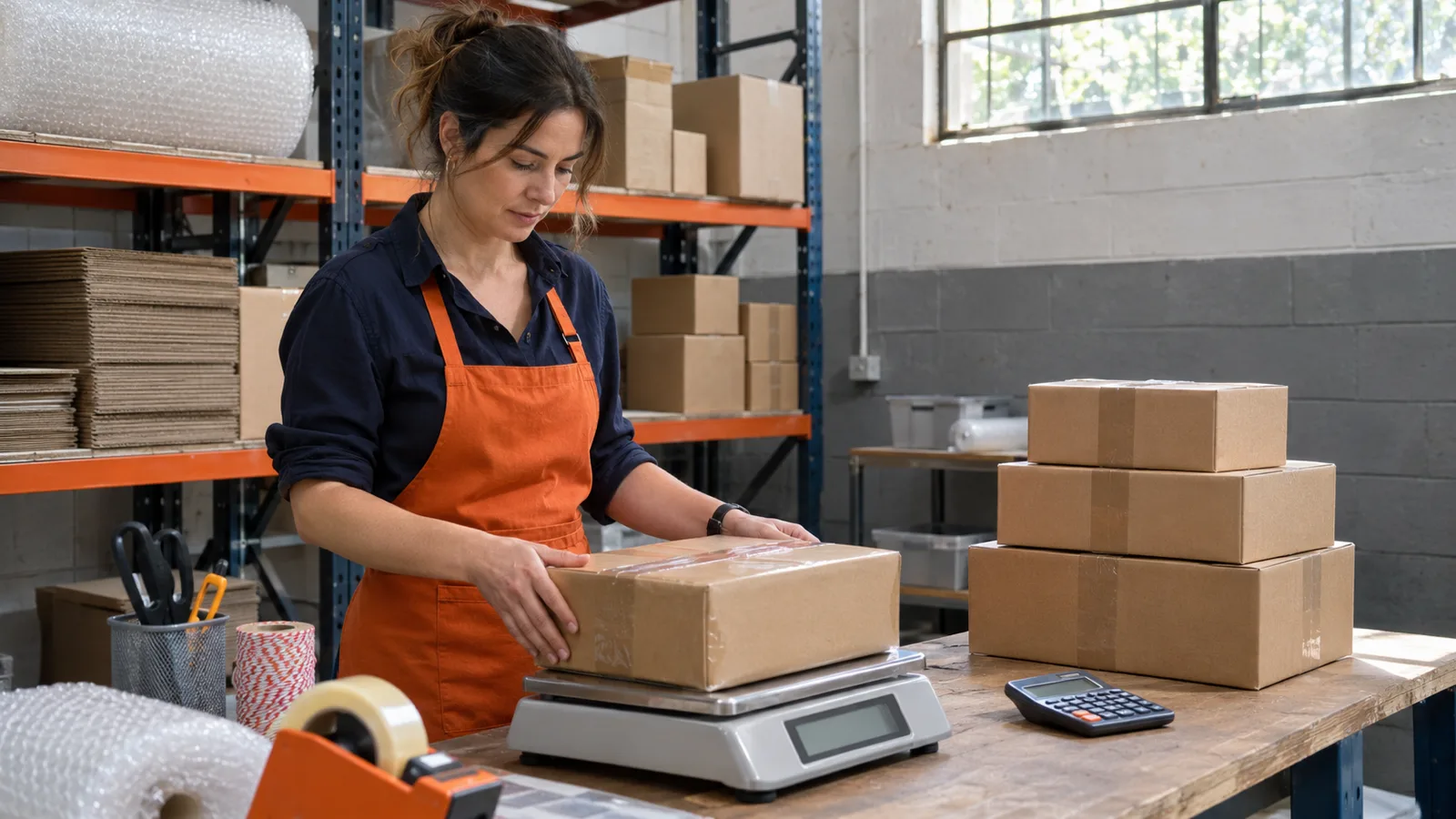
A home goods brand selling from a small warehouse unit in Erin Mills launched free shipping on every order last spring. Conversion went up right away, and the owner was thrilled for about six weeks. Then the accountant ran the numbers. Small orders of a single candle or a set of coasters were shipping to Nova Scotia and British Columbia at a loss, and the bump in sales was coming mostly from exactly those orders.
Free shipping is one of the most powerful levers an online retailer has. Shoppers have come to expect it, and an unexpected shipping fee at checkout is one of the most common reasons carts get abandoned. But shipping is never actually free. Someone pays for it, and if it is not the customer, it comes out of your margin. The goal is not to avoid free shipping. It is to design an offer that gets the sales benefit without handing away the profit.
This article compares the main free shipping models, shows how to calculate a threshold that makes sense for your store and covers the Mississauga-specific advantages that can make free shipping cheaper to deliver than you might think.
Start with your real cost to ship
Before choosing a strategy, find out what shipping actually costs you per order. Many retailers only look at the carrier label cost, but the full cost to get an order out the door includes more than that:
- Carrier charges, including base rate, fuel surcharge and any accessorial fees such as residential delivery, remote area or oversize surcharges.
- Packaging, including the box or mailer, void fill, tape, labels and inserts.
- Pick and pack labour, whether it is your own time or a fulfillment fee.
- Damage, loss and reshipment costs, spread across all orders.
Pull a few months of shipment data and group it by destination region and by parcel size. Look at the cost spread, not just the average. The cost to ship a small parcel from Mississauga to Oakville is very different from the cost to ship a bulky box to the Yukon. Our guide on how package dimensions impact shipping costs explains why the size of your box often matters more than its weight.
Five free shipping models compared
1. Free shipping on everything
The simplest message and the most expensive to run. It works when your margins are high, your average order value is well above your average shipping cost and your products are small and light. It struggles when you sell low-priced items, heavy goods or bulky products.
2. Free shipping over a threshold
The most common model. Orders above a set value ship free; smaller orders pay a fee. Done well, a threshold nudges customers to add one more item, which raises order value and spreads the shipping cost across more margin. The art is in choosing the number.
3. Flat-rate shipping
Every order pays the same fee, regardless of destination or size. It is easy to understand and avoids sticker shock, but you win on some orders and lose on others. Many retailers combine flat rate with a free threshold. If you are weighing this option, see our explainer on what flat-rate shipping means.
4. Shipping cost built into product prices
Prices go up slightly and every order ships free. Customers see one clear number. This can work well for a single-product brand or a store where every item has a similar size. It is harder to do fairly when you sell a wide range of products.
5. Membership or loyalty free shipping
Customers pay an annual fee, or reach a loyalty tier, and get free shipping on every order. This encourages repeat purchases, but it only makes sense if your customers buy often enough to value it.
How to calculate a threshold that protects margin
There is no universal right number, but there is a sensible process.
- Find your current average order value and look at the distribution. Where do most orders cluster?
- Find your average fully loaded shipping cost for orders around that value, using the cost components above.
- Find your gross margin percentage on typical products.
- Work out the order value at which the margin comfortably covers shipping. Divide your average shipping cost by your gross margin percentage. That gives you the order value at which shipping would consume all of the gross profit. Your threshold needs to sit well above that point so there is profit left over after shipping.
- Set the threshold slightly above your current average order value, as long as it is above the break-even point. Many retailers find that a threshold a little higher than what customers usually spend encourages them to add one more item without feeling out of reach.
- Test and watch. Track average order value, conversion rate and shipping cost as a share of revenue for several weeks after any change.
Be careful with a threshold that sits far above what customers normally spend. If it feels unattainable, shoppers ignore it, and you get the cost of shipping on the orders that do qualify without the order-value lift on the rest.
Use zones instead of one national offer
Canada is big, and that is the core challenge for Canadian free shipping. A Mississauga retailer can usually deliver to most of the Greater Toronto Area and southern Ontario by ground in a day or two at modest cost. Shipping to British Columbia, Newfoundland or northern communities takes longer and costs more.
Many retailers handle this with regional offers:
- A lower free shipping threshold for Ontario and Quebec, where ground delivery is fast and cheap.
- A higher threshold, or a flat fee, for Western and Atlantic Canada.
- Paid shipping, or a separate offer, for remote and northern postal codes.
- A separate offer for the United States, where duties, taxes and brokerage come into play.
Most e-commerce platforms, including Shopify, let you set shipping rules by zone. Be transparent about the rules on your shipping page so customers outside Ontario do not feel misled.
Exclude the products that break the math
Some products simply cannot ship free profitably: oversized items, heavy items, fragile goods that need extra packaging and anything that triggers a carrier surcharge. It is fine to exclude these from free shipping, or to set a separate shipping charge for them, as long as you say so on the product page. Customers accept an honest shipping fee for a large item much more readily than a surprise at checkout.
Lower the cost instead of raising the threshold
The cheaper each shipment is, the lower your threshold can be. Before raising your free shipping line, look at the cost side:
- Right-size your boxes. Dimensional weight pricing means a box that is too big costs more to ship. Cartonization software picks the smallest suitable box for each order automatically.
- Use multiple carriers. Different carriers price different zones and parcel sizes differently. Rate shopping on each order, through a shipping platform, can lower the average cost per shipment.
- Use discounted rates. A fulfillment partner that ships high volumes may have access to rates that a single small retailer cannot get on its own.
- Ship from a good location. Mississauga's position next to the 401, 403, 407 and 427, and close to the major carrier sorting facilities around Toronto Pearson, means parcels can enter carrier networks quickly. That helps keep ground services competitive for most Canadian destinations.
- Audit your invoices. Incorrect surcharges and billing errors add up. Our post on reducing shipping costs for an e-commerce business covers more ways to bring the number down.
Communicate free shipping clearly
A good offer only works if customers see it. Display the threshold in the site header or announcement bar. Show a progress message in the cart ("You are $X away from free shipping") so the customer knows exactly how much more to add. Suggest low-cost add-on items near the threshold, ideally products with good margins and small packaging.
Be clear about delivery times, too. Free shipping that takes two weeks frustrates customers. Many retailers offer free standard shipping and a paid expedited option for customers who need an order sooner.
Watch returns
Free shipping and free returns are two different promises. If you offer free returns as well, you pay for two shipments on every returned order. Decide whether returns are free, paid or free only for exchanges. Apparel retailers, in particular, need to consider how free shipping can encourage customers to order multiple sizes and return the extras. A clear returns management process helps keep that cost under control.
Review the strategy every season
Carrier rates change, fuel surcharges move and your product mix evolves. Make a habit of reviewing your free shipping numbers at least twice a year, and again before each peak season. Look at:
- Shipping cost as a share of revenue, overall and by region
- Average order value before and after the threshold change
- The share of orders that qualify for free shipping
- Conversion rate and cart abandonment
- Profit per order by region
A partner with clear reporting and analytics makes this review quicker, because the shipping cost per order is already broken out by carrier, zone and service.
Build an offer that grows sales and keeps margin
Free shipping is a promise to the customer and a cost to the business. The Mississauga retailers who get it right know their true cost per order, set thresholds based on margin rather than guesswork, adjust by region and keep pushing the underlying cost down. If you would like help understanding your real shipping costs and building a stronger offer, request a quote from ShipCarte or schedule a consultation to review your shipping data with our team.