
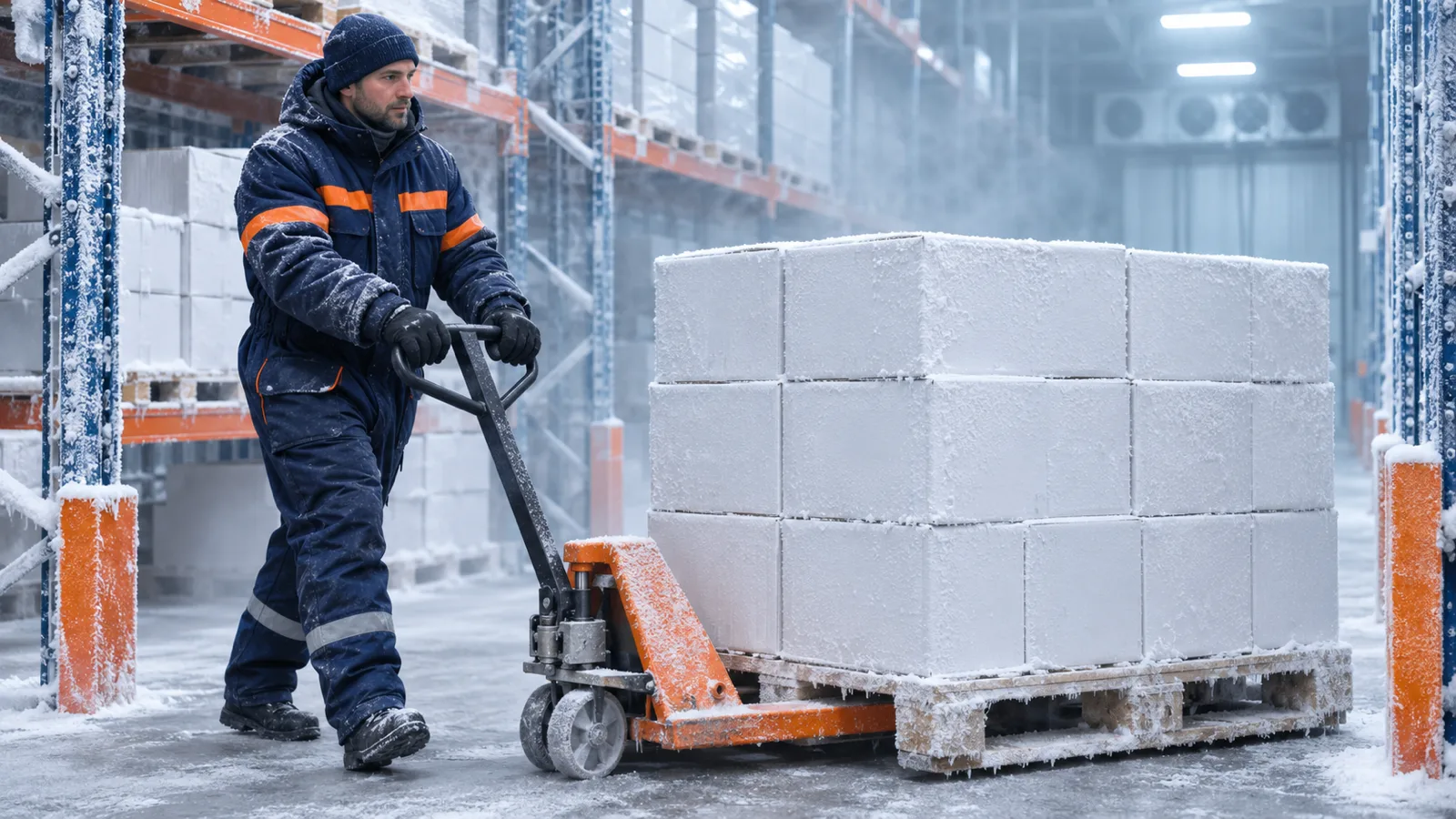
A frozen dumpling maker in Mississauga's Gateway area sells to independent grocers across Ontario and has just been approached by a chain in Atlantic Canada. The recipe is solid and the packaging looks great. The question keeping the owner up at night is simpler and harder: how do you get thousands of cases from a blast freezer near Pearson to store shelves 1,800 kilometres away without a single carton creeping above freezing on the way?
Frozen food is unforgiving. Chilled products have a band of a few degrees to work within, but frozen goods have a hard ceiling. Once ice crystals start to melt and refreeze, texture suffers, glaze forms on the product, and in some categories safety becomes a concern. Buyers know the signs, and a pallet with frost inside the cases or soft corners on the cartons can be rejected at the dock.
The good news is that Mississauga is one of the best places in the country to run a frozen supply chain. This article walks through each link in that chain, from production to final delivery, and points out where product typically warms up and how to stop it.
Why the target is a range, not a number
Most frozen foods are held at or below -18°C, which is the widely used industry benchmark for frozen storage. Ice cream and some seafood are often held colder. Your product's specification, set by your food safety plan and any buyer requirements, determines the actual setpoint. The important idea is that frozen shipping is about holding product below a threshold the entire time, including the minutes it spends on a dock or in a doorway, not only while it is sitting in a freezer.
It also matters that product goes into the chain properly frozen. A reefer trailer or a freezer warehouse is designed to maintain temperature, not to pull heat out of warm product. If cases are loaded before they have reached their core temperature, no amount of equipment downstream will fully fix it. If you want to understand how quick-freezing fits in, our article on flash freezing explains the process.
The cold chain, link by link
Link 1: Production to storage
The first transfer is often the riskiest because it is treated as routine. Product leaves the blast freezer, gets palletized, wrapped and moved to storage. If that happens in an ambient room, or if pallets wait near a dock door while paperwork is sorted out, the outer cases warm first. Keep staging areas refrigerated, wrap pallets quickly, and move them directly into the freezer.
Link 2: Frozen storage
A well-run freezer warehouse maintains a stable temperature with continuous monitoring and alarms, and it rotates stock by production date or best-before date. When you work with a provider offering cold storage, ask how temperatures are recorded, how often, who gets alerted when readings drift, and how long those records are kept. Those records are your evidence if a customer ever questions a shipment.
Link 3: The loading dock
Dock doors are where frozen product most often warms up. A Mississauga summer afternoon can easily be in the high twenties or above, and a trailer that has been sitting in the sun is hot inside. Good practice includes:
- Pre-cooling the trailer to setpoint before loading starts.
- Using dock seals or shelters so the trailer is sealed against the building.
- Loading from a refrigerated dock rather than an ambient one.
- Loading quickly, without leaving pallets sitting in the doorway.
- Recording the product temperature at loading and the trailer reading.
Link 4: Reefer transport
Refrigerated trailers, known as reefers, have their own refrigeration units. For frozen loads, the unit should be set to continuous operation rather than start-stop cycling unless your product spec allows otherwise, and air needs to circulate around the pallets. That means leaving space at the front and rear, keeping load height below the airflow chute, and not blocking the floor channels. Many carriers can provide temperature download reports after delivery, which you should request on every load.
Link 5: The customer's dock
Grocery distribution centres usually check temperature on arrival, often with a probe between cases. Delays at the receiver, such as a trailer waiting hours for a door, are a reefer unit's job to handle, but door-open time during unloading still matters. If you are shipping into a facility with appointment rules, book early and make sure your carrier knows the slot.
Reefer freight versus parcel: choosing the right mode
Not all frozen shipments look like pallets heading to a grocery chain. Many Mississauga food brands also sell direct to consumers online. The two channels need very different approaches.
Pallet freight to retailers and food service
For case and pallet shipments, refrigerated LTL and full truckload are the standard. Refrigerated LTL lets smaller producers share trailer space with other temperature-controlled freight, though not every LTL network handles frozen, and you need to confirm the trailer will be held at a frozen setpoint rather than a chilled one. Full truckload gives you a dedicated trailer at your setpoint for the whole trip. Lanes from Mississauga into Quebec and the Maritimes typically run along Highway 401 and onwards, while western Canada lanes are long enough that transit time and driver hours become major planning factors.
Insulated parcel shipments to consumers
Direct-to-consumer frozen orders usually ship in insulated packaging with refrigerant, most commonly dry ice for frozen product. The package needs to stay frozen for the full transit time plus a buffer for delays. Things to plan for:
- Transit time: Ship by the fastest practical service and avoid sending orders that would sit in a depot over a weekend.
- Dry ice rules: Dry ice is a regulated dangerous good when shipped by air, and carriers have their own packaging, quantity and marking requirements. Ground shipments also have carrier rules. Check with each carrier before you ship.
- Packaging validation: Test your shipper in realistic conditions, including summer heat, before launching.
- Delivery area: Some brands limit frozen delivery to regions they can reach within a set number of days.
Our guide on how to ship frozen foods for e-commerce goes deeper on packaging, and a partner offering cold chain fulfillment can pick and pack consumer orders from a freezer environment.
Regulatory points every frozen shipper should know
Food businesses in Canada work within the Safe Food for Canadians Regulations, administered by the Canadian Food Inspection Agency. Depending on your activities, you may need a licence and a preventive control plan, particularly if you ship food across provincial borders or import or export it. Temperature control is a core part of those plans. Other points worth noting:
- Traceability: You should be able to trace product one step forward and one step back, which means lot numbers and dates must follow your product through storage and shipping.
- Labelling: Consumer packaging sold in Canada needs bilingual labelling and must meet federal food labelling rules.
- Cross-border: Shipping frozen food to the US brings in FDA requirements, including prior notice for food imports, plus customs clearance at crossings such as the Peace Bridge or Lewiston-Queenston Bridge. Delays at the border affect reefer fuel and timing, so documentation must be ready before the truck leaves.
This is general information, and your specific obligations depend on your products and activities. CFIA guidance is the authoritative source.
Why Mississauga works well for frozen distribution
Location matters for frozen freight because every extra hour on the road is another hour of risk. A Mississauga base offers direct access to Highway 401 east and west, the 407 ETR for bypassing core congestion, the 403 and QEW toward Hamilton and Niagara, and the 427 and 410 for Toronto and Brampton. Many grocery and food service distribution centres in the GTA are within a short drive, and Toronto Pearson International Airport is close by for time-critical air shipments. The city's large concentration of food processors also means there is an established network of reefer carriers and temperature-controlled warehouses in the area.
A frozen shipping checklist
Before you ship your next frozen order, run through this list:
- Product is at core temperature before it leaves production.
- Pallets are built, wrapped and moved into the freezer without delay.
- Storage temperature is continuously monitored, with alarms and records.
- Trailer is pre-cooled and checked before loading.
- Loading happens through a sealed, refrigerated dock.
- Reefer setpoint and run mode are written on the bill of lading.
- Load pattern allows airflow around pallets.
- Lot numbers and dates are recorded for every pallet.
- Appointment is booked with the receiver where required.
- Temperature download is requested after delivery.
- For parcel orders, packaging has been tested and dry ice rules are followed.
Where things usually go wrong
When a frozen shipment fails, the cause is rarely the freezer or the reefer unit itself. It is usually a gap between two links: pallets that waited on an ambient dock, a trailer that was not pre-cooled, a reefer set to the wrong temperature because the bill of lading was unclear, or a consumer parcel that sat over a long weekend. That is why it helps to keep as many links as possible under one coordinated process. A provider offering food and beverage logistics can handle storage, picking and carrier coordination with consistent temperature records across each step.
Keep your frozen product frozen
Whether you are a Mississauga producer shipping pallets to grocers or an online brand sending meal kits to customers' doors, the principles are the same: freeze properly, keep every transfer short and cold, and document everything. ShipCarte supports food businesses with temperature-controlled warehousing, cold chain fulfillment and refrigerated freight coordination. Request a quote and tell us about your products, volumes and destinations.