
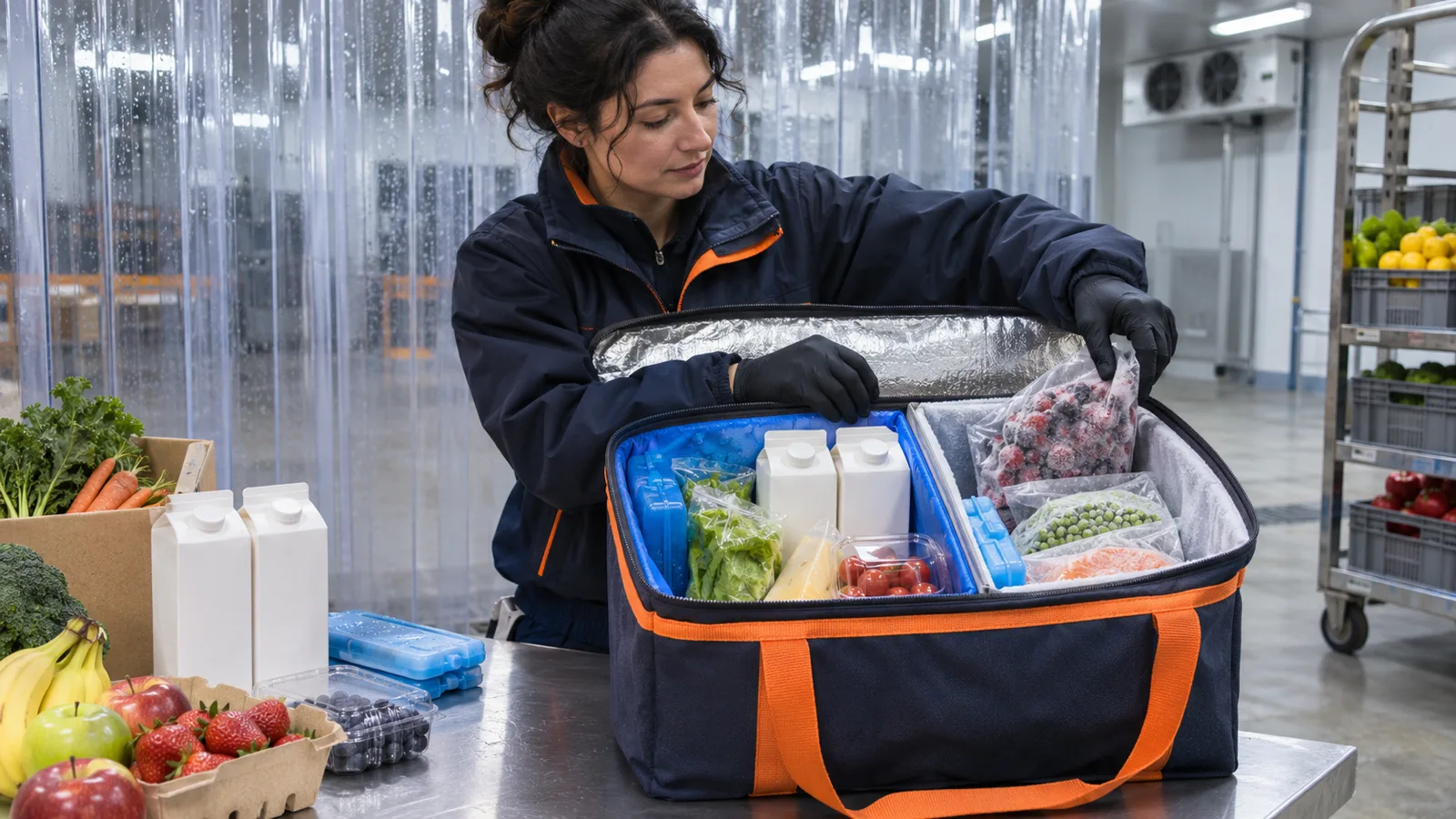
A specialty grocer in Mississauga starts taking online orders. Customers in Churchill Meadows and Erin Mills love the idea: spices and rice, a tub of yogurt, a bag of frozen dumplings and fresh paneer, all in one delivery. Then the first hot July week arrives. The yogurt is warm, the dumplings have thawed into one block, and the rice bag is wet with condensation from a leaking ice pack. The products were fine. The logistics were not.
Mixed-temperature grocery orders are among the hardest things to fulfill well. A single basket can contain shelf-stable items that just need protecting from crushing, chilled items that must stay cold but never freeze, and frozen items that need to stay hard-frozen until they reach the customer's freezer. Each group has its own storage, picking, packing and delivery rules, and yet the customer sees one order and expects one doorstep handoff.
This article follows a single mixed order through every stage, from receiving inventory to the moment the customer opens the bag, and explains what has to happen at each point to keep all three temperature zones intact.
The three zones, defined
Before getting into process, it helps to agree on terms. Exact ranges depend on the product and should follow the manufacturer's guidance and food safety requirements, but broadly:
- Ambient (shelf-stable): dry goods, canned items, snacks, beverages, spices, cleaning products. Stored at room temperature, protected from heat extremes, moisture and pests.
- Chilled (refrigerated): dairy, fresh meat and fish, deli, prepared meals, many fruits and vegetables. Generally kept cold, at or below 4°C, without freezing.
- Frozen: ice cream, frozen meals, frozen meat and seafood, frozen desserts. Generally kept at about -18°C or colder.
Some products sit awkwardly between zones. Bananas, tomatoes and bread do not like the fridge. Some chocolate and gummies suffer in summer heat even though they are technically shelf-stable. A good grocery operation maps every SKU to a zone and notes the exceptions rather than assuming.
Stage 1: Receiving and storage
The order's fate starts long before it is placed. When inventory arrives at the warehouse, chilled and frozen goods should move from the truck into the correct zone quickly, with temperatures checked and recorded on arrival. A refrigerated trailer sitting at a dock door on a summer afternoon near Pearson can warm up faster than people expect.
Each zone needs its own storage: an ambient area, a cooler and a freezer, all with temperature monitoring and alarms. Lot numbers and best-before dates must be captured at receiving so stock can be rotated first-expired, first-out (FEFO) and traced if there is ever a supplier recall. If you are new to these concepts, our posts on FIFO and handling perishable goods in fulfillment are a good starting point.
ShipCarte's temperature-controlled warehousing is built around exactly this kind of zoning, so a brand does not have to juggle separate ambient and cold storage providers.
Stage 2: The order drops
Our example order lands at 9:40 p.m. on a Tuesday: two bags of basmati rice, a jar of pickle, a 750 g tub of yogurt, a block of paneer, a pack of fresh coriander and two bags of frozen samosas. Delivery is promised for Wednesday afternoon to a house in Meadowvale.
The order management system needs to do three things immediately:
- Split the order by zone so each item goes to the right pick list.
- Allocate specific lots, picking the earliest-dated stock that still has enough shelf life left for the customer. Many grocers set a minimum remaining shelf life for outbound items.
- Slot the order into a delivery wave so the frozen pick happens as close to dispatch as practical.
That third point matters. Ambient items can be picked hours ahead. Chilled items can be picked a little ahead and held in the cooler. Frozen items should be picked last, ideally right before packing and loading. A good order management system handles that sequencing automatically instead of relying on a supervisor's memory.
Stage 3: Picking without breaking the cold chain
Pickers working in coolers and freezers need appropriate cold-weather gear and limits on continuous exposure time, which affects how many orders can be picked per hour in those zones. Totes for chilled and frozen picks should be pre-chilled, not pulled from a warm ambient area.
Each zone's pick for the order lands in its own tote, labelled with the order number. The ambient tote waits at the pack station. The chilled tote waits in the cooler. The frozen tote is pulled last. The aim is that no cold item spends more than a few minutes in an ambient environment before it is packed with the right coolant.
Stage 4: Packing three zones into one delivery
This is where most mixed-temperature operations either succeed or fail. There are several workable packing models, and the right one depends on volume, delivery method and the product mix.
Option A: Separate bags or boxes per zone
Ambient goods go in a regular bag or box. Chilled goods go in an insulated bag or liner with gel packs. Frozen goods go in a separate insulated container with frozen gel packs or dry ice. All are labelled with the same order number and handed over together. This is the most reliable approach and the easiest for customers to understand, but it uses more packaging.
Option B: One insulated box with internal zones
A single insulated shipper is divided into compartments, with frozen items at the bottom closest to the coolant, chilled items above with a barrier, and ambient items on top or in a separate outer section. This works well for courier-delivered meal kits and subscription boxes, but it needs careful testing so the frozen coolant does not freeze the yogurt.
Option C: Reusable insulated totes on your own route
Grocers running their own vans or a dedicated local courier often use reusable insulated totes, swapped at each delivery. Combined with a refrigerated or partitioned van, this can cut packaging waste significantly. It requires a return process for the totes and works best in a dense delivery area.
Whatever the model, a few rules apply across the board:
- Protect ambient goods from condensation. Bag rice, flour and paper-wrapped items before they go anywhere near a chilled section.
- Put heavy items at the bottom and soft produce and eggs on top.
- Size coolant to the season and the expected time in transit. A winter pack-out and a summer pack-out should not be the same.
- Label dry ice according to carrier rules. Dry ice is regulated for transport, and courier networks have specific marking and quantity requirements.
- Write pack-outs down and test them. Put a temperature logger in a test shipment and run it through a real delivery route on a hot day.
Our deeper guides on shipping frozen foods and shipping temperature-sensitive products go further into coolant choices.
Stage 5: The last mile across Mississauga
For a local grocer, the last mile is often the shortest part of the journey and the riskiest. Mississauga is spread out. A route covering Port Credit, Cooksville, Malton and Streetsville involves real driving on Hurontario, Dundas and Highway 403, and summer congestion can turn a two-hour route into a three-and-a-half-hour one.
Ways to keep temperatures safe on the road:
- Cluster routes tightly. Group deliveries by neighbourhood and by delivery window so each van makes many stops in a small area.
- Use temperature-controlled or partitioned vehicles for larger volumes. For smaller volumes, insulated packaging rated for the full route duration does the job.
- Load in reverse stop order so drivers are not holding doors open while digging for the right bags.
- Offer delivery windows customers can actually be home for. An unattended frozen order on a porch in July is a refund waiting to happen. Many grocers require a signature or in-person handoff for cold items, or offer pickup lockers with refrigerated sections.
- Send clear notifications with a live ETA so the customer knows when to be ready.
Some grocers extend beyond Mississauga to Oakville, Brampton and Toronto using courier partners with next-day service. In that case, the pack-out has to be rated for a longer transit, and cut-off times become critical. ShipCarte's cold chain fulfillment pairs zoned storage with pack-outs and carriers chosen for the delivery distance.
Stage 6: When something goes wrong
Even well-run operations will see the occasional failure: a van breaks down, a customer is not home, a coolant pack leaks. Decide in advance how you will handle each case:
- What happens to cold items returned to the warehouse after a failed delivery? In most cases, perishable food that has left your control should not go back into saleable stock.
- Who approves a refund or redelivery, and how fast?
- How do you capture the cause so the same failure does not repeat?
- If a supplier issues a recall, can you identify every order that received the affected lot within hours rather than days?
Lot-level traceability is not optional in food. In Canada, the Safe Food for Canadians Regulations set traceability expectations for many food businesses, and your logistics partner should be able to support that with lot records tied to orders.
Costs to plan for
Without putting numbers on it, here is what drives the cost of a mixed-temperature grocery order compared with a standard ecommerce parcel:
- Cold storage space, which typically costs more per pallet position than ambient storage because of energy and equipment.
- Slower picking in cooler and freezer zones.
- Insulated packaging and coolant, which scale with the season.
- Specialized delivery, either refrigerated vehicles or premium courier services.
- Higher spoilage and write-off risk.
Many grocers manage this with minimum order values, delivery fees that vary by zone or basket size, or by steering customers toward scheduled delivery windows that allow denser routes.
A quick self-check for grocery sellers
If you are already shipping groceries from Mississauga, or planning to, ask yourself:
- Is every SKU mapped to a temperature zone, with exceptions noted?
- Do you record lot numbers and dates at receiving and on every outbound order?
- Is your frozen pick timed as close to dispatch as possible?
- Have you tested summer and winter pack-outs with temperature loggers?
- Do your delivery windows and routes keep cold items within the time your packaging is rated for?
- Do you have a written process for failed deliveries and recalls?
If you answered "no" or "not sure" to more than one, that is where the next customer complaint is likely to come from.
Get help keeping every zone in range
Grocery delivery in Mississauga is a fast-growing opportunity, but it rewards businesses that treat temperature as a process rather than a hope. If you would like to talk through storage, pack-outs or delivery options for ambient, chilled and frozen products under one roof, explore our food and beverage logistics capabilities and then schedule a consultation with ShipCarte.