
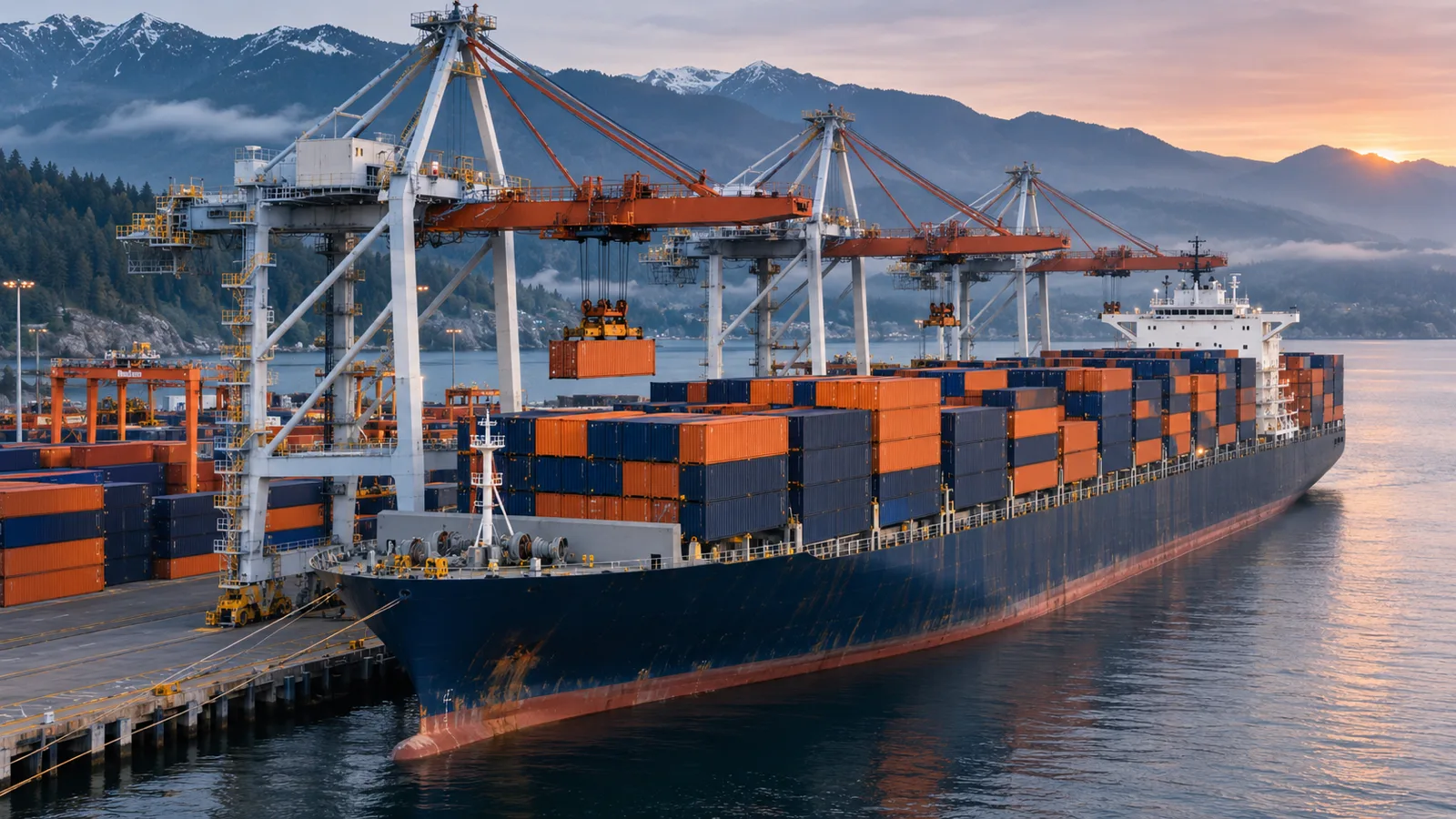
A Canadian home goods retailer finds a factory in Guangdong that can make its best-selling kitchen storage line for a fraction of the cost of a domestic supplier. The samples look good, the price is right and the minimum order is manageable. Then come the questions nobody covered in the supplier's chat window: Who books the freight? What does FOB actually include? How long will the container take to reach the warehouse? What happens when it lands in Vancouver, and why is the broker asking about wooden pallets?
China is one of Canada's largest sources of imported goods, and countless Canadian businesses, from single-founder ecommerce shops to national retailers, buy from Chinese manufacturers. The process is well travelled, but it has a lot of moving parts. Mistakes at the start, such as unclear Incoterms, vague invoices or missing labels, tend to become expensive problems at the end.
This guide follows a shipment from a Chinese supplier to a Canadian warehouse, stage by stage, and highlights the decisions that matter most at each step.
Stage 1: Finding and vetting suppliers
Most Canadian businesses find Chinese suppliers through online marketplaces, trade shows, sourcing agents or referrals. Whatever the channel, the goal at this stage is to separate reliable manufacturers from trading companies with little control over production, and to agree terms clearly enough that there are no surprises later. Our guide on finding suppliers on Alibaba covers the search process in more depth.
Before placing an order, pin down:
- Specifications. Materials, dimensions, colours, tolerances and packaging, written down and attached to the purchase order.
- Samples. Approved pre-production samples that become the reference for quality checks.
- Minimum order quantity and lead time. Production times can lengthen around Chinese public holidays, particularly Chinese New Year, when many factories close for weeks.
- Payment terms. A deposit with balance before shipment is common; understand what leverage you have if quality is poor.
- Inspection. Many importers hire a third-party inspection service to check goods at the factory before the balance is paid.
- Canadian requirements. Tell the supplier early about bilingual labels, carton markings and any product safety standards that apply in Canada.
Stage 2: Agreeing Incoterms
Incoterms define where the supplier's responsibility ends and yours begins. The most common terms for China-to-Canada shipments are:
- EXW (Ex Works). You collect from the factory door and handle everything, including Chinese export clearance. It gives you the lowest product price but the most work, and export clearance can be awkward for a foreign buyer.
- FOB (Free On Board). The supplier delivers the goods loaded onto the vessel at a named Chinese port, such as Shenzhen, Ningbo or Shanghai, and handles export clearance. You book and pay for the ocean freight and everything after. This is the most popular choice for Canadian importers because it balances control and simplicity. See our FOB explainer for details.
- CIF or CFR. The supplier books freight to a Canadian port. It looks convenient, but you have less control over routing and destination charges, which can be higher than expected.
- DDP (Delivered Duty Paid). The supplier handles everything to your door, including Canadian duties. Be cautious: it is easy to lose visibility over how goods are declared, and you may still be responsible if something goes wrong.
Stage 3: Booking freight across the Pacific
Full container load or consolidation
If your order fills most of a 20-foot or 40-foot container, a full container load (FCL) is usually most economical and keeps your goods sealed from origin to destination. Smaller orders travel as less-than-container load (LCL), consolidated with other shippers' cargo. LCL is billed by volume and weight, involves more handling, and adds time at origin and destination for consolidation and deconsolidation. Our overview of types of shipping containers explains the options.
Ports of entry
Most ocean freight from China to Canada arrives on the West Coast:
- Port of Vancouver. Canada's largest port, handling a large share of trans-Pacific container traffic. Goods for British Columbia are trucked locally; goods for the Prairies, Ontario and Quebec often continue by rail.
- Port of Prince Rupert. A northern BC port with a short sailing distance from Asia and direct rail connections inland. Many containers bound for central Canada and the US Midwest move through it.
Some cargo for eastern Canada also comes through the Suez Canal to Halifax or Montreal, but for most Chinese origins the West Coast plus rail is the main route.
Transit time
Port-to-port sailing across the Pacific typically takes a couple of weeks, but the full door-to-door timeline is longer once you add factory pick-up, origin port cut-offs, waiting for a vessel, unloading, rail to an inland terminal such as Toronto, Montreal, Calgary or Winnipeg, and final delivery. Plan for several weeks overall, and more during peak shipping season in late summer and early autumn, when retailers bring in holiday stock.
Air freight
Air is far faster but costs much more. It is typically reserved for samples, urgent replenishment or high-value, lightweight goods. Air shipments usually land at Vancouver or Toronto Pearson.
Stage 4: Documents your broker will ask for
Before the goods arrive, your customs broker will need:
- A commercial invoice with full product descriptions, quantities, unit prices, currency, country of origin and Incoterms.
- A packing list with carton counts, weights and dimensions.
- The ocean bill of lading or air waybill. If you are unsure of the difference between master and house bills, our article on master vs house bills of lading explains it.
- Your business number with import-export account, plus your CARM Client Portal registration and any financial security if you use release prior to payment.
- Any permits or certificates required for your product category.
Stage 5: Customs clearance with the CBSA
Your broker transmits the import declaration to the Canada Border Services Agency, ideally before the goods arrive. The CBSA may release the goods, request more information or select them for examination. Exams cause delays and can add costs for moving and handling the container, so accurate documents matter.
Duties
Canada does not have a free trade agreement with China, so goods from China are generally charged at Canada's Most-Favoured-Nation tariff rates. China no longer benefits from Canada's General Preferential Tariff, which some importers still assume applies. Duty rates vary widely by product: some items enter duty free, while others, such as many apparel and footwear lines, carry significant rates. Correct tariff classification is essential.
Trade remedies
Certain products from China, including a range of steel goods and some other industrial products, are subject to anti-dumping or countervailing duties under Canada's Special Import Measures Act. These can be substantial. Canada has also applied surtaxes to certain Chinese goods in recent years, such as electric vehicles and some steel and aluminum products, and these measures have changed more than once. If you import metal products, building materials or industrial components, ask your broker to check before you commit to an order.
Taxes
GST is charged on the duty-paid value of imported goods, and in HST provinces the provincial component may also be collected at import. GST-registered businesses can usually claim input tax credits for this amount.
Stage 6: Watch for these compliance traps
- Wood packaging. Pallets, crates and dunnage made of solid wood must meet the international ISPM 15 standard, which means heat treatment or fumigation and an official stamp. The Canadian Food Inspection Agency enforces this, and non-compliant wood can lead to the shipment being refused or treated at your cost.
- Labelling. Consumer goods usually need bilingual labels. Textiles need fibre content and a Canadian dealer identity. Getting the factory to print these correctly is far cheaper than relabelling in Canada.
- Product safety. Children's products, cosmetics, electrical goods and items that contact food have Canadian requirements under Health Canada and other bodies. Ask for test reports and check them against Canadian standards, not just generic certificates.
- Batteries. Products containing lithium batteries are regulated as dangerous goods for transport and need correct packing and documentation.
- Undervaluation. Some suppliers offer to under-declare the value to "save duty". This exposes you, the importer, to penalties. Declare the real price.
Stage 7: From port to warehouse
Once released, the container or LCL cargo moves to your warehouse. For FCL shipments arriving by rail in Toronto or Montreal, a drayage carrier collects the container from the rail terminal and delivers it to the warehouse dock. Free time at terminals is limited, and storage and per diem charges add up quickly if the container is not picked up and returned on time, so book your warehouse appointment in advance.
Floor-loaded containers, where cartons are stacked directly on the container floor rather than on pallets, are common from China because they fit more product. They take longer to unload and usually cost more to receive. Your 3PL will hand-unload, count, palletise and label the cartons before putting them away. Pick and pack services then handle individual orders from that stock.
Calculating landed cost
Your real cost per unit is not the factory price. It is the landed cost, which includes:
- Product cost and any inspection fees
- Origin charges and ocean or air freight
- Destination port, terminal and rail charges
- Customs brokerage and duties
- Drayage or inland trucking to the warehouse
- Receiving and any labelling or prep work
Use the method in our guide on calculating landed cost per unit to price your products properly. Many importers are surprised at how much destination charges add, particularly on small LCL shipments.
Frequently asked questions
How far ahead should I order?
Work backwards from when you need stock on the shelf. Allow for production, inspection, booking, ocean transit, rail, clearance and receiving, plus a buffer for delays. Around Chinese New Year and the autumn peak, add more.
Should I ship to Vancouver and truck across Canada?
For goods destined for central Canada, rail from the West Coast to inland terminals is usually more economical than trucking a container the whole distance. Your freight forwarder will quote through routings.
Can a 3PL receive containers directly?
Yes. A 3PL can accept container deliveries, unload, check counts against your packing list, and store and ship the goods. ShipCarte's distribution warehousing is set up for this.
Bring your next shipment home with ShipCarte
Importing from China is easier when the Canadian end is organised. ShipCarte receives import containers and freight for businesses across Canada, and handles storage, fulfillment and domestic distribution. Request a quote for receiving and warehousing, or schedule a consultation to plan your import flow.