
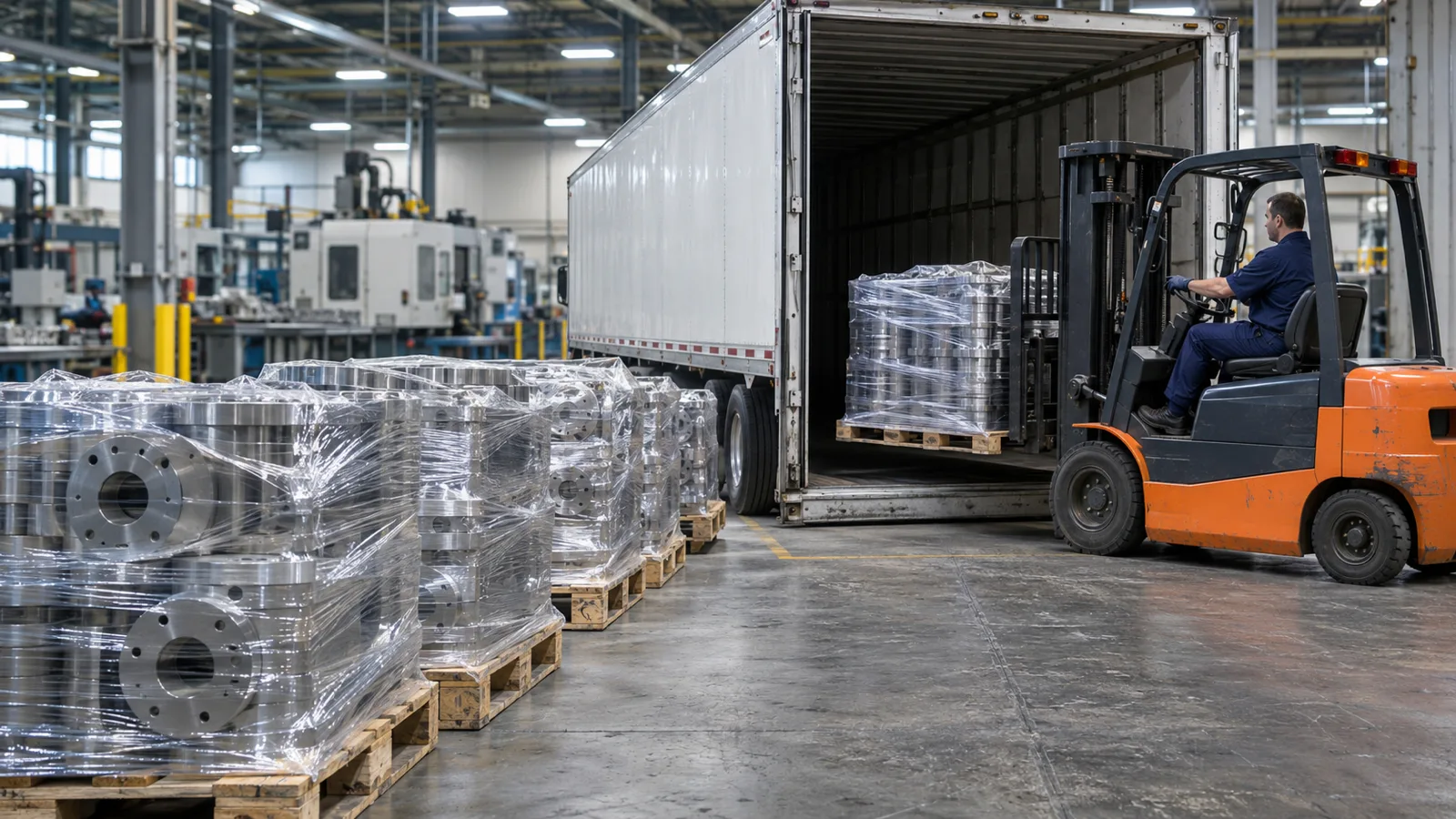
For a mid-sized manufacturer in Canada, a typical week might look like this. A container of components from Asia is sitting at the Port of Vancouver waiting for a rail slot east. A US supplier's truck is delayed at the Ambassador Bridge. Meanwhile, the sales team has confirmed a large order from a distributor in Alberta that must ship complete by Friday, and the plant's shipping area is already crowded with pallets waiting for pickup.
Manufacturing logistics sits on two sides of the factory floor at once. On one side, raw materials and components have to arrive in time to keep production running. On the other, finished goods have to reach customers on time, in full and in good condition. Problems on either side quickly spread to the other: a shortage of one inbound part can stop a line, and a congested outbound dock can slow everything inside the building.
This year has also tested assumptions many manufacturers held about lean inventory. Disruptions in the spring showed that supply chains built with very little slack can break when a single supplier, border crossing or region is affected. This article looks at practical ways Canadian manufacturers can strengthen both inbound and outbound logistics.
The Canadian Manufacturing Landscape
Manufacturing in Canada is concentrated in the Windsor–Quebec City corridor, with large clusters in southern Ontario and the Montreal region, and important centres in Winnipeg, Calgary, Edmonton, the Lower Mainland and Atlantic Canada. Much of it is closely tied to the United States, with components and finished goods crossing the border daily through Windsor–Detroit, Sarnia–Port Huron, Fort Erie–Buffalo, Lacolle–Champlain and Western crossings.
That integration brings efficiency but also exposure. A delay at a border crossing or a disruption at a supplier's plant in another country can quickly reach a Canadian production line. With CUSMA having replaced NAFTA on July 1, many manufacturers are also reviewing rules of origin and documentation to ensure their goods continue to qualify for preferential treatment.
Part One: Inbound Logistics
Just-in-time versus just-in-case
Just-in-time (JIT) delivery minimizes inventory by having components arrive shortly before they are needed. It frees up cash and floor space, but leaves little room for error. Just-in-case means holding buffer stock to protect against disruptions, at the cost of tied-up capital and storage space.
Most manufacturers land somewhere in between. A useful approach is to classify components by risk:
- Low risk: readily available parts from multiple nearby suppliers. These can run lean.
- Medium risk: parts from a single supplier or with moderate lead times. Hold modest buffers.
- High risk: long-lead, single-source or imported parts where a shortage would stop production. Hold meaningful safety stock, possibly in a nearby third-party warehouse.
Using an off-site warehouse for buffer stock
Floor space inside a plant is usually better used for production than storage. A nearby dedicated warehousing or distribution warehousing arrangement lets manufacturers hold buffer inventory without expanding their own building. Components can be released to the plant in daily or shift-based deliveries, sometimes sequenced in the exact order the line needs them.
Consolidating inbound freight
Manufacturers that receive many small shipments from different suppliers often pay more in freight and spend more time receiving than necessary. Options to consolidate include:
- Milk runs, where one truck collects from several nearby suppliers on a set route
- Consolidating overseas shipments into full containers at origin
- Using a cross-dock to combine LTL shipments into full truckloads to the plant
- Setting supplier delivery windows to smooth out receiving workload
Consolidated LTL freight and planned full truckload moves reduce both cost and receiving congestion.
Managing imports
For components from overseas, the route usually runs through the ports of Vancouver, Prince Rupert, Montreal or Halifax, followed by rail or truck inland. Each step adds time and potential delay. Building realistic lead times, tracking containers closely and keeping paperwork accurate are essential. The CBSA requires accurate commercial documentation, and errors can lead to holds, reassessments or penalties. Our explainer on bonded warehouses describes one way manufacturers can defer duties on imported goods until they are needed.
Part Two: Outbound Logistics
Understanding your customer mix
Outbound logistics depends heavily on who the customers are:
- Other manufacturers often order full pallets or truckloads on a regular schedule, with delivery appointments at their receiving docks.
- Distributors and wholesalers may order mixed pallets and expect accurate advance ship notices.
- Retailers typically have strict routing guides, labelling rules and penalties for non-compliance. Retail fulfillment requires attention to these details.
- Direct-to-consumer buyers order single units shipped to homes, which requires a completely different picking and packing process.
Manufacturers that serve several of these channels often struggle to run all of them from a plant shipping dock designed for full pallets. Moving finished goods into a distribution warehouse that is set up for mixed order profiles can relieve pressure on the plant.
Positioning finished goods
Shipping everything from a single plant in Ontario or Quebec may mean long transit times to customers in Western or Atlantic Canada. Holding finished goods in a regional warehouse closer to those customers can shorten delivery times and reduce the cost of many small shipments, since inventory moves west in efficient full loads before being distributed locally.
Packaging and load quality
Damage to finished goods often happens because of poor pallet building, insufficient stretch wrap or loads that shift in transit. Standardized pallet patterns, corner boards, proper wrapping and load bars in trailers are simple, inexpensive protections. Our guide to dunnage explains materials that keep loads secure.
Aftermarket and service parts
Many manufacturers also supply replacement parts to customers and dealers. Service parts orders are small, urgent and unpredictable, which makes them a poor fit for a plant shipping department built around large orders. A separate service parts operation, possibly run by a 3PL with pick and pack services, lets the plant focus on production while customers get fast parts support.
Exporting to the United States
For many Canadian manufacturers, the US is the largest outbound market. Shipping finished goods south smoothly depends on a few essentials:
- Accurate commercial invoices with clear product descriptions, values and tariff classifications
- Correct country of origin information and, where goods qualify, proper CUSMA certification of origin so the US buyer can claim preferential treatment
- A US customs broker who receives documents before the truck reaches the border
- Carriers with experience at the crossings you use most, and drivers enrolled in programs that speed up clearance where applicable
Errors in paperwork are one of the most common causes of delays at the border, and a truck held at a crossing can disrupt the delivery schedule for every other order on board. ShipCarte's cross-border shipping team helps manufacturers keep documentation and timing aligned.
Seasonal and weather risk
Canadian winters affect outbound freight as much as inbound. Snowstorms can close stretches of Highway 401, the Trans-Canada through the Rockies or the Coquihalla for hours or days. Products sensitive to freezing, such as some adhesives, coatings and liquids, may need heated trailers between roughly late fall and early spring. Planning for these conditions, rather than reacting to them, protects both delivery promises and product quality.
Technology That Connects Both Sides
Inbound and outbound logistics work best when they share the same information. Useful capabilities include:
- Real-time inventory visibility across plant and off-site locations through inventory management software
- Integration between the manufacturer's ERP and the warehouse system, so orders flow automatically. ShipCarte's integrations connect common business systems.
- Shipment tracking for both inbound and outbound freight
- Reporting on supplier on-time performance, order fill rates and freight costs
Without these connections, staff spend time chasing information by phone and email, and problems are discovered late.
Questions to Ask When Evaluating a Logistics Partner
- Can you handle both full-pallet and small-order picking from the same location?
- How do you integrate with our ERP or order system?
- Can you sequence deliveries to our plant by shift or production order?
- What is your experience with retailer compliance requirements?
- Can you support cross-border freight in both directions?
- What reporting will we receive, and how often?
- How quickly can you scale space and labour if our volumes change?
The last question has been especially relevant this year, as demand for some products surged while other categories slowed sharply. Flexible capacity has proven valuable for manufacturers facing uncertain demand.
Measuring Success
A few metrics give a clear picture of whether manufacturing logistics is working:
- Line stoppages due to material shortages, which should trend toward zero
- Supplier on-time delivery, measured against agreed windows
- Inventory turns for components and finished goods
- Order fill rate and on-time shipment to customers
- Freight cost as a share of sales, tracked over time
- Damage and claims rates on outbound shipments
Our list of top logistics KPIs includes more options, and reporting and analytics tools make it easier to track them consistently.
Conclusion
Canadian manufacturers compete in a demanding environment shaped by long distances, cross-border supply chains and a climate that challenges every carrier. Strengthening logistics on both sides of the plant, with smart buffer stock, consolidated inbound freight, well-positioned finished goods and connected systems, makes operations more resilient and customers better served.
Partner With ShipCarte
ShipCarte supports manufacturers across Canada with warehousing, inventory management and freight shipping for both inbound components and outbound finished goods. To explore how we can help your operation, request a quote today.