
A home goods importer based near Hurontario and the 401 had a familiar problem. Their warehouse sat in the middle of Canada's biggest consumer market, but a growing share of their wholesale orders was heading to Calgary, Edmonton and the Lower Mainland. Every week they were booking full truckloads across more than 3,000 kilometres of highway, through Northern Ontario in winter, paying for driver hours and fuel on every mile.
Then a freight broker asked a simple question: how fast does this freight really need to get there? The answer, for most of their replenishment orders, was "within a week is fine." That opened the door to intermodal, where a container travels most of the distance by rail and only the first and last legs by truck.
Intermodal is not a universal answer, but for long-haul domestic and cross-border freight out of Mississauga it is a tool worth understanding. Here is how it works, when it makes sense and what to watch for.
What Intermodal Actually Means
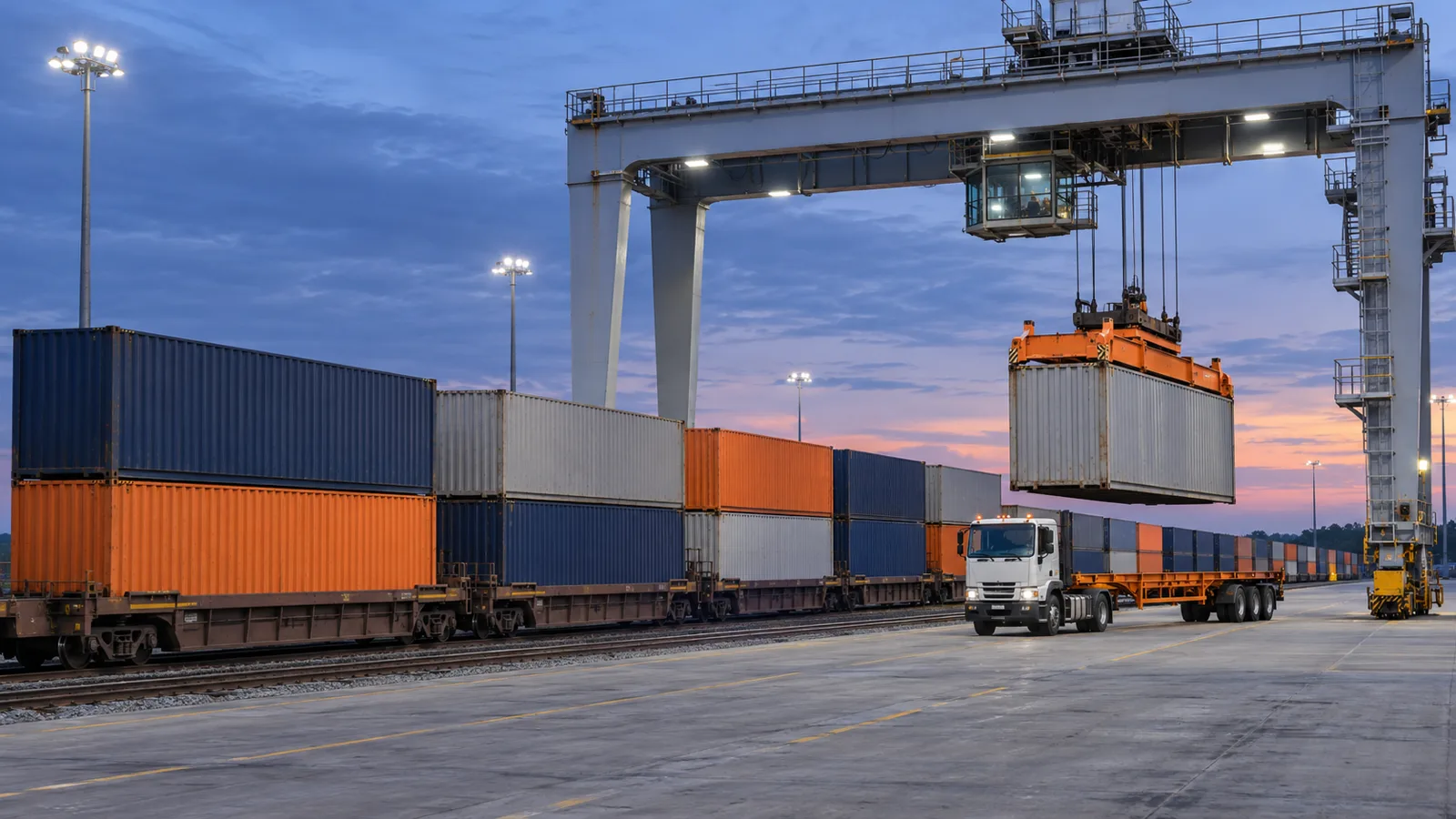
In North American domestic freight, intermodal usually refers to loading goods into a container or trailer once, then moving that unit by truck to a rail terminal, by train across a long distance, and by truck again to the final destination. The freight itself is not touched between modes. Only the box is lifted from chassis to railcar and back.
Domestic intermodal in Canada commonly uses 53-foot containers, which hold roughly the same as a standard dry van trailer, though usable weight can differ by equipment and route. International shipments arriving through ports such as Vancouver, Prince Rupert, Montreal or Halifax often move inland by rail in 20-foot or 40-foot marine containers before reaching the GTA. For more on equipment, see our overview of the different types of shipping containers.
The Three Legs of an Intermodal Move
First mile: dray to the ramp
A drayage carrier brings an empty container to your dock, you load it, and the driver takes it to a rail terminal. For Mississauga shippers, the major rail intermodal terminals are a short drive away in Brampton and Vaughan, reached via Highways 407, 410 and 427. That proximity keeps the truck portion short, which is one of the reasons intermodal works well for this region. If drayage is unfamiliar, our explainer on what drayage is covers the basics.
Line haul: the rail portion
The container is lifted onto a railcar, often double-stacked, and travels on a scheduled train to a terminal near the destination. Trains run to published cut-off times. Miss the cut-off and your container waits for the next departure.
Last mile: dray to the consignee
At the destination terminal, the container is lifted onto a chassis and drayed to your customer or distribution centre, unloaded and returned. Free time at both ends is limited, and storage or detention fees can apply when containers sit too long.
Intermodal Versus Truckload: A Side-by-Side Look
The best way to decide is to compare the two modes against what your freight actually needs.
- Transit time. Over-the-road truckload is generally faster on long hauls, particularly with team drivers. Intermodal typically adds time for terminal handling, train schedules and drayage coordination. Exact transit varies by lane and carrier.
- Cost on long lanes. Rail is efficient over distance. On lanes of many hundreds or thousands of kilometres, intermodal is often less expensive than truckload. On short lanes, the fixed cost of two drays and terminal handling usually wipes out any saving.
- Capacity. When trucking capacity tightens, intermodal can offer an alternative, though rail capacity has its own limits and service disruptions.
- Predictability. Trains run to schedules, but weather, rail congestion and labour disruptions can create delays. Trucks are more flexible but are exposed to highway weather and driver availability.
- Handling. Containers are lifted and the train can produce more longitudinal movement than a highway trailer. Freight must be blocked and braced well.
- Emissions. Rail generally moves freight with lower fuel use per tonne-kilometre than trucks, which matters to brands and retailers with sustainability targets.
When Intermodal Makes Sense From Mississauga
Intermodal tends to fit best when several conditions line up:
- The lane is long. Toronto-area origins to Winnipeg, Calgary, Edmonton, Vancouver or major US markets such as Chicago are classic intermodal lanes. Mississauga to Montreal or Ottawa, by contrast, is usually better served by truck.
- The freight is not urgent. Replenishment orders, seasonal pre-builds and stock transfers between warehouses can usually absorb a few extra days.
- You ship full loads. Intermodal is fundamentally a full container product. If you are moving a few pallets, LTL freight or a consolidation program is usually the better fit.
- The freight is dense and durable. Packaged goods, building materials, paper products, non-perishable food and many manufactured goods travel well by rail.
- Volumes are regular. Repeating moves on the same lane let you plan around train schedules and build relationships with drayage providers.
When to Stick With the Truck
Intermodal is a poor fit for time-critical freight such as retail launch dates with tight appointment windows, production parts feeding a line, or anything where a missed day carries a heavy penalty. It is also difficult for very fragile items, freight that cannot be properly braced, and loads that require frequent stops. Temperature-controlled intermodal exists on some lanes, but availability is more limited than refrigerated trucks, so perishables usually stay on the road.
For those shipments, full truckload remains the reliable choice, and having both options quoted side by side lets you pick per shipment rather than per year.
Loading a Container for Rail
Rail moves impose different forces from highway travel. Containers are lifted by cranes or side-loaders, trains can surge and slack as they start and stop, and loads can shift if not secured. Some practical habits help:
- Load evenly from front to back and side to side, with heavy freight on the floor.
- Fill voids with airbags, dunnage or load bars so pallets cannot slide.
- Stretch-wrap pallets tightly and use corner boards for tall loads.
- Avoid overhang; cartons that extend past the pallet edge are vulnerable.
- Photograph the loaded container before sealing, and record the seal number on the bill of lading.
Our post on what dunnage means goes into the materials used to keep loads stable.
Hidden Costs to Account For
An intermodal rate quote that looks attractive can grow if you do not plan for the extras. Common ones include:
- Drayage fuel surcharges on both ends, separate from the rail line-haul rate.
- Detention when containers sit at your dock or your customer's dock beyond the free loading or unloading time.
- Storage at the terminal if a container is not picked up within the allowed window.
- Chassis fees on some lanes and with some providers.
- Accessorials at delivery such as appointments or wait time.
A good comparison includes all of these alongside the truckload alternative, rather than comparing headline rates.
Cross-Border Intermodal
Rail lines connect the GTA with major US hubs, and intermodal can be used for some cross-border freight. Customs requirements remain the same as for trucks: commercial invoices, proper declarations, and pre-arrival data submitted on time. Goods qualifying under CUSMA need proper origin documentation. Delays at the border can be more complex to resolve with rail freight, so work with a broker and logistics partner who has handled the lane before. For shipments that need more flexibility, trucking across the Ambassador Bridge or the Niagara crossings often remains the simpler choice. ShipCarte's cross-border shipping team can help weigh the options.
Building Intermodal Into a Distribution Strategy
The most effective use of intermodal is usually part of a larger network rather than a one-off cost saving. A Mississauga brand might hold its main stock in the GTA, ship ecommerce orders directly to Ontario and Quebec customers, and move full containers by rail to a western warehouse that serves the Prairies and BC. That reduces long-distance parcel spend while keeping the line-haul cost in check. Distribution warehousing in multiple regions only pays off when the replenishment freight between them is efficient, and intermodal can be a big part of making that equation work.
Planning is the trade-off. You need to forecast demand far enough ahead to accept slower replenishment, and keep enough safety stock at the destination to ride out the occasional rail delay.
Questions to Ask Before Your First Intermodal Shipment
- What is the door-to-door transit estimate, not just the rail transit?
- What are the cut-off times at the origin terminal, and how far ahead do I need to book the dray?
- How much free time do I have to load and unload?
- What happens if a train is delayed or cancelled?
- What liability coverage applies, and does my freight need additional insurance?
- Can I get the same lane quoted by truckload for comparison?
Find the Right Mode for Each Lane
Intermodal can be a smart way to move long-haul freight out of Mississauga, but it works best as one option in a toolkit rather than a blanket rule. ShipCarte works with shippers to compare truckload, LTL and rail-based options on their real lanes and to coordinate pickups, transit and delivery through our distribution services.
If you are shipping full loads west or south and wondering whether you are overpaying for speed you do not need, request a quote and we will lay out the options for your lanes.