
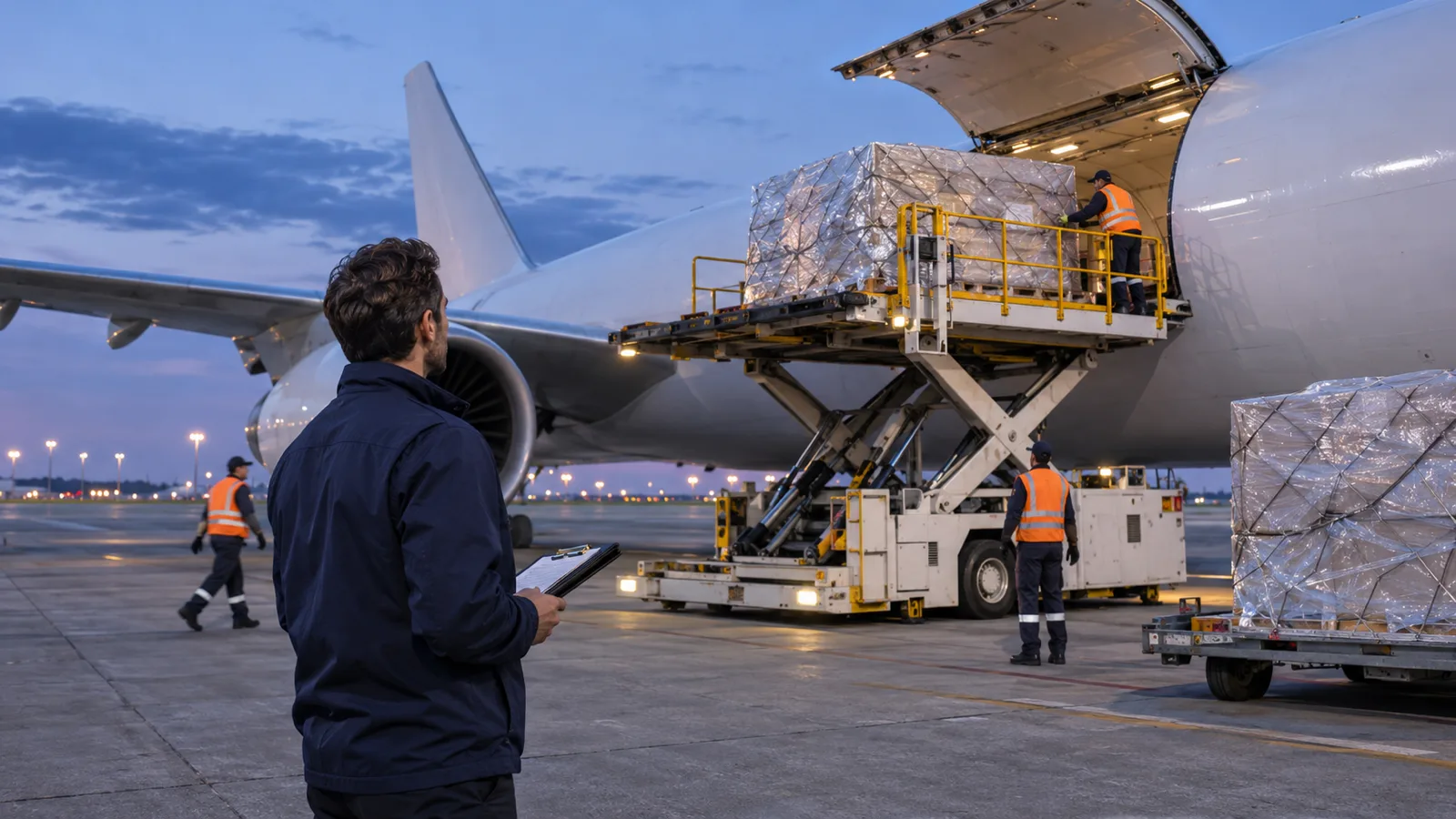
A Mississauga company that makes specialty kitchen equipment lands its first distributor in Germany. The distributor wants a trial order of forty units in three weeks, then a full container every quarter if the trial sells. The owner has shipped across Canada and into the US for years, but never overseas. Suddenly there are three very different ways to get product to Hamburg, and each one changes the price the distributor pays, the cash the business ties up, and how much paperwork lands on someone's desk.
That situation plays out constantly across Peel Region. Mississauga sits next to Toronto Pearson International Airport, has fast highway access to the rail terminals that feed the Port of Montreal and the Port of Halifax, and is home to depots for every major express courier. Having all three modes nearby is an advantage, but it also makes the choice less obvious. The cheapest option on a rate sheet is often not the cheapest option once you count inventory sitting on the water, customs delays or a missed launch date.
This guide compares air freight, ocean freight and express courier from a Mississauga starting point. It looks at when each mode makes sense, what drives the cost, what documents you need, and how many businesses end up mixing modes rather than picking one forever.
The three options at a glance
Before getting into details, it helps to understand what each mode is actually built for.
- Express courier (the integrated carriers such as DHL Express, FedEx International and UPS Worldwide) handles door-to-door delivery of parcels and small multi-piece shipments, including customs clearance on most lanes. It is the simplest option for the shipper and usually the fastest for small volumes.
- Air freight moves larger consignments, typically on pallets or in loose cartons, through freight forwarders who book space on passenger and cargo aircraft. Pick-up, export clearance, the flight, import clearance and final delivery are separate steps that a forwarder coordinates.
- Ocean freight moves goods in shipping containers, either a full container load (FCL) for one shipper or less than container load (LCL), where your cargo shares a container with other shippers. It is the slowest option and the cheapest per kilogram for heavy or bulky goods.
The real question is not which mode is best in general. It is which mode fits a specific shipment's weight, value, urgency and destination.
Express courier: best for small, urgent and high-value shipments
For most Mississauga e-commerce brands and B2B sellers sending samples, spare parts or individual customer orders overseas, courier is the default. You create a label and commercial invoice, the carrier picks up from your dock or your 3PL, and the carrier's own brokerage team handles clearance at destination.
Where courier wins
- Shipments under roughly 70 kg, where the carrier's per-kilogram pricing still beats the minimum charges that air freight forwarders apply.
- Time-sensitive deliveries such as replacement parts, trade show materials or first orders where speed builds trust.
- Direct-to-consumer orders where the recipient expects a tracking number and doorstep delivery.
- Destinations where you have no forwarder or customs broker relationship.
Where courier gets expensive
Courier pricing is built on billable weight, which is the greater of actual weight and dimensional weight. Light but bulky products such as pillows, lampshades or packaged furniture can be billed far above their actual weight. Fuel surcharges, remote area surcharges and duty-and-tax forwarding fees add up as well. Our guide to how package dimensions affect shipping costs explains the calculation in detail.
Once a shipment grows past a few cartons, it is worth asking a forwarder for an air freight quote side by side with the courier rate. The crossover point varies by lane and by your negotiated discounts, so test it rather than assuming.
Air freight: speed for pallets and larger consignments
Mississauga businesses have an unusual advantage for air freight. Toronto Pearson is Canada's largest airport for cargo, and its freight handling and forwarder warehouses cluster around the Airport Corporate Centre, Malton and the industrial areas along Airport Road and Derry Road. A pallet built at a warehouse in Meadowvale or Gateway can often be tendered to a forwarder the same day.
How an air freight shipment works
- Your forwarder books space on a flight and issues a booking confirmation with a cut-off time.
- The cargo is picked up, or dropped at the forwarder's warehouse near Pearson, where it is weighed, measured and screened for security.
- Export documentation is filed. Most commercial exports from Canada valued above set thresholds need an export declaration through the Canadian Export Reporting System (CERS), and certain goods need permits regardless of value.
- The cargo flies under an air waybill, often consolidated with other shippers' freight.
- At destination, a customs broker clears the goods and a local agent delivers to the consignee or holds them for pick-up.
When air freight makes sense
Air freight suits goods with a high value-to-weight ratio: electronics, pharmaceuticals, cosmetics, fashion, precision components. It also suits any shipment where being late carries a real cost, such as a production line waiting on parts or a seasonal collection that loses value after a launch date. Perishables like fresh seafood or flowers almost always fly, usually with temperature-controlled handling arranged in advance.
Air freight is priced by chargeable weight as well, with the dimensional calculation using a different divisor than most couriers. Rates also move with fuel costs, seasonal demand and available capacity, so the same lane can price quite differently in October than in February.
Ocean freight: the economical choice when time allows
Mississauga is inland, so ocean exports start with a truck or train ride. Most containers from the Greater Toronto Area move by rail to the Port of Montreal or to the East Coast ports, or to Vancouver and Prince Rupert for Asian destinations. Some exporters truck containers to US East Coast ports when sailings or rates are better. The rail intermodal terminals at Brampton and Vaughan are a short drive up Highway 410 or Highway 427 from most Mississauga industrial parks.
FCL or LCL?
A full container load gives you the whole box. You pay a single container rate whether it is half full or packed to the roof, so FCL becomes economical once you have enough volume to fill a large share of a 20-foot or 40-foot container. LCL charges by cubic metre or weight, but adds consolidation and deconsolidation steps at each end, which extend transit time and add handling. Smaller exporters often start with LCL and graduate to FCL as order sizes grow. Our article on the different types of shipping containers covers sizes and specialized equipment.
The hidden cost of slow transit
Ocean rates per kilogram are typically a small fraction of air rates, but the goods spend weeks in transit. That inventory is paid for and not yet sold. For a business with tight cash flow, carrying an extra month of stock on the water can matter as much as the freight bill. Port congestion, blank sailings and rail delays can stretch timelines further, so ocean freight works best when you plan replenishment well ahead and keep a safety buffer at the destination.
Comparing the modes side by side
Here is a practical way to compare the three for any given shipment from Mississauga.
- Speed: Courier is usually fastest door to door for small shipments. Air freight is fast for the flight itself but adds pick-up, screening and clearance time. Ocean takes weeks, plus inland rail on both ends.
- Cost per kilogram: Ocean is lowest, air freight sits in the middle, and courier is highest per kilogram but has no minimums that punish small shipments.
- Paperwork for the shipper: Courier is the lightest because the carrier bundles clearance. Air and ocean require a forwarder, a commercial invoice, packing list, and often certificates of origin or permits.
- Risk of damage: Courier parcels pass through many automated sorts. Palletized air freight is handled less often. Ocean cargo faces long transit and humidity, so packing and dunnage matter.
- Carbon footprint: Ocean is generally the lowest emitting per tonne-kilometre and air the highest. Some buyers now ask about this in tenders.
Documents you will need regardless of mode
Every international shipment from Canada needs accurate documentation. Mistakes here are the most common cause of delays at destination customs.
- A commercial invoice with a full product description, Harmonized System (HS) code, country of origin, quantity, unit value, currency and Incoterms.
- A packing list showing weights, dimensions and the contents of each package or pallet.
- A certificate of origin where a free trade agreement applies, such as CETA for the European Union, CPTPP for several Pacific Rim markets, or CUSMA for the US and Mexico.
- Export permits for controlled goods, and an export declaration through CERS where required.
- Any destination-specific documents, such as food safety certificates or product registration for regulated goods.
Choosing the right Incoterm is equally important. Whether you ship DAP, DDP or FCA decides who pays freight, who handles import clearance, and who pays duties. Our guides on what DDP means and common international shipping mistakes are worth reading before quoting an overseas buyer.
Mixing modes: how growing exporters actually ship
Back to the kitchen equipment maker. A sensible plan might look like this: send the forty-unit trial order by air freight so the distributor has stock for its launch, then move regular quarterly replenishment by ocean FCL once demand is proven. Spare parts and warranty replacements go by courier, because a single part needs to arrive in days, not weeks.
This split is common. Many Mississauga businesses use courier for individual orders, air for urgent or high-value restocks, and ocean for planned bulk replenishment. The key is having inventory, order data and shipping options in one place so that the choice is made shipment by shipment, not by habit.
Questions to ask before every international shipment
- What is the deadline, and what does it cost the business if the goods arrive a week late?
- What is the chargeable weight once dimensions are counted?
- Who is responsible for import duties and taxes under the agreed Incoterm?
- Does a free trade agreement reduce duties if we supply a certificate of origin?
- Is the product regulated at destination, and do we have the registrations or permits?
- How will the shipment be packed for the handling it will receive in that mode?
How a Mississauga 3PL fits into international shipping
A third-party logistics partner close to Pearson and the major highways can take a lot of this work off your team. ShipCarte stores inventory, picks and packs orders, and books outbound shipments through its shipping platform, which lets you compare courier services on each order. For larger consignments, our cross-border shipping and carrier management services help coordinate the carriers, documentation and handoffs. Pallets can be built and labelled in the warehouse ready for a forwarder's pick-up, and export cartons can be packed to suit the mode they will travel in.
For brands selling direct to consumers abroad, e-commerce fulfillment from a Mississauga warehouse means international orders go out alongside domestic ones, with the right commercial invoice data pulled from your store and attached to each label.
Plan your next international shipment with ShipCarte
Air, ocean and courier each have a place, and the right answer usually changes as your business grows. If you are shipping overseas from Mississauga and want a second opinion on mode choice, documentation or packaging, our team can walk through your products, lanes and volumes with you. Request a quote or schedule a consultation to get started.