
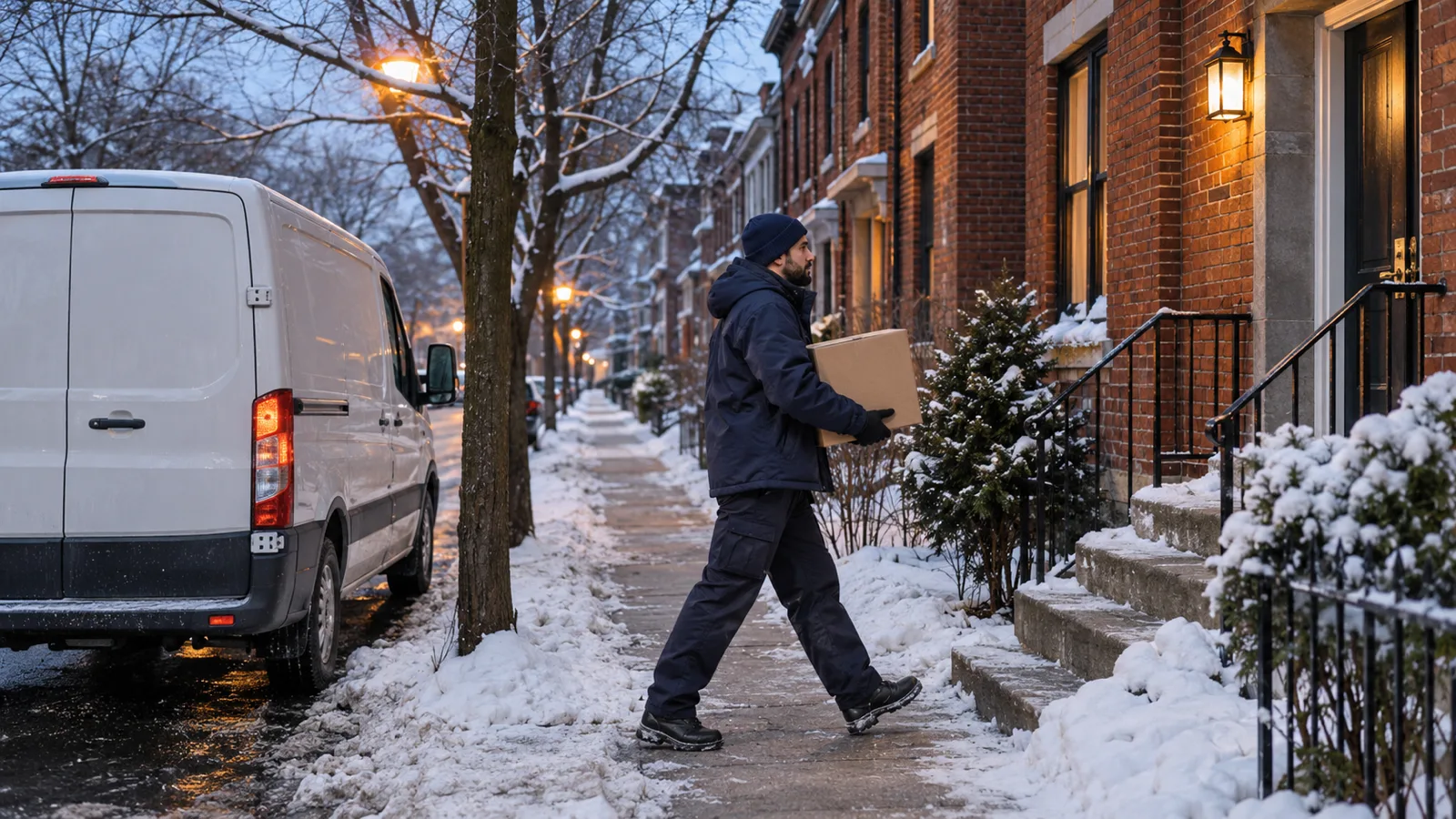
The last few kilometres of a delivery are often the most expensive and the most visible. A parcel can travel from a warehouse to a city's sorting facility efficiently in a trailer full of other parcels, but once it reaches the city it has to be loaded into a smaller vehicle, driven through traffic, carried up stairs or into a condo lobby, and handed to someone who may or may not be home. If the customer is out, the parcel goes back on the truck, and the cost of the delivery doubles.
In recent years, the number of parcels moving through Canadian cities has grown steadily as more people shop online. That has put pressure on traditional carriers and opened the door to new approaches: app-based drivers who deliver in their own cars, local courier companies offering same-day service, and parcel lockers in apartment buildings and stores. For businesses shipping into Toronto, Montreal, Vancouver, Calgary, Edmonton, Ottawa, Winnipeg and other urban centres, there are now more last-mile options than ever.
Each option solves a different problem. This article compares the main ones, explains where each fits in Canadian cities specifically, and suggests how to combine them so you can offer customers the right choice without driving up your costs.
Why the last mile in Canadian cities is its own challenge
Canadian cities share some features that shape how last-mile delivery works:
- High-rise living. Downtown Toronto, Vancouver, Montreal and increasingly Calgary and Ottawa have large numbers of condo and apartment towers. Drivers lose time getting through lobbies, waiting for elevators and dealing with concierge desks that may not accept parcels.
- Suburban sprawl. Outside the cores, many Canadian metropolitan areas spread out into low-density suburbs, which means longer distances between stops.
- Winter. Snow, ice and early darkness slow drivers down for months of the year, and parcels left on porches face both weather and theft.
- Bilingual requirements. In Quebec and in bilingual regions, customer communications such as delivery notices and tracking messages are expected in French as well as English.
- Traffic and parking. Congested downtown streets and limited loading zones make each stop slower and sometimes lead to parking fines that carriers build into their costs.
Option 1: National couriers
The large national courier networks are the backbone of business parcel delivery in Canada. They offer ground and express services, reliable tracking, signature options, and coverage across all major cities and most smaller ones.
Strengths: predictable service levels, integrations with almost every ecommerce platform, negotiated volume pricing, and good handling of business-to-business deliveries where a receiving desk is open during the day.
Weaknesses: residential surcharges in some cases, failed first attempts when no one is home, and limited flexibility on delivery time windows. During peak periods, networks may impose volume caps or surcharges.
Best for: most standard ecommerce parcels, business deliveries and anything that needs to travel between cities before the last mile begins.
Option 2: Canada Post
Canada Post reaches every address in the country, which no private carrier can match, and it is often the most economical choice for small and light parcels going to residences. In cities, its network of post offices and retail counters gives customers a convenient place to pick up parcels that could not be delivered, and options such as holding parcels for pickup at a chosen post office help customers who are rarely home.
Strengths: universal coverage, competitive pricing for small parcels, many pickup points, and familiarity for customers.
Weaknesses: transit times can be less predictable during high-volume periods, and large or heavy items may be better suited to courier services.
Best for: lightweight residential deliveries, customers in apartments who prefer pickup, and orders where cost matters more than speed.
Option 3: Local and regional couriers
Most Canadian cities have local courier companies that specialize in same-day and next-day delivery within a metropolitan area. Some operate vans, some use bicycle couriers in dense cores, and some work with businesses on scheduled routes.
Strengths: fast delivery within the city, often with defined time windows, flexibility on special requests and local knowledge of buildings and neighbourhoods.
Weaknesses: coverage limited to one region, variable technology and tracking, and higher per-parcel costs for low volumes.
Best for: same-day delivery, time-sensitive B2B shipments, and businesses with a warehouse or store inside the same metropolitan area as their customers. Our article on where same-day delivery works in Canada explores this in more detail.
Option 4: Crowdsourced and app-based drivers
Crowdsourced delivery uses independent drivers who accept delivery jobs through an app, usually using their own vehicles. Several platforms operate in major Canadian cities, and some retailers and grocery chains have used them to expand delivery capacity quickly during busy periods.
Strengths: rapid scaling during peaks, same-day and on-demand delivery, and evening or weekend delivery windows that suit residential customers.
Weaknesses: service quality can vary from driver to driver, handling of fragile or high-value goods is less consistent, and coverage outside large urban areas is limited. Businesses should also understand how the platform handles insurance, lost parcels and proof of delivery.
Best for: local same-day orders, grocery and convenience items, and overflow capacity during busy periods in big cities.
Option 5: Parcel lockers and pickup points
Parcel lockers and pickup points take the "nobody home" problem off the table. Instead of delivering to a door, the carrier delivers to a secure locker or a partner store, and the customer collects the parcel at a convenient time using a code. Lockers have been appearing in apartment buildings, transit stations, retail locations and post offices in Canadian cities.
Strengths: fewer failed deliveries, lower theft risk, efficient multi-parcel drops for carriers, and convenience for customers who work long hours or live in buildings without a concierge.
Weaknesses: size limits for large items, the customer has to travel to collect, and locker networks are still uneven across cities, with far fewer options in suburbs and smaller centres.
Best for: small parcels to dense urban neighbourhoods, high-value items at risk of porch theft, and customers who choose pickup at checkout.
Matching options to the kind of order
Rather than picking one approach, most businesses get the best results by matching delivery method to the type of order. Here is a simple way to think about it:
- Small, light, non-urgent orders: Canada Post or an economical courier ground service, with a pickup point option for customers who want it.
- Standard ecommerce parcels: a national courier ground service, using rate shopping between carriers to find the best price per postal code.
- Urgent or same-day orders in a city where you hold stock: a local courier or app-based driver.
- High-value items: signature-required courier delivery or delivery to a locker.
- Large or heavy items: courier services with appropriate handling, or LTL with residential delivery and appointment options for very large goods.
- B2B deliveries to offices and stores: national or regional couriers that deliver during business hours.
A multi-carrier shipping platform makes this practical by letting you apply rules automatically: for example, choosing the cheapest carrier for each postal code, or switching to a same-day courier for orders placed before a cut-off in specific cities.
Reducing failed deliveries in cities
Failed first attempts are one of the biggest hidden costs of urban last-mile delivery. A few practices help regardless of which carriers you use:
- Collect complete addresses, including unit or suite numbers and buzzer codes for apartment buildings. Make the unit field prominent at checkout.
- Collect a phone number and send proactive delivery notifications so customers know when to expect the parcel.
- Offer pickup at a post office, store or locker as an alternative to home delivery.
- Allow customers to add delivery instructions, such as leaving parcels with a concierge.
- Give customers easy access to tracking. A branded tracking page reduces "where is my order" contacts and helps customers plan to be home.
Costs to watch
Last-mile pricing involves more than the base rate. Watch for residential delivery surcharges, additional handling fees for oversized or irregular parcels, address correction fees when information is incomplete, signature fees, and fuel surcharges that change periodically. Peak season surcharges can also apply in the busiest weeks of the year. Reviewing invoices regularly and auditing them against what you expected to pay will catch errors and help you understand which services are really costing you the most. Our article on types of shipping surcharges explains the most common ones.
How fulfillment location shapes the last mile
The last mile does not start at the city limits; it starts wherever your inventory is. If your stock sits in a warehouse close to a major population centre, more of your customers fall within reach of next-day ground service and same-day options. If it sits far away, every parcel spends days in the linehaul before the last mile even begins. Many growing brands find that improving warehouse location does more for delivery speed than changing carriers. Small parcel shipping and carrier management services can help you use the right carriers for each region from wherever your stock is held.
Build a last-mile strategy that fits your customers
There is no single best last-mile option for Canadian cities. The right mix depends on your products, your customers and where your inventory sits. What matters is having more than one option available and the systems to choose between them automatically. ShipCarte works with businesses across Canada to combine courier, postal and local delivery options through one platform. Request a quote to compare rates for your typical shipments, or schedule a consultation to talk through your delivery strategy.