
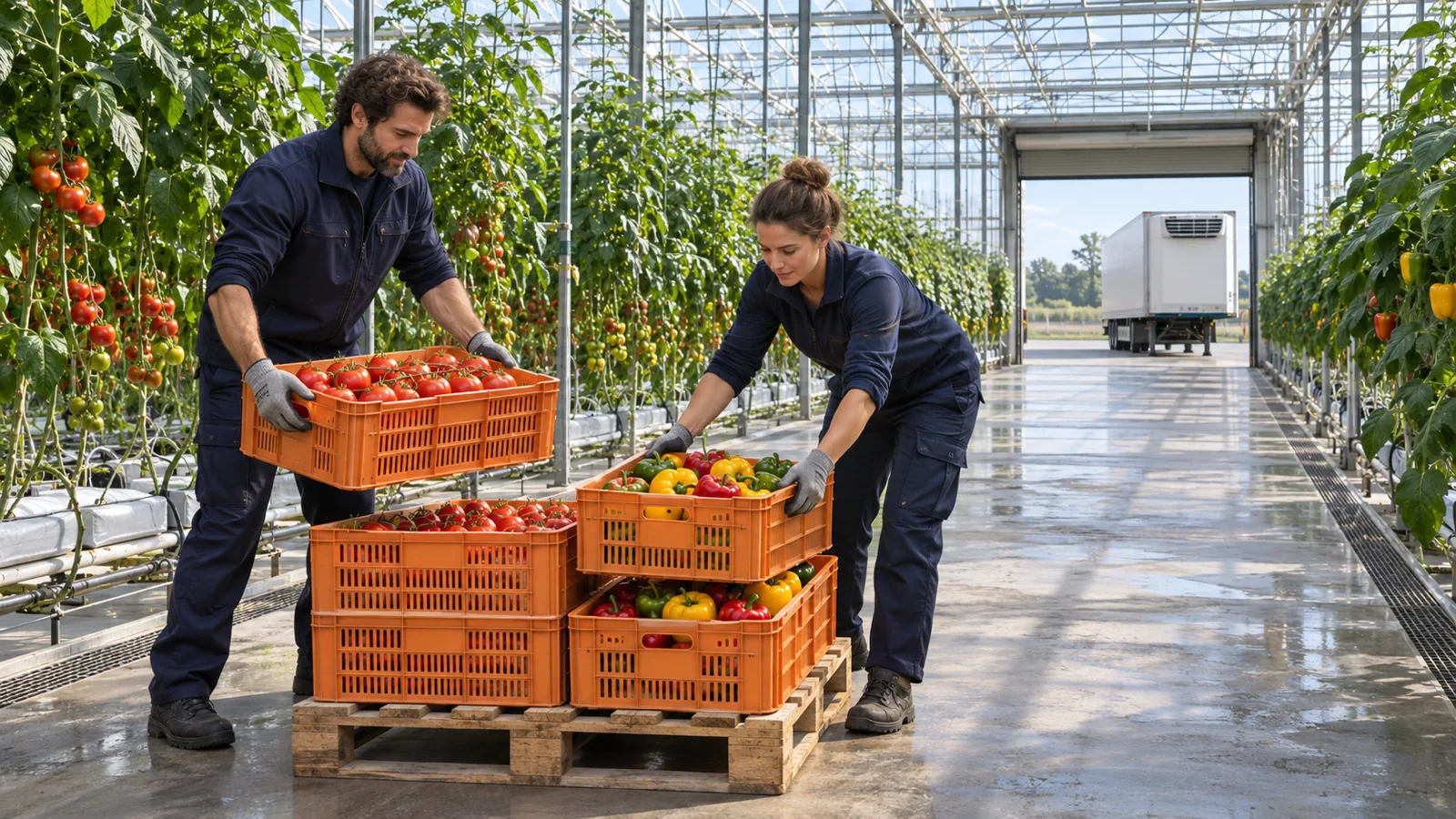
At six in the morning, the glass houses around Leamington and Kingsville are already busy. Picking crews move down rows of tomato vines that climb well above head height, carts of mini cucumbers roll toward the packing hall, and a refrigerated trailer is backed into a dock waiting for its first pallets. By evening, much of what was picked today will be on the road: some heading up Highway 77 to the 401 and on to the Ontario Food Terminal in Toronto, some crossing the Ambassador Bridge for Chicago, Detroit or Columbus, and some bound for distribution centres in Montreal.
Essex County has one of the largest concentrations of greenhouse vegetable production in North America, and most of it sits within a short drive of Leamington. Ontario's greenhouse growers produce tomatoes, cucumbers and peppers in quantities that far exceed what the province can eat, so a large share is shipped to the United States. That makes Leamington a logistics story as much as an agricultural one: the value of a crop depends on how quickly and carefully it can be moved.
This article looks at how greenhouse produce moves from Leamington to market, where the cold chain can break, and what growers, packers and distributors can do to protect freshness and margins.
The Clock Starts at Harvest
Fresh vegetables start losing quality the moment they are picked. Respiration continues, moisture is lost and, if the temperature is wrong, chilling injury or decay can set in. A typical day for a Leamington greenhouse shipment looks something like this:
- Early morning: harvest begins. Produce is moved quickly from the growing area to the packing facility.
- Morning to midday: grading, sorting and packing into cases or clamshells, often with labelling for specific retail customers.
- Within hours of packing: pre-cooling, often with forced-air systems, to bring product down to its target holding temperature.
- Afternoon: pallets are built, wrapped and staged in a cooler. Orders from retailers and wholesalers are confirmed.
- Late afternoon to evening: reefer trailers load and depart. Toronto loads may arrive overnight; Midwest and Quebec loads usually arrive the next day.
Every hour lost between picking and pre-cooling shortens shelf life at the store. That is why the most efficient operations put packing, cooling and loading under one roof or very close together.
Getting the Temperature Right for Each Crop
Greenhouse vegetables are not all handled the same way. Each has a recommended temperature range, and getting it wrong can cause as much damage as a delay. General guidelines from post-harvest research are:
- Tomatoes: roughly 10 to 13°C for mature fruit. Below about 10°C, tomatoes are prone to chilling injury that affects flavour, texture and colour development.
- Cucumbers: roughly 10 to 13°C. Colder temperatures can cause pitting and water-soaked areas that show up after the product reaches the store.
- Bell peppers: roughly 7 to 10°C. Peppers tolerate slightly lower temperatures than tomatoes and cucumbers.
- Lettuce and leafy greens grown under glass: close to 0 to 2°C, which is very different from the fruiting crops above.
Relative humidity also matters. Most of these crops do best at high humidity, which limits moisture loss and shrivelling.
Mixed loads and ethylene
Tomatoes produce ethylene, a natural ripening gas. Cucumbers are sensitive to it and can yellow and soften when exposed. Shipping these together in the same trailer for long distances can reduce cucumber quality. When mixed loads are necessary, for example a regional distributor's daily delivery to grocery stores, keep transit short, maintain good air circulation and, where possible, separate ethylene producers and sensitive products within the load.
Setting the reefer correctly
The trailer's refrigeration unit should be set to the correct temperature before loading and pre-cooled. Continuous mode, rather than start-stop cycling, provides steadier air circulation for fresh produce. Pallets should be loaded with space for air to flow along the floor and walls. A trailer that is pre-cooled but loaded with warm product will not catch up quickly; refrigeration units maintain temperature far better than they reduce it.
Routes Out of Leamington
Leamington sits at the southern tip of mainland Canada, which shapes its routing:
- To Toronto and the GTA: about three and a half to four hours via Highway 77 or Highway 3 to the 401. Loads for the Ontario Food Terminal and grocery distribution centres often run overnight to arrive for early-morning receiving.
- To Ottawa and Montreal: roughly eight to ten hours, typically next-day arrival, with team drivers or relay points used for tight windows.
- To the US Midwest: Windsor and the Ambassador Bridge are under an hour away, putting Detroit within an hour or two and Chicago, Cleveland and Columbus within a single shift.
- To Northern Ontario and Western Canada: longer hauls where consolidation with other temperature-controlled freight helps keep costs reasonable.
Because so much of the crop is sold in the United States, many Leamington shippers treat the border as part of their daily routine rather than an exception. A dedicated cross-border shipping process, with brokers, carriers and paperwork lined up in advance, is what allows a load picked in the morning to be on a Chicago dock the next day. Where Ambassador Bridge queues are long, some carriers route north to the Blue Water Bridge at Sarnia instead, trading extra kilometres for a more predictable crossing.
Crossing the Border With Fresh Produce
US-bound produce shipments need more than a standard commercial invoice. The US Food and Drug Administration requires prior notice for imported food, submitted before the shipment arrives at the border. Produce must also meet US food safety requirements, including those under the Food Safety Modernization Act that apply to the farm and its supply chain. A customs broker experienced with fresh produce will make sure entries and prior notice are filed in time for the truck's arrival.
Most greenhouse growers ship through FAST-approved carriers and use established brokers so that border crossings take minutes rather than hours. A truck sitting in secondary inspection with a load of tomatoes is not just delayed; it is losing shelf life with every hour.
Canadian Food Safety and Licensing
On the Canadian side, the Safe Food for Canadians Regulations came into force in January 2019. Businesses that import, export or trade fresh fruit and vegetables across provincial borders generally need a licence from the Canadian Food Inspection Agency, along with traceability records that allow product to be tracked one step forward and one step back. Requirements for fresh produce were phased in over the years that followed and now apply in full, so growers should make sure their licences, preventive controls and records are current. Our article on the Safe Food for Canadians licence explains the basics.
Good traceability is not just a regulatory box to tick. When a retailer reports a quality problem or a recall is needed, the ability to identify exactly which lot, which greenhouse and which trailer was involved limits the scope and cost.
Where Warehousing Fits In
Greenhouse produce is mostly shipped quickly from grower-packers to customers, but there are good reasons to use third-party cold storage along the way:
- Forward stocking near customers: holding a buffer of product in a cold storage facility in the GTA allows same-day replenishment for retailers and foodservice distributors.
- Consolidation: smaller growers can combine product into full loads for distant markets.
- Cross-docking: product can arrive in full loads and be split into smaller store deliveries without lengthy storage.
- Value-added work: repacking, labelling or building mixed cases for specific retailers.
Facilities need to maintain the right temperature zones for each crop and keep detailed records, which is where temperature-controlled warehousing with continuous monitoring pays off.
Common Cold Chain Weak Points
Most produce quality problems can be traced to one of a handful of moments:
- Dock dwell time: pallets left on an unrefrigerated dock while a trailer is late or a load is being rebuilt.
- Warm loading: product not fully pre-cooled before loading.
- Incorrect setpoints: a trailer set for frozen or for leafy greens when it is carrying tomatoes.
- Door openings on multi-stop routes: each stop lets cold air escape and warm air in.
- Receiving delays: trucks waiting hours to unload at busy distribution centres.
Temperature recorders in each load, or reefer units with remote monitoring, provide evidence when a dispute arises and help identify which part of the chain needs attention.
Seasonal Pressures
Greenhouse production in Ontario now runs for much of the year, with supplemental lighting extending winter output. Even so, volume peaks in spring and summer. During those months, reefer capacity in Southwestern Ontario can tighten, especially when field crops from across the province and the US are moving at the same time. Growers who lock in carrier capacity early and give carriers predictable weekly volumes tend to get better service.
Winter brings the opposite problem. Produce must be protected from freezing during loading and transit, and roads between Leamington and the 401 can be affected by snow squalls off Lake Erie and Lake St. Clair. Reefers can heat as well as cool, so a properly set unit protects the load from both directions.
Keep Fresh Produce Moving
Leamington's greenhouse sector depends on speed, temperature control and reliable border crossings. Growers and distributors who manage those well can put Ontario vegetables on shelves in Toronto, Montreal and the US Midwest within a day or two of harvest, with quality that justifies a premium.
ShipCarte provides refrigerated freight, cold storage and food and beverage logistics for producers across Ontario. To discuss reefer capacity, cross-border produce shipments or forward stocking in the GTA, request a quote or schedule a consultation.