
A building supply dealer in Southern Ontario orders a load of spruce-pine-fir from a mill in Quebec, a truckload of drywall from a plant in the Greater Toronto Area, and a set of engineered floor joists that are longer than most trailers. Meanwhile, a window manufacturer in Manitoba needs to get a large order to a condo project in Calgary without a single cracked pane, and a truss plant in Nova Scotia has a house package due on a job site down a gravel road on Thursday morning. All of them are moving heavy, bulky, sometimes fragile products, and all of them depend on freight running on time.
Building products are among the most demanding freight in Canada. Loads are heavy and often long or oversized, products are vulnerable to weather, delivery points are frequently job sites rather than loading docks, and the country's geography adds mountains, long distances and seasonal road restrictions. This year has added another layer: strong renovation and construction demand and unusually volatile lumber prices have put pressure on mills, dealers and carriers alike.
This guide looks at how lumber and building products move across Canada, product by product and mode by mode, and what shippers and receivers can do to cut damage, delays and cost.
Know your products: different loads, different needs
Dimensional lumber and panels
Softwood lumber and panels such as plywood and OSB are produced across the country, with large volumes coming from British Columbia, Alberta, Quebec, Ontario and New Brunswick. They ship in banded bundles, typically wrapped to protect against weather. Heavy and dense, they often reach legal weight limits before a trailer is full. Bundles must be secured properly and protected from moisture, which can cause staining and mould.
Engineered wood
Glulam beams, laminated veneer lumber and I-joists can be very long. Long loads may need extendable trailers and, beyond certain lengths, oversize permits from each province the load passes through. Engineered products are expensive, and damaged edges or flanges can make a piece unusable.
Trusses and wall panels
Prefabricated roof trusses and wall panels are bulky and awkward. They are often wide or tall enough to require permits, escorts or specialised trailers, and they usually go directly to job sites where crane or boom truck unloading is needed.
Drywall, insulation and roofing
Gypsum board is heavy and breaks at the edges and corners; it must be kept dry. Insulation is light and bulky, so trailers fill by volume long before weight. Shingles are heavy and dense, and pallets must be stable. These products often move by full truckload from plants to distribution yards and by smaller deliveries to job sites.
Windows, doors and finished products
Windows, doors, cabinets, flooring and fixtures behave more like general freight but are easily damaged. Windows travel on A-frames or racks; doors and cabinets on pallets with edge protection. These products often travel by LTL freight to dealers and contractors, where careful handling and clear labelling matter most.
Choosing a mode
Building products move across Canada by truck, rail and occasionally water. Each has a place:
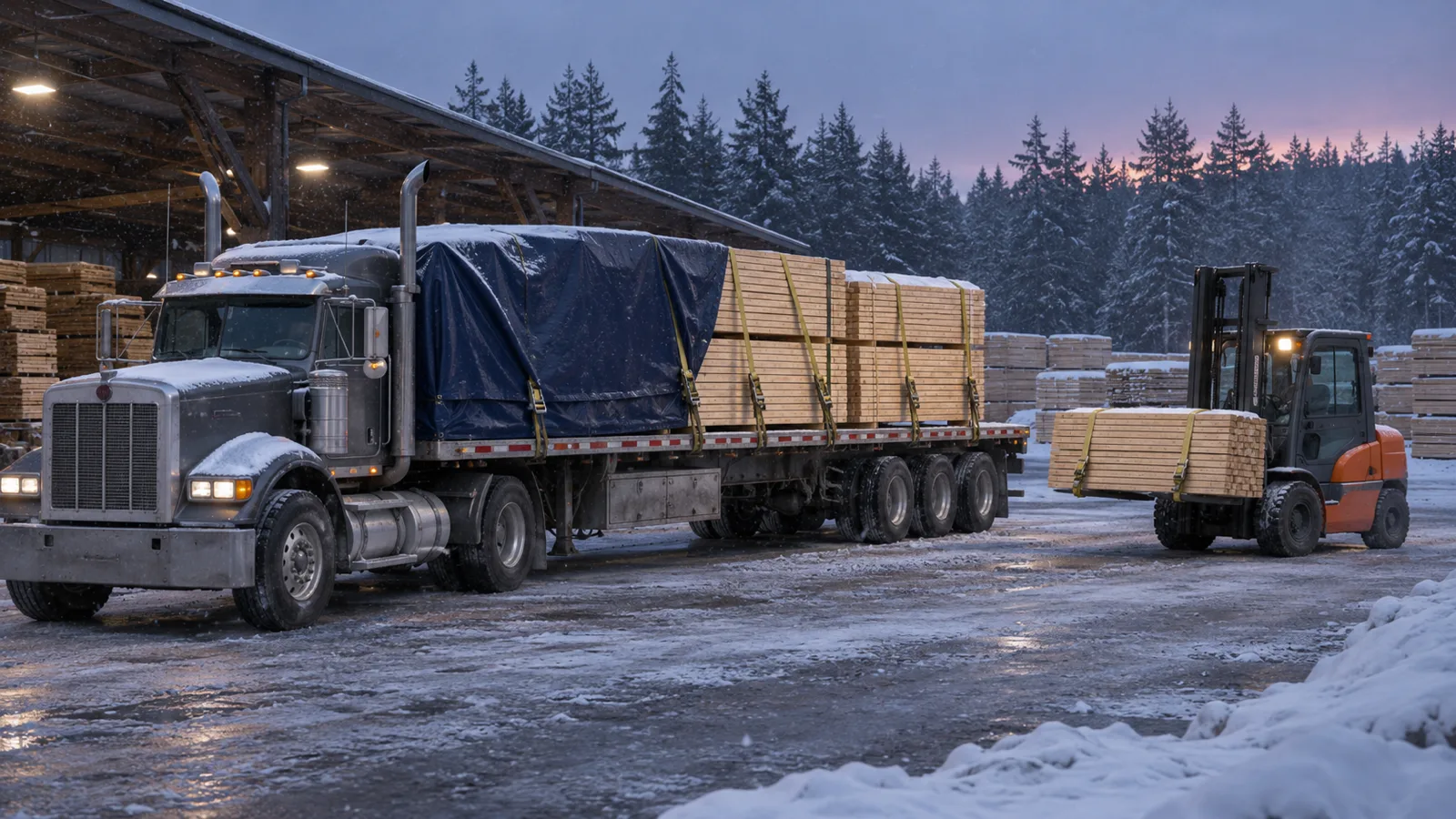
- Flatbed and step-deck trucks: the workhorses for lumber, panels and engineered wood. Flatbeds can be loaded from the side by forklift and unloaded at yards without docks. Loads must be tarped where weather protection is required.
- Curtain-side and enclosed trailers: better for weather-sensitive products such as drywall, insulation and finished goods. Curtain-siders combine side loading with weather protection.
- Boom trucks and specialised delivery: for job sites where the receiver has no forklift, trucks with cranes or truck-mounted forklifts unload directly to the site.
- Rail: centrebeam and bulkhead flatcars carry large volumes of lumber and panels from mills in British Columbia, Alberta and Quebec to distribution centres across Canada and into the United States. Rail is cost-effective for long distances but requires reload facilities to transfer product to trucks for final delivery.
- LTL: useful for smaller orders of finished goods, hardware and accessories, especially to retailers and contractors.
Many supply chains combine these modes. A mill in the BC Interior may ship lumber by rail to a reload centre in the Prairies or Ontario, where product is transferred to trucks for delivery to dealers. Our guide to freight service types explains the differences between these options in more depth.
Securement, tarping and weather
Cargo securement rules in Canada follow the National Safety Code standard on load security, adopted by the provinces and territories, which sets out how many tie-downs are needed and how loads must be secured. Lumber and panel loads can shift during braking and cornering if not tied down correctly, endangering drivers and other road users.
Moisture is the other enemy. Canadian weather varies from coastal rain in British Columbia to snow in the Prairies and freezing rain in Ontario and Quebec. Bundled lumber is usually wrapped, but tarps are still needed for many products and lanes. Wet drywall or insulation is often a total loss. Shippers should specify tarping requirements on the bill of lading and confirm them with the carrier. Our article on the purpose of the bill of lading explains why those details matter if there is a claim.
Seasonal road restrictions
Much of Canada experiences spring thaw, when frozen ground softens and roads are vulnerable to damage from heavy loads. Provinces including Alberta, Saskatchewan, Manitoba, Ontario, Quebec and the Atlantic provinces impose seasonal load restrictions on certain roads, typically in late winter and spring. During these periods, trucks may be limited to lower axle weights on affected routes, which reduces how much lumber or drywall a single truck can carry and can raise costs per tonne.
Building supply businesses can prepare by:
- Checking provincial and municipal restriction schedules early in the year.
- Pre-stocking dealers and yards before restrictions begin, especially in rural areas.
- Planning job site deliveries in restricted areas with smaller trucks or partial loads.
- Communicating with customers about possible delays or added costs during thaw season.
Delivering to job sites
Job site deliveries cause more failed deliveries and damage claims than almost any other part of building products logistics. A checklist helps both shippers and receivers:
- Confirm site access. Is the road passable for a large truck? Are there height or weight restrictions, overhead lines or tight turns?
- Confirm unloading equipment. Does the site have a forklift or telehandler, or does the truck need its own crane or forklift?
- Book a time window. Sites are busy, and a delivery that arrives when the crew is pouring concrete may be turned away.
- Name a contact. Someone on site must be available to direct the driver and sign for the delivery.
- Prepare a laydown area. Products need a flat, dry place to land, ideally off the ground on dunnage. See our note on what dunnage means.
- Inspect before signing. Note damage and shortages on the delivery receipt and take photos.
Cross-border lumber and building products
Canada exports large volumes of softwood lumber to the United States, and building products flow in both directions across the border. Softwood lumber trade between the two countries has a long history of disputes, and US duties on Canadian softwood lumber have been in place in recent years. Exporters need accurate documentation, correct tariff classification and attention to the specific requirements that apply to their products. Since July 2020, CUSMA has replaced NAFTA as the trade agreement governing North American trade, so origin documentation should reference the new agreement where preferential treatment is claimed. A partner experienced in cross-border shipping can help keep loads moving through crossings such as Windsor–Detroit, Sarnia–Port Huron, Lacolle and the Pacific Highway.
Warehousing and distribution for building products
Manufacturers and distributors of finished building products such as flooring, fixtures, hardware, windows and doors increasingly need warehousing that can handle both pallet-level B2B orders and smaller shipments to contractors and consumers. A distribution warehousing partner can store product close to major construction markets, consolidate orders and coordinate deliveries, while carrier management keeps freight costs and performance in view across many lanes.
What drives the cost of a building products load
Freight rates for building products swing with the construction season, fuel prices and how much capacity is available on a given lane. Rather than chasing a single rate, it helps to understand the factors that push a quote up or down:
- Equipment type: flatbeds, step-decks, curtain-siders and boom trucks are not interchangeable, and specialised equipment is scarcer in some regions, especially during the spring and summer building season.
- Weight versus volume: dense products such as shingles and lumber hit weight limits; light products such as insulation fill trailers by volume. Mixing the two on one load, where practical, can use a trailer more efficiently.
- Length and permits: over-length or over-width loads need permits from each province on the route and sometimes escorts or travel-time restrictions, all of which add cost and planning time.
- Accessorial services: tarping, job site delivery, waiting time while a crew finds a forklift, and redelivery after a failed attempt are often billed separately.
- Backhaul opportunities: lanes where trucks would otherwise return empty can be cheaper. Lanes out of remote mill towns may be pricier if carriers expect to deadhead.
Reviewing invoices against quotes regularly also matters. Accessorial charges are easy to miss on a busy month, and a pattern of detention or redelivery fees usually points to a fixable problem at a specific yard or job site.
Plan your next load with ShipCarte
ShipCarte helps manufacturers, distributors and retailers across Canada move freight by full truckload and LTL, store products in distribution warehouses, and ship across the border. To discuss your building products lanes and delivery requirements, request a quote.