
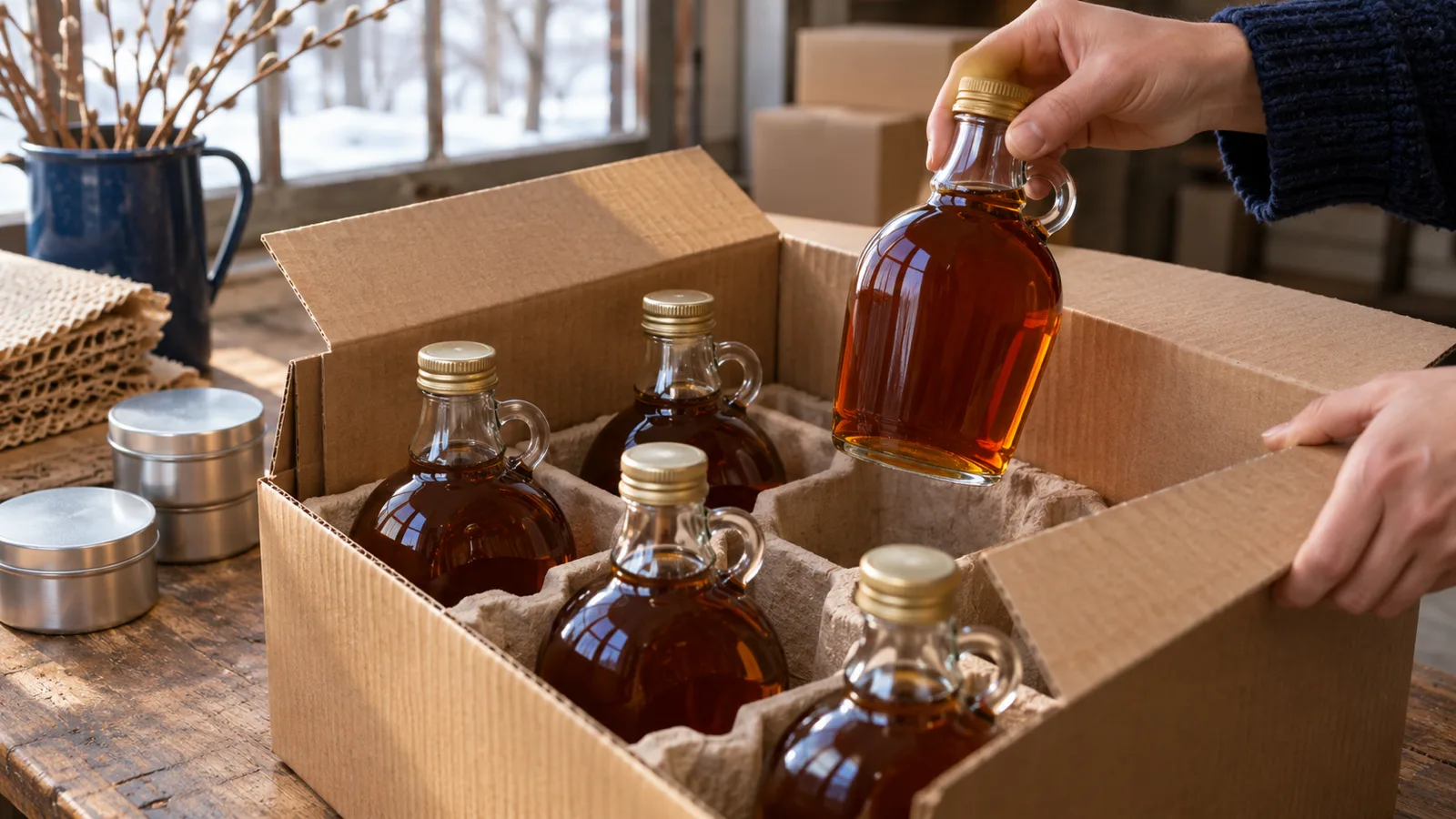
A family sugar bush in the Eastern Townships or the Ottawa Valley can boil an entire year's syrup in a few weeks of March and April. The work of selling it, though, runs all year: gift orders from customers in Alberta, wholesale cases for a specialty grocer in Halifax, a pallet of jugs for a distributor in the United States, and a growing number of web orders from Europe and Asia where Canadian maple syrup is a recognisable premium product.
Shipping that syrup is a different challenge from making it. Glass bottles break, plastic jugs leak if caps are not torqued properly, tins dent, and heavy liquid in a box drives up shipping costs. Then there are the rules: federal food labelling and licensing requirements here at home, and import requirements that change from one country to the next.
This guide is for maple producers, packers and food brands that want to ship syrup confidently, both within Canada and abroad. It is organised around the decisions you actually make: what container to use, how to pack it, which rules apply, and how to time inventory around a very short production season.
Start with the container
Your choice of container shapes everything downstream: breakage risk, weight, shipping cost, shelf appeal and which markets you can serve easily.
Glass bottles
Glass is the premium choice for gifts and retail shelves, from small leaf-shaped bottles to larger round bottles. It is also the heaviest and most fragile option. Glass works well for retail and gift channels, but each bottle needs proper cushioning for parcel shipping, and the added weight affects cost on long routes such as Quebec to British Columbia.
Metal cans and tins
The classic maple tin is light, unbreakable and iconic. Tins dent rather than break, which makes them a good fit for parcel and international shipping. The main risks are seam leaks if the can was poorly sealed and dents that make gifts look tired. A snug carton and dividers solve most of that.
Plastic jugs and pouches
Plastic jugs are lighter than glass and nearly unbreakable, making them practical for everyday sizes and for food service. Their weakness is the cap. A loosely applied cap, temperature changes in transit, or a crushed corner can lead to a sticky leak that ruins the shipment and anything around it. Induction-sealed caps and a plastic bag around each jug are inexpensive insurance.
Bulk drums and totes
Most of Canada's syrup leaves the farm in bulk barrels for packers and processors. Bulk syrup in Quebec is handled through a collective marketing system managed by the provincial producers' federation, which sets rules for how bulk syrup is sold there. If you are a packer moving bulk syrup or finished goods by the pallet, you are in freight territory rather than parcel, and the logistics look more like any other food distribution business.
Packing syrup for parcel shipping: a checklist
Whether you pack in-house or use a fulfillment partner, these steps prevent most damage and leak claims:
- Check that every cap is tight and, if possible, induction-sealed before packing.
- Bag each plastic jug or bottle so a leak cannot spread to other items or other packages.
- Use molded pulp or corrugated dividers so glass bottles cannot touch each other or the box walls.
- Leave enough cushioning at the top and bottom of the carton, where impacts usually happen when a box is dropped.
- Use double-wall cartons for heavier multi-bottle orders and gift sets.
- Do a shake test: if anything moves, add void fill.
- Mark multi-bottle cartons with orientation arrows, accepting that carriers cannot guarantee orientation.
Maple syrup does not usually freeze solid at the temperatures a parcel sees in a Canadian winter, but extreme cold can make plastic more brittle and glass more prone to cracking on impact. In summer, a hot delivery truck will not spoil sealed syrup, but heat can stress seals. Avoid letting packed orders sit on a loading dock in direct sun. For more on protecting breakable items, see our post on how to properly pack fragile items.
The Canadian rules that apply
Maple syrup is a food product, so federal food rules apply when it is sold across provincial borders or exported. The Safe Food for Canadians Regulations, which came into force in January 2019, consolidated the former maple products regulations into a single framework administered by the Canadian Food Inspection Agency (CFIA). Key points for shippers include:
- Licensing: businesses that pack or label maple syrup for interprovincial trade or export generally need a Safe Food for Canadians licence and must have preventive controls and traceability in place.
- Grading: syrup sold in small containers must carry a grade, and Canada Grade A syrup is classified into colour classes, each with its taste descriptor (for example, golden with a delicate taste, or dark with a robust taste).
- Labelling: labels generally need the common name, net quantity in metric units, grade and colour class, the name and address of the business, and lot or traceability information. Consumer labels need mandatory information in both English and French.
- Traceability: you must be able to trace product one step forward and one step back, which is essential if there is ever a recall.
The CFIA's website is the authoritative source for current requirements. Rules for selling within your own province, at a farm gate or at a farmers' market may differ, so check provincial requirements too.
Exporting maple syrup
Canadian maple syrup ships to many countries, with the United States as the largest market and strong demand in Europe, Japan and Australia. Each destination brings its own requirements.
United States
Food shipped to the US generally requires that the manufacturing or packing facility be registered with the US Food and Drug Administration, and commercial food shipments require prior notice to the FDA before arrival. Labels must meet US requirements, which differ from Canadian ones in areas such as the nutrition facts format and units. Since July 2020, preferential duty treatment is claimed under CUSMA rather than NAFTA, so update your origin documentation. For ecommerce orders, low-value consumer shipments can often enter more simply, but food rules still apply.
European Union and United Kingdom
Exports to Europe require labels that meet EU food information rules, often in the language of the destination country. The UK's transition period after Brexit ends at the end of this year, so shipments to Britain from January 2021 may need different documentation from shipments to the EU. Confirm the current requirements with your customs broker before the holiday rush.
Asia and other markets
Markets such as Japan, China and South Korea may require specific labelling, ingredient declarations, or export certificates. The CFIA's export requirements library lists what is needed for each country. Some importers will handle local labelling for you; others expect the product to arrive ready for sale.
In all cases, the paperwork must match the shipment: product description, harmonized system code, quantity, value and country of origin. Errors are one of the most common causes of delays at the border. Our article on avoiding common international shipping mistakes covers the paperwork pitfalls, and our cross-border shipping team can help with US-bound orders.
Seasonality: a short harvest and a long selling year
Maple is unusual among food products because supply comes in one burst while demand is spread across the year with distinct peaks.
- Spring (March to May): syrup is produced and graded. Producers pack fresh stock and fulfil pre-orders. Sugar shack season also generates local demand.
- Summer: steady sales, tourist shops and cottage country retailers restock, and export orders are fulfilled.
- Autumn: corporate gift programs are planned, and retailers stock up for the holidays.
- Holiday season (November to December): the busiest time for gift sets and consumer web orders, both in Canada and overseas.
For producers, the challenge is storing finished goods well and packing them in batches that match demand. Glass bottles and gift sets take a lot of space. A dedicated food-grade warehouse with stock rotation and lot tracking helps you keep older lots moving first, which matters for best-before dates. ShipCarte's food and beverage logistics and inventory management services are designed for this kind of lot-controlled product.
Corporate gifts and holiday programs
Maple syrup is a popular corporate gift for Canadian businesses sending something to clients at home and abroad. These orders can be a great source of revenue, but they come with their own fulfillment needs: custom gift boxes, branded cards, kitted assortments, and shipments to hundreds of addresses on a tight schedule.
Plan corporate programs early. Lock in packaging supplies by early autumn, assemble gift sets before the holiday parcel crunch, and agree with the client on the address list format and the delivery date. A partner with kitting and assembly capability can build gift sets in batches and release them for shipping on a set date.
Cost drivers to watch
Liquid is heavy, and maple syrup is no exception. A few cost drivers matter most:
- Weight and distance: shipping a multi-bottle glass order from Quebec to Western Canada or the North can cost a significant share of the product value.
- Packaging: molded pulp, double-wall cartons and bags add cost but cost much less than breakage and reshipments.
- Carrier choice: rates for the same box can differ widely between carriers on the same lane; comparing options per order is worthwhile.
- Stock positioning: for brands with significant sales in the West, moving finished goods by LTL freight to a western warehouse before the holidays can reduce per-order costs and transit time.
Ship your maple syrup with confidence
ShipCarte helps food brands across Canada store, pack and ship products like maple syrup, whether that is a single bottle to Saskatoon, a corporate gift program to hundreds of addresses, or a pallet bound for the United States. Request a quote and tell us about your containers, channels and markets.