
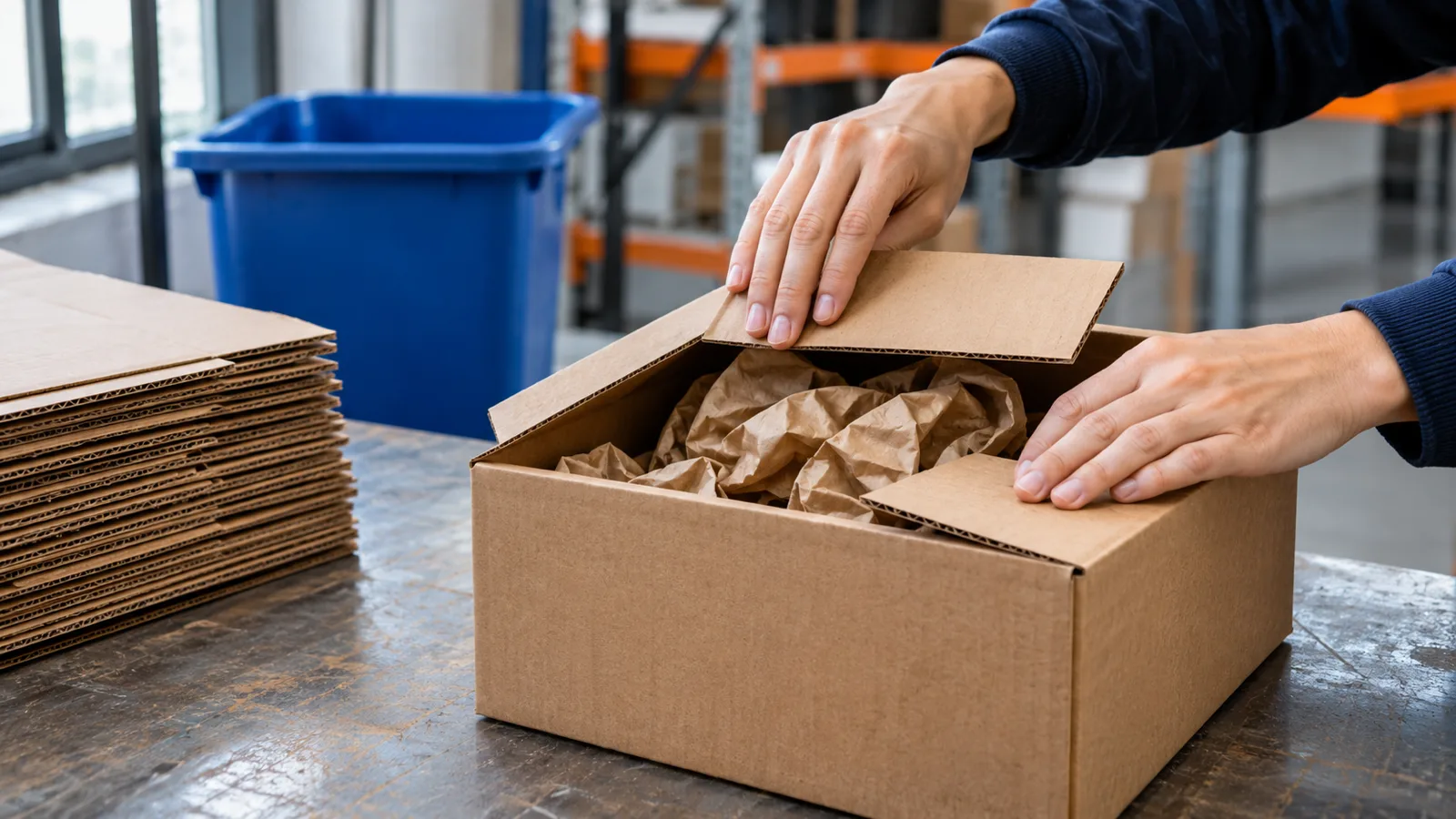
Picture a growing skincare brand that ships a few thousand orders a month to customers in Toronto, Ottawa and London. Every order goes out in a printed mailer box with tissue, a glass jar in a moulded insert, a folded product card and an air pillow or two. The founder has spent months on the unboxing moment. What the founder hasn't spent any time on is what happens to all of that material once the customer is done with it, and who in Ontario is expected to pay for collecting it.
The answer, in Ontario, is that brand owners have been paying a share of the cost of residential recycling for well over a decade through the Blue Box program. Many smaller e-commerce companies don't realise they may be "stewards" until they cross a revenue threshold or receive a letter. And with the province signalling a move toward full producer responsibility for packaging, the amount of attention brands pay to packaging weight and material choice is only going to grow.
This article explains how the system works as of spring 2019, who it applies to, what drives the fees, and the practical packaging decisions that help packaging-heavy brands keep costs and waste under control.
How the Blue Box Program Is Funded Today
Ontario's curbside Blue Box is run by municipalities. Your city or regional government collects recyclables from homes, sorts them at a material recovery facility, and sells what it can. That costs a lot more than the materials earn back, so the province set up a shared funding model under the old Waste Diversion Act: businesses that put packaging and printed paper into Ontario households pay roughly half of the municipalities' net costs, and municipalities cover the rest.
The businesses that pay are called stewards, and the organisation that collects their fees and passes the money to municipalities is Stewardship Ontario. Oversight of the system sits with the Resource Productivity and Recovery Authority, which was created when the Waste-Free Ontario Act replaced the Waste Diversion Act in 2016.
Who counts as a steward
Broadly, the steward is the brand holder of the product whose packaging ends up in Ontario homes. If the brand holder isn't resident in Ontario, the obligation typically falls to the first importer or the business that first supplies the product into the province. Retailers can be stewards for their own private-label goods and for the packaging they add, such as shopping bags or shipping boxes.
For e-commerce, that last point matters. The corrugated shipper, the paper fill, the poly mailer and the printed packing slip that you add to an order are all packaging and printed paper that land in a residential Blue Box. If your business is the steward, those materials are part of what you report, alongside the product's own primary packaging.
Small business thresholds
The program has thresholds that exempt or simplify reporting for small businesses, based on annual revenue and the tonnage of material supplied. Many young direct-to-consumer brands sit below them. Growing brands should check the current Stewardship Ontario rules each year rather than assuming they're exempt, because crossing a threshold triggers registration and reporting obligations, and catching up on missed years is unpleasant.
What Drives the Fee You Pay
Stewards report the weight of each material type they supplied into Ontario households over the year, and pay a per-kilogram rate for each category. The rates are set annually and reflect how expensive each material is to collect and process and how much it's worth on the market. A few patterns have held for years:
- Corrugated cardboard and boxboard carry relatively low rates because they're easy to sort and have established end markets.
- Glass is heavy, so even a moderate rate becomes meaningful when multiplied by weight.
- Plastic films, laminates and mixed-material packaging tend to carry some of the highest rates because they're hard to sort and have weak markets.
- Expanded polystyrene is light but expensive to manage, and many Ontario municipalities don't accept it at the curb at all.
- Printed paper, including catalogues, flyers and inserts, is reported as well.
The fee is therefore a function of two things you control: how much packaging you use, and what it's made of.
Walking Through One Order
Let's go back to that skincare brand and take one order apart, piece by piece, the way a steward report would.
The product packaging
A glass jar with a plastic lid, a printed folding carton around it, and a thin plastic shrink band. Each component is a different material category. The glass is the heaviest part by far. The carton is boxboard. The lid and band are plastic.
The shipping packaging
A printed corrugated mailer box, a sheet of tissue, two air pillows, a moulded pulp insert and a strip of tape. The corrugated and the pulp insert are fibre. The air pillows are plastic film, which is light but sits in a higher-cost category and is often not accepted in curbside programs.
The printed paper
A packing slip, a product card and a discount flyer for the next order.
Multiply each component weight by monthly volume and you can estimate the annual tonnage by category. For many brands this exercise is the first time anyone has looked at the packaging bill of materials in kilograms rather than in cents per unit. It often reveals that one or two components, usually the void fill and the inserts, are doing very little for the customer but adding weight, cost and waste.
Packaging Changes That Actually Help
Here's where operations and sustainability goals line up neatly. Most of the changes that reduce stewardship exposure also reduce shipping costs and improve the customer's experience of opening the box.
Right-size the shipping box
The single biggest lever is the size of the outer carton. An oversized box needs more void fill, weighs more, and costs more to ship because carriers bill on dimensional weight. A fulfillment operation that uses cartonization logic to pick the smallest suitable box for each order trims corrugated, fill and freight in one move. We've covered the freight side in detail in our piece on how package dimensions impact shipping costs.
Switch void fill to paper
Kraft paper fill is heavier than air pillows, so it can increase reported weight slightly, but it lands in a fibre category that's cheaper per kilogram, it's accepted in every Ontario municipal program, and customers generally see it as the more responsible choice. For many brands that trade is worth making.
Cut the paper you don't need
Does the customer need a printed packing slip when the order details are already in their email? Does every order need a flyer? Moving these to email or to a single printed card cuts printed paper tonnage and saves labour on the packing line.
Avoid mixed materials where possible
A mailer that combines paper and plastic film, or a box with a plastic window, is hard for a material recovery facility to sort. Mono-material packaging is easier to recycle and is likely to be treated more favourably as the system shifts.
Watch the premium extras
Foam inserts, magnetic closures, ribbon and metallic laminates feel premium but are often the hardest pieces to recycle. A well-designed moulded pulp insert or a die-cut corrugated insert can protect a glass product just as well. If you're rethinking the presentation, our article on unboxing experiences for Canadian brands has ideas that don't rely on hard-to-recycle materials.
The Shift Toward Full Producer Responsibility
The Waste-Free Ontario Act set the direction for moving Ontario's waste programs toward full individual producer responsibility, where producers are responsible for the whole cost and performance of collecting and recycling their materials rather than half. The tire and electronics programs have been on that path, and the province's environment plan released late last year committed to moving the Blue Box in the same direction. The timelines and details haven't been set yet, and there's ongoing discussion between the province, municipalities and producers about how the transition will work.
For a brand owner, the practical implication is straightforward: packaging decisions made today will likely carry more financial weight in the years ahead, not less. Building the habit of tracking packaging weights by material now, and designing new packaging with recyclability in mind, is cheap insurance.
Getting Your Data in Order
Stewardship reporting is far easier if packaging data lives somewhere structured. Here's a simple approach that works for most small and mid-sized brands:
- Build a packaging bill of materials for each SKU, listing every component with its material type and weight in grams.
- Do the same for each shipping box, mailer and insert used by your fulfillment operation.
- Record which packaging was used on each order, or at least the proportion of orders using each box size.
- Pull Ontario residential shipments separately from business-to-business and out-of-province orders, because only packaging reaching Ontario households is in scope.
- Review the totals annually against Stewardship Ontario's reporting categories and thresholds.
If you work with a 3PL, ask them for box usage reports by month and by destination province. A fulfillment partner with a good warehouse system can usually produce this without much effort, and it makes your annual reporting a matter of hours rather than weeks.
What About Business-to-Business Shipments?
The Blue Box program is about residential material. Pallets of goods shipped to a retailer's distribution centre in Brampton, with stretch wrap and corrugated master cartons, don't end up in a household Blue Box. That transport packaging is handled through commercial recycling and is the responsibility of the receiving business under Ontario's industrial, commercial and institutional waste rules. If your business sells both wholesale and direct, separating those flows in your data avoids over-reporting.
Subscription and Gift Box Brands Face the Most Exposure
Brands that send curated boxes are particularly packaging-heavy. A subscription box often has a decorative outer box, individual product packaging for six or eight items, tissue, crinkle paper, printed cards and inserts. Multiply that by monthly shipments to thousands of Ontario subscribers and the tonnage adds up quickly. If you run a subscription box program, it's worth running the per-order weight exercise above at least once a year.
Consumer packaged goods brands selling through retail are in a similar position: the product packaging itself is usually the bulk of their obligation, and decisions about it are made early in product development. Bringing operations and packaging design into the same conversation helps. Our consumer packaged goods team sees this regularly.
How a Fulfillment Partner Helps
A good fulfillment partner can't take on your legal obligations as a steward, but it can make them easier to manage and cheaper to meet. At ShipCarte, our e-commerce fulfillment operation stocks a range of box sizes so orders go out in a snug fit, uses paper-based fill by default, and can report box usage by month and destination. We can also help you test packaging changes on a sample of orders and measure damage rates before you commit across the board.
Talk to Us About Your Packaging
If your brand ships a lot of packaging into Ontario homes and you'd like to cut weight, waste and freight cost at the same time, we'd be glad to look at your current setup. Request a quote and tell us what your typical order looks like.