
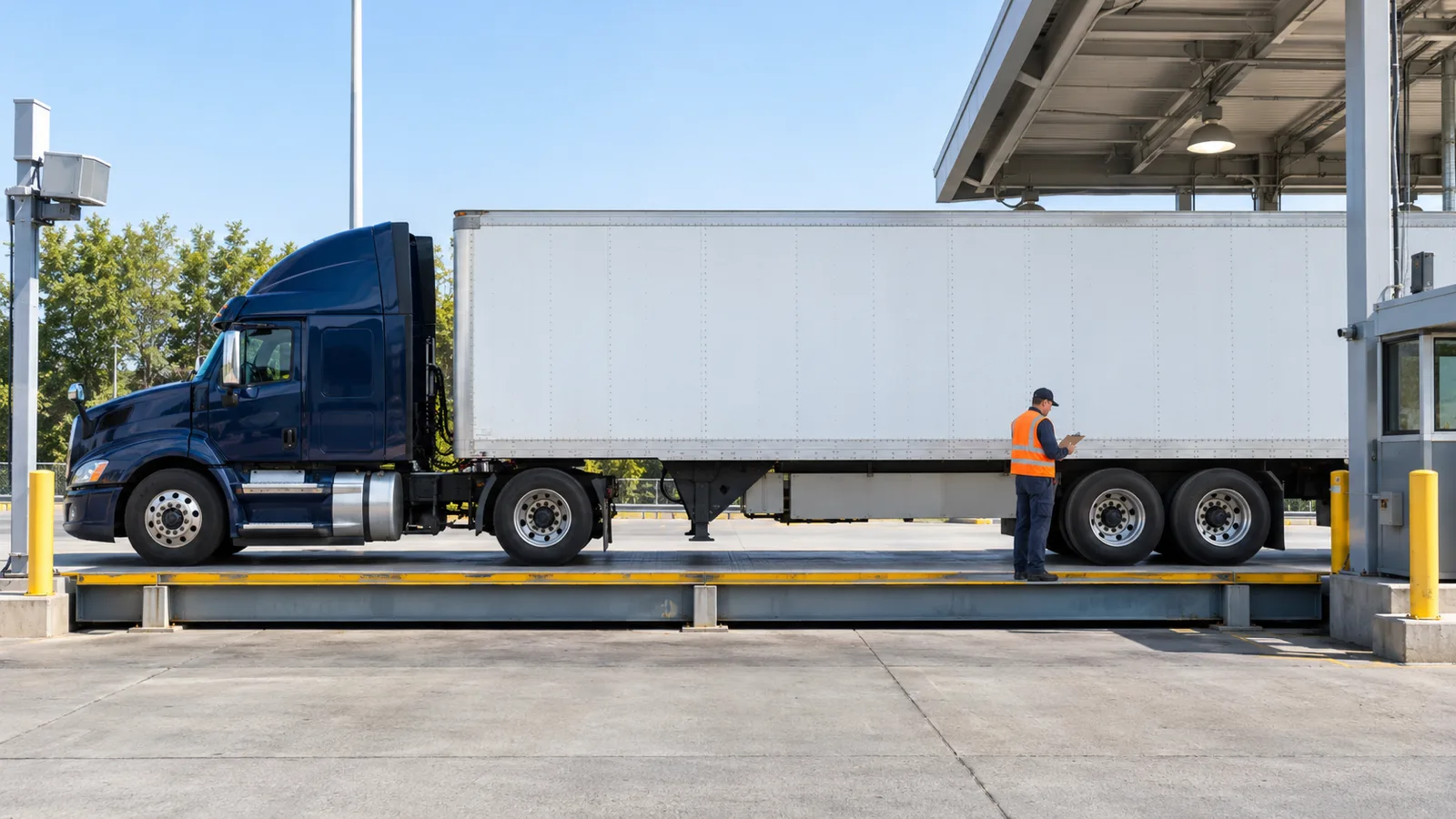
A beverage company in Guelph lands a large order from a retailer's distribution centre and decides to ship it as a full truckload. The warehouse team fills a 53-foot trailer to the doors with cases of canned drinks, 26 pallets in all. The driver pulls onto Highway 401, rolls into a truck inspection station, and is told the trailer is several thousand kilograms over the legal limit. The truck has to return, the load is partially unloaded, and the company now needs a second truck for the remainder. What looked like efficient loading ended up costing two trucks, a missed appointment and a frustrated customer.
Heavy, dense products such as beverages, paper, metal parts, tiles and building materials can easily exceed legal truck weight limits long before the trailer runs out of space. Large or awkward items can exceed dimension limits. And freight crossing into the United States faces different rules again. Understanding the basics of Ontario's weight and size limits helps you plan loads that move on the first attempt.
This guide is written for shippers, not engineers. It explains the key limits in plain terms, shows how loads go wrong, and offers practical steps to build legal, efficient shipments.
Who Sets the Rules
Vehicle weights and dimensions in Ontario are governed by the Highway Traffic Act and its regulations, enforced by Ministry of Transportation enforcement officers and police. Since the late 2000s, Ontario has used a set of vehicle design standards known as SPIF, which stands for Safe, Productive and Infrastructure-Friendly. SPIF defines which combinations of tractors, trailers and axles qualify for higher weights, with the goal of protecting roads and bridges while allowing productive loads.
For shippers, the practical point is this: the legal weight of a truck depends on its configuration. The number of axles, how far apart they are, and whether the trailer meets SPIF standards all change how much the truck may carry. That is why two carriers can give you different maximum payloads for what looks like the same trailer.
The Key Numbers in Plain Terms
The figures below are general guidance for common equipment. Always confirm specific limits with your carrier for the exact configuration they will send.
Dimensions
- Width: 2.6 metres, about 8 feet 6 inches, is the standard maximum without a permit.
- Height: 4.15 metres, about 13 feet 7 inches, measured from the road to the top of the load or vehicle.
- Semitrailer length: standard semitrailers can be up to 16.2 metres, the familiar 53-foot trailer.
- Overall length: a tractor-semitrailer combination is generally limited to 23 metres overall, with longer limits for certain double-trailer combinations.
Weights
- Standard five-axle tractor-trailer: commonly allowed to gross roughly 39,500 to 41,000 kilograms in Ontario, depending on axle spacings and configuration.
- Tractor with a tridem trailer: adding a third trailer axle can raise the allowable gross weight substantially, which suits dense freight.
- Multi-axle combinations: certain B-trains and multi-axle configurations can gross up to 63,500 kilograms, among the highest limits in North America.
- Axle and axle group limits: each axle group has its own limit, so a truck can be overweight on one axle group even when the total gross weight is legal.
Remember that gross weight includes the tractor, the trailer and the fuel. A typical tractor and 53-foot dry van might weigh 14,000 to 16,000 kilograms empty, so the payload available for your freight is far less than the gross number suggests. For a standard five-axle dry van in Ontario, many carriers plan on somewhere around 23,000 to 25,000 kilograms of payload as a practical working figure.
Three Ways Loads Go Wrong
1. Weighing out before cubing out
This is the Guelph beverage example. Dense products fill weight capacity long before the trailer is full. If you load by pallet count rather than by weight, you can easily overshoot. A rough rule: if your pallets weigh more than about 900 kilograms each, you probably cannot fill all 26 floor positions of a 53-foot trailer with a standard five-axle truck.
2. Poor weight distribution
Even when the total is legal, putting the heaviest pallets at the front of the trailer can overload the tractor's drive axles. Putting them all at the back can overload the trailer axles. Drivers can sometimes slide the trailer's axles to rebalance, but only within limits. Heavy pallets should be spread along the trailer, with the weight centred over the axle groups as much as possible.
3. Overheight or overwidth freight
Machinery, crated equipment and tall loads on flatbeds can exceed the height limit once the deck height is added. A piece that measures 3 metres tall sitting on a 1.5-metre flatbed deck is already over 4.15 metres. Step-deck and lowboy trailers exist for exactly this reason. Our post on flatbed and oversized freight explains when you need specialized equipment.
Cross-Border Freight: The Weight Gap
Ontario allows heavier trucks than most US states. On the US Interstate highway system, the federal gross weight limit for a standard tractor-trailer is 80,000 pounds, about 36,287 kilograms, with limits of 20,000 pounds on a single axle and 34,000 pounds on a tandem. Some states allow heavier loads on certain roads or with permits, but the federal limit applies on most Interstate routes.
That means a load built to Ontario's limits may be overweight the moment it crosses the Ambassador Bridge or the Peace Bridge. If you ship to US customers, build loads to the US limit from the start. For a standard dry van, that usually translates to a practical payload of roughly 20,000 to 21,000 kilograms, several thousand kilograms less than the same truck could carry within Ontario, depending on the tractor and trailer weights. Confirm with your carrier, since lighter equipment allows more cargo.
It is also worth checking the state limits along the full route. A load that is legal in Michigan may face different rules in Ohio or Indiana. Our cross-border shipping team can help you build compliant US loads.
Oversize and Overweight Permits
When a load cannot be divided and exceeds normal limits, the carrier can apply for a special permit. In Ontario, the Ministry of Transportation issues oversize and overweight permits for provincial highways, while municipalities issue permits for their own roads. Permits can be single-trip, project-based or annual, depending on the type of move.
Permits usually come with conditions, such as:
- Specific approved routes that avoid weak bridges or low clearances.
- Travel time restrictions, such as daylight-only movement or bans during holiday weekends.
- Escort vehicles for very wide or long loads.
- Signs, flags and lights on the vehicle and load.
Permits apply only to loads that cannot reasonably be broken down. You cannot get a permit to carry extra pallets of a divisible product. Build lead time into any project that involves oversize freight, as approvals and escort arrangements take time.
Long Combination Vehicles
Ontario allows long combination vehicles, or LCVs, under a special permit program. These typically pull two full-length trailers behind one tractor on designated highways, mostly the 400-series, with strict rules on drivers, equipment, speed and weather. LCVs are attractive for high-volume, light freight moving between major hubs, such as between distribution centres in the GTA and terminals in Ottawa or London. They do not raise weight limits beyond what the configuration allows; their benefit is cube.
Practical Steps for Shippers
Know your pallet weights
Weigh representative pallets of each product and record the figures in your system. If you do not have a floor scale, your warehouse partner should. Accurate weights are the foundation of every good load plan.
Plan loads by weight and cube
Use a simple load plan showing pallet count, total weight and position in the trailer. For mixed loads, place heavy pallets in the middle and light ones toward the ends. Cartonization and load planning tools in a warehouse management system help get the right products into the right size containers and pallets.
Share accurate information with your carrier
Tell the carrier the total weight, pallet count, dimensions and any heavy or tall items when you book. Carriers can then send suitable equipment, such as a tridem trailer for heavy freight in Ontario or a step-deck for tall machinery.
Consider splitting heavy loads
When freight is too heavy for one truck, compare options. Two trucks, a heavier-capacity configuration, or a truckload plus an LTL shipment may each be the cheapest answer depending on the lane.
Watch for seasonal limits
Weight limits are not the same all year. In spring, many municipal roads and some highways in Northern Ontario reduce allowable axle weights during the thaw. A load that is legal in July may not be legal on a rural road in April.
Frequently Asked Questions
Who pays if a truck is overweight?
The carrier and driver face the fines and convictions, which affect the carrier's safety record. But the shipper often bears the practical cost: delays, reloading, a second truck and possible charges from the carrier for an inaccurate weight declaration.
How many pallets fit in a 53-foot trailer?
Typically 26 standard 48 by 40 inch pallets loaded two across and single-stacked. Weight, not space, often becomes the true limit for dense products.
Does LTL freight face the same limits?
Yes, though the LTL carrier manages the trailer's total weight. Very heavy or oversize individual pieces may require special handling or be refused, so declare weights and dimensions accurately.
Build Better Loads With ShipCarte
ShipCarte helps businesses across Ontario plan full truckloads, LTL shipments and cross-border freight that stay within legal limits while making the most of every trailer. From accurate pallet weights in our warehouses to carrier selection for heavy or oversize loads, we can help. Request a quote or schedule a consultation to plan your next load.