
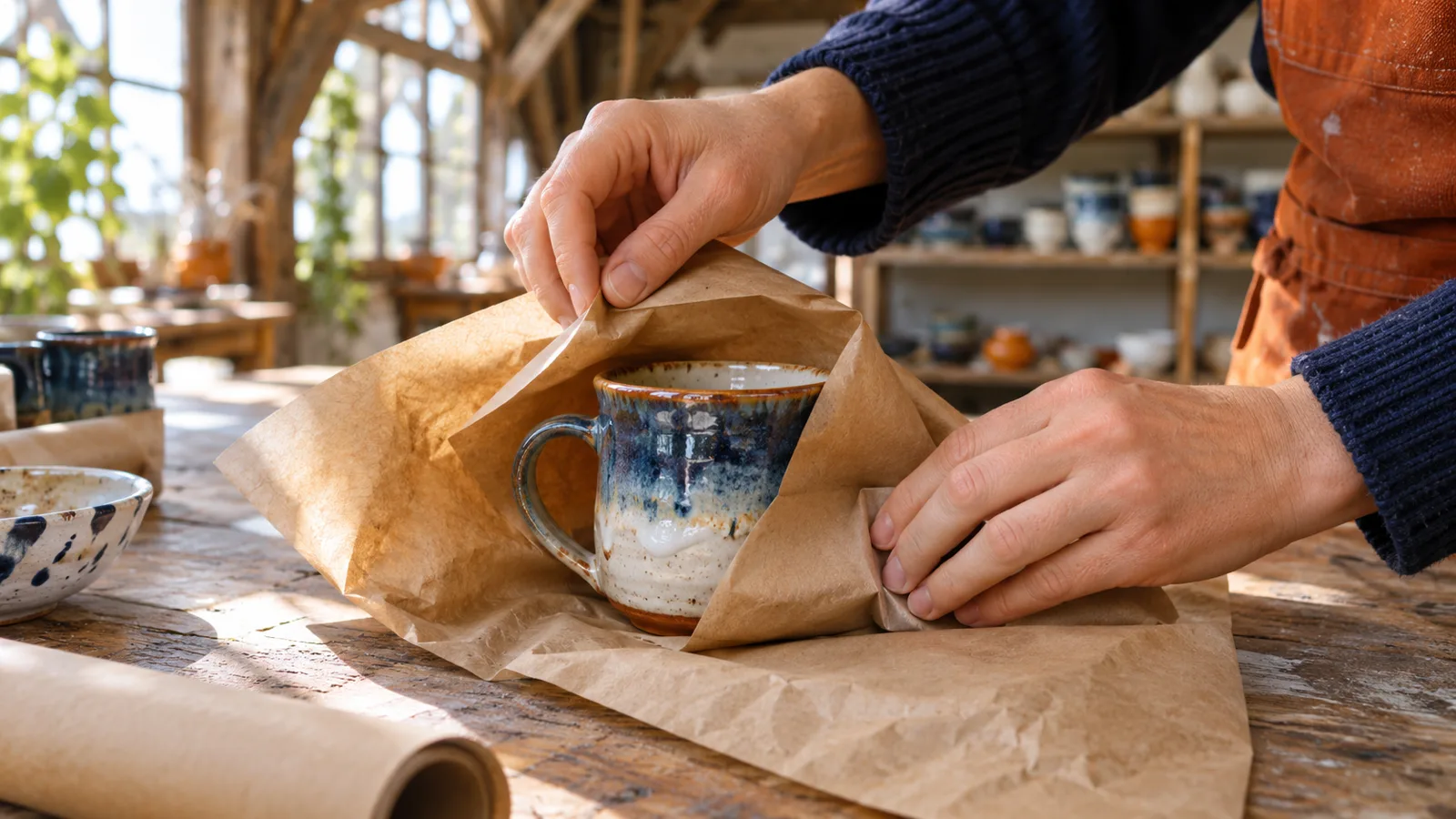
A potter in Prince Edward County spends two days throwing, glazing and firing a set of mugs, sells them to a buyer in Saskatoon, wraps them carefully and drops the box at the post office. Ten days later a photo arrives: one handle snapped off in transit. The refund wipes out the profit on the whole order, and the replacement means more studio hours. Down the road in Muskoka, a candle maker discovers that her summer orders to Windsor are arriving with tops that have melted and re-set unevenly. In Hamilton, a jewellery maker realises she has been paying parcel rates on orders that could have gone as much cheaper mail.
Ontario has a remarkable community of makers: ceramicists, woodworkers, knitters, soap and candle makers, printmakers, leatherworkers and jewellers, selling through Etsy, their own websites, Instagram and craft shows. Shipping is rarely the part of the business they love, yet it often decides whether a handmade product is profitable. Postage, packaging and breakage can eat a third of a small order's margin if they are not managed.
Rather than a generic list, this guide is organised around the questions Ontario makers ask most, with answers grouped by the kinds of products they sell.
How do I stop paying parcel rates for small, flat items?
Jewellery, art prints, stickers, patches, pins and greeting cards are often light and thin enough to travel as mail rather than as a parcel. Within Canada, Canada Post's letter and oversized letter services are far cheaper than its parcel services, but they generally come without tracking, and items must stay within size and thickness limits. A padded envelope with earrings may qualify; a small box usually will not.
The trade-off is protection. Untracked mail leaves you with no proof of delivery, so many makers set a rule: untracked mail for low-value orders, tracked service above a set dollar amount. Make your policy clear in your shop so buyers understand what they are paying for.
For US buyers, tracked small-packet services are often much cheaper than courier options for lightweight items under a couple of kilograms. They take longer, so set honest delivery estimates in your listings.
How do I ship ceramics, glass and other fragile pieces?
Breakage is the most painful shipping problem for makers, because every broken piece represents hours of work. The approach that works is consistent and slightly over-engineered:
- Wrap each piece individually, with extra padding around handles, spouts and rims.
- Fill hollow pieces, such as mugs and vases, with crumpled paper so the walls are supported from inside.
- Use a box at least five centimetres larger than the wrapped item on every side, and fill the gap completely.
- For valuable or very delicate work, use the box-in-box method: a padded inner box suspended inside a larger outer box.
- Shake test before you seal. If anything moves, add more fill.
Our guide to packing fragile items goes into more detail. Remember that a "fragile" sticker does not change how a parcel is handled on automated sorting equipment. The packaging has to survive a drop.
My candles and soaps melt or sweat in summer. What can I do?
Southern Ontario summers are hot and humid, and parcels can sit in delivery trucks for hours. Container candles with soft wax are especially vulnerable. A few tactics help:
- Ship early in the week so parcels do not sit in a depot over a weekend.
- Use faster services in July and August, even if it costs a little more.
- Seal lids tightly and place each candle in a sealed bag in case wax shifts.
- Choose lighter-coloured outer packaging, which absorbs less heat.
- For long-distance orders during heat waves, consider holding shipments for a day or two and telling the customer why.
Winter brings the opposite problem for some products. Liquid soaps, lotions and some glazes can freeze in transit to northern Ontario or the Prairies in January. Freezing may not damage every product, but customers may assume something is wrong if a lotion separates.
Makers of soap, balms and other cosmetics should also remember that Health Canada requires a Cosmetic Notification Form to be filed within ten days of first selling a cosmetic in Canada, and that ingredient labelling rules apply even to handmade products.
How do I ship furniture, woodwork and large pieces?
Woodworkers and furniture makers in places like Grey County, the Ottawa Valley and Elora face a different challenge: items too big or heavy for standard parcel services. A cutting board ships easily. A dining table does not.
For large pieces, palletised freight through an LTL carrier is usually far cheaper than oversized parcel rates. Crate or palletise the piece, wrap it in moving blankets and stretch film, and book residential delivery with a liftgate if the buyer has no loading dock. Quote freight carefully before you price large items, because delivery to a rural address can cost more than delivery to a city.
Why is shipping a light box so expensive?
Dimensional weight is the usual culprit. Carriers charge based on whichever is higher: the actual weight or a weight calculated from the box's dimensions. A large, light box of knitted blankets or pillows can be billed as if it weighs several times more than it does. Measuring your boxes and choosing the smallest one that still protects the product is one of the easiest savings available. Our explainer on how package dimensions affect shipping costs walks through the calculation.
How do I keep up during craft show season?
For many Ontario makers, the busiest weeks of the year are the run-up to Christmas, when the big craft shows in Toronto and Ottawa and countless church, community and holiday markets across the province overlap with online holiday orders. Inventory gets split between your booth and your online shop, and orders pile up while you are standing behind a table.
- Set aside a specific number of each product for online sales so you do not oversell.
- Pre-build packaging kits, with boxes cut, wrap prepared and inserts printed, before show season starts.
- Post clear holiday shipping cut-offs in your shop and on social media.
- Consider pausing custom orders a few weeks before Christmas.
- Book a regular courier pickup so you are not lining up at the post office between shows.
I live in a rural area. How do I get parcels out the door?
A lot of Ontario makers work from rural studios: a converted barn near Creemore, a workshop on the Bruce Peninsula, a cabin outside Haliburton. Courier pickup may only be available on certain days, and the nearest post office might be a small rural outlet with limited hours and early dispatch times. That changes how you plan your week.
- Learn the actual dispatch time at your local post office, not just its opening hours. A parcel dropped after the truck leaves will not move until the next day.
- Batch your packing for the days when pickup is available, and tell customers your real dispatch days in your shop policies.
- If you regularly drive into a larger centre such as Barrie, Owen Sound or Peterborough, schedule drop-offs around those trips.
- Factor in that inbound supplies, from boxes to raw materials, also take longer to reach you. Keep a few weeks of packaging on hand, especially before the holidays.
Rural makers also tend to see more delivery problems on inbound returns, since a returned parcel may sit at a local outlet waiting for pickup. Check tracking regularly so nothing is left unclaimed.
What about taxes and fees?
Once your worldwide taxable sales exceed $30,000 over four consecutive calendar quarters, you need to register for and charge HST, which is 13 percent for Ontario buyers and different rates for other provinces. Many makers register voluntarily earlier so they can claim input tax credits on supplies. Remember that marketplace fees, payment processing fees and packaging costs all come out of your margin, so build them into your pricing alongside postage.
Is it worth getting business shipping rates?
Almost always. Canada Post's small business program offers discounts off counter prices, and couriers and multi-carrier shipping platforms can offer negotiated rates even at modest volumes. Printing labels at home also saves trips and makes it easier to track every parcel in one place. A shipping platform that compares carriers for each order can quickly show you which service is cheapest for each destination and box size.
When should I stop shipping from my kitchen table?
Some makers love packing every order themselves, and for one-of-a-kind work that personal touch matters. But as a shop grows, packing can crowd out making. Signs that it may be time for help:
- you regularly spend more than a day a week on packing and shipping
- you have a few bestselling products that sell in steady volume
- you are launching wholesale accounts that need case packs and labelled cartons
- holiday volume is more than you can handle alone
A fulfillment partner can store your consistent sellers, pack orders the same day and ship them at volume rates, while you keep handling custom and one-off pieces yourself. If you sell gift sets or bundles, kitting and assembly services can build them ahead of the holiday rush. For more on selling handmade goods nationally, see our guide to Etsy and handmade shipping in Canada.
Let us take some of the shipping off your bench
ShipCarte works with small businesses across Ontario, from home studios to growing brands, on small parcel shipping, discounted rates and full ecommerce fulfillment. Request a quote and see how much time and postage you could save.