
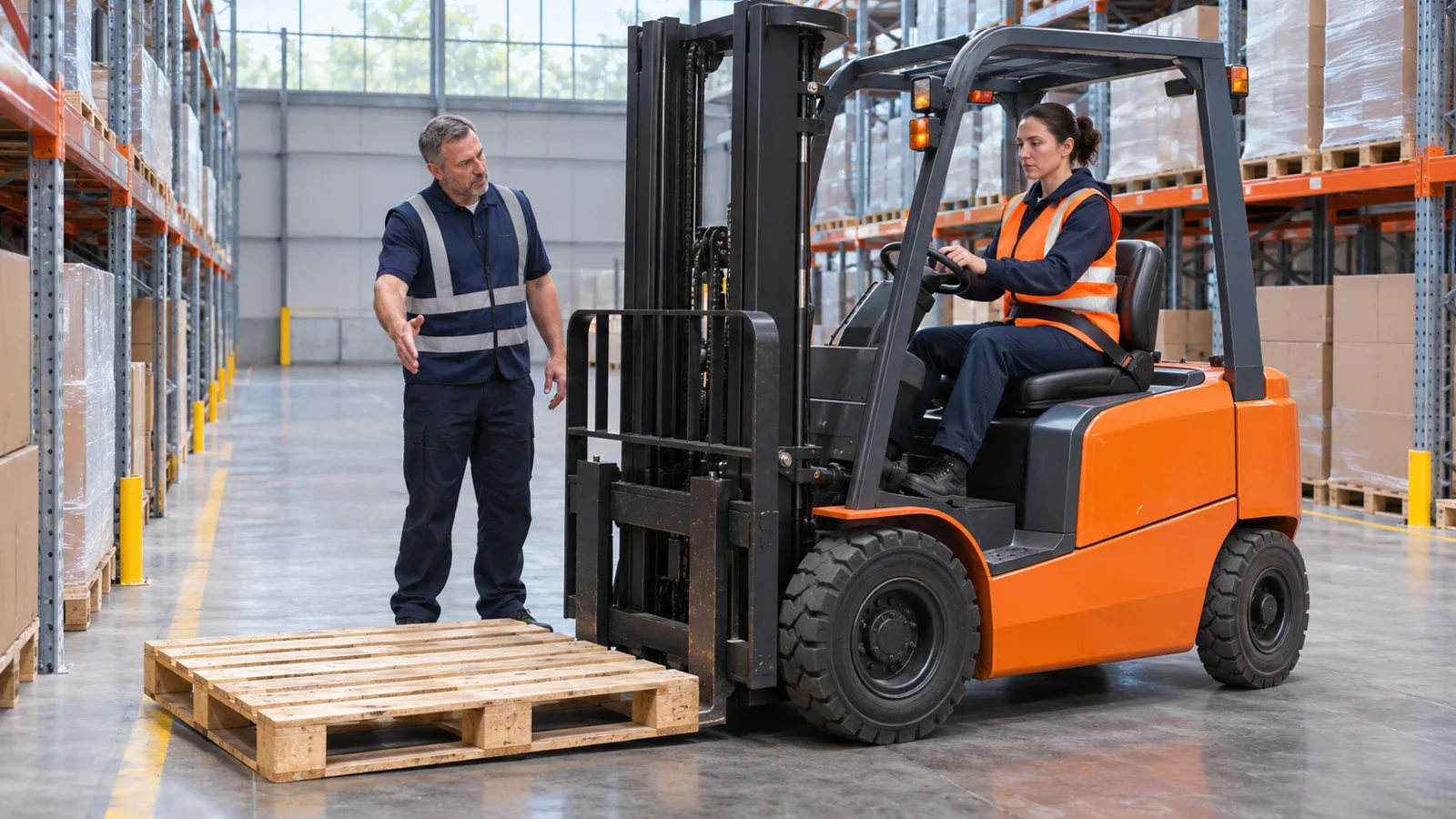
Spring is when a lot of Ontario warehouses start hiring for the busy half of the year. A distributor in Kitchener picks up a new contract, a food importer in Vaughan adds a second shift, a seasonal garden-products company in the Niagara region brings back its temporary crew. Within a week someone on the floor asks the obvious question: "Can the new guy just hop on the forklift? He says he drove one at his last job."
That question has caused more trouble for Ontario employers than almost any other in material handling. A worker's say-so, or even a wallet card from a previous employer, does not make that person competent to drive your equipment in your building. When something goes wrong, the inspector from the Ministry of Labour, Immigration, Training and Skills Development who shows up will ask what training you provided, what you evaluated, and where the records are. "He told us he had a licence" is not an answer that ends well.
This guide walks through what the rules in Ontario actually say about forklift operators, what a solid training program looks like in practice, and how warehouse managers can build a system that holds up on a busy Tuesday and during an inspection alike.
There Is No Provincial "Forklift Licence" in Ontario
The first thing to clear up is the most common misunderstanding. Ontario does not issue a government forklift licence the way the Ministry of Transportation issues a driver's licence. The cards that training companies hand out are proof that a person completed a course on a particular day, on particular equipment. They are useful evidence, but they are not a licence and they do not transfer automatically from one employer to the next.
What the law does is place the duty squarely on the employer. Under the Occupational Health and Safety Act, employers must provide information, instruction and supervision to protect workers, and must make sure equipment is operated in a safe way. The Regulation for Industrial Establishments (Regulation 851) goes further for lifting devices: a lift truck has to be operated only by a competent person, and it must be inspected and maintained so it can be used safely.
What "competent person" means
The Act defines a competent person as someone who is qualified because of knowledge, training and experience to organise the work and its performance, is familiar with the Act and regulations that apply to the work, and has knowledge of any potential or actual danger to health or safety in the workplace. Read that carefully and you'll notice it is specific to the work and the workplace. An operator who was competent on a sit-down counterbalance truck in a Windsor auto parts plant is not automatically competent on a narrow-aisle reach truck in your Ottawa distribution centre with 30-foot racking and pedestrian cross-traffic.
Where CSA B335 fits in
The Canadian Standards Association's B335 standard for lift truck safety is the reference most Ontario trainers build their programs around. It sets out what operator training should cover, how evaluation should work, and how often operators should be re-evaluated. The standard itself is not automatically law in Ontario, but inspectors, insurers and courts treat it as the benchmark of reasonable practice. If your program lines up with B335, you are in a strong position. If it doesn't, you will need a very good reason why.
The Three Parts of a Proper Training Program
Good forklift training in Ontario has three distinct pieces, and skipping any one of them is where most programs fall short.
- Classroom or theory instruction. This covers how a lift truck works: the stability triangle, load centres, the data plate and rated capacity, why a truck tips when it turns with a raised load, braking distances, and the specific hazards of the type of truck being used. It also covers the rules of your site, such as speed limits, horn use at intersections, pedestrian walkways and dock procedures.
- Practical, hands-on training. The trainee operates the actual class of truck they will use, under the eye of a qualified trainer, in conditions that resemble the real job. That means picking up and placing loads at height, travelling with a load, working in the dock area and entering trailers if that's part of the role.
- Evaluation. Someone qualified watches the trainee perform and documents whether they met the standard. A written test alone is not an evaluation. The practical assessment is what demonstrates competence.
The evaluation step deserves extra attention, because it is the one that gets quietly dropped when the floor is short-handed. A trainee who sat through a morning of slides and drove around an empty parking lot has not been evaluated on loading a 53-foot trailer at your dock.
Matching Training to the Truck and the Building
Lift trucks come in several classes, from electric rider trucks and narrow-aisle reach trucks to internal combustion counterbalance trucks with cushion or pneumatic tires, electric pallet jacks and walkie-stackers, and rough-terrain machines used in yards. Each has different handling characteristics. A reach truck operator stands sideways, the mast moves independently, and the truck behaves very differently from a sit-down counterbalance machine.
Training must match what the worker will actually drive. If someone trained on a counterbalance truck is moved to a reach truck because of a staffing gap, they need additional practical training and evaluation on that class before they operate it alone.
Site-specific familiarisation matters just as much. Every Ontario warehouse has its own quirks:
- A building in Hamilton's older industrial area might have uneven floors, column-dense layouts and dock plates that need manual positioning.
- A newer cross-dock along Highway 401 in Milton or Cambridge might have very wide aisles but heavy truck traffic and tight dock scheduling.
- A cold storage facility needs training on visibility through fogged glasses, slower stopping on frosted floors and battery performance in the cold.
- A facility in Thunder Bay or Sudbury may involve outdoor yard work in snow and ice for a good part of the year.
Document the site-specific portion separately from the general course so you can show that each operator was familiarised with your actual building, traffic routes and procedures.
Propane Trucks and the TSSA Requirement
Many Ontario warehouses still run propane-powered counterbalance trucks. Swapping a propane cylinder is a regulated activity. Ontario's propane regulations, administered by the Technical Standards and Safety Authority (TSSA), require anyone who handles propane, including changing a forklift cylinder, to have the appropriate training and a record of it. Operators who swap their own cylinders need that training in addition to their lift truck training, and the employer should keep the record on file. This is a frequent gap in otherwise sound programs.
Electric trucks have their own risks around battery charging and changing: hydrogen gas during charging, acid exposure, and the weight of the battery itself. Battery handling should be covered for anyone who charges or changes batteries, with the right eye protection and eyewash available nearby.
Pre-Use Inspections Are Part of the Job
Regulation 851 requires lifting devices to be maintained in a condition that does not endanger workers, and the practical way to meet that is a documented pre-shift inspection. Operators should check forks for cracks and wear, the mast and chains, hydraulic leaks, tires, brakes, steering, horn, lights, seat belt, the data plate and the fluid or battery levels before they start.
A paper checklist clipped to the truck works. A digital one tied to the truck's ID works better, because it's harder to fill in retroactively and easier to audit. Whichever you use, the rule must be simple: if a truck fails inspection, it is tagged out and reported, and nobody drives it until it's fixed.
How Often Operators Should Be Re-evaluated
B335 calls for operators to be re-evaluated at least every three years, and that has become the standard practice across Ontario. But a calendar date is only the minimum. Re-training and re-evaluation should also happen when:
- An operator is involved in an incident or a near miss.
- An operator is seen driving unsafely or a supervisor has concerns.
- The operator is assigned to a different class of truck.
- The workplace changes in a way that affects safe operation, such as new racking, a re-slotted layout, a new mezzanine or a change in dock configuration.
- The operator has been away from the equipment for a long stretch.
Keep a tracking sheet or use your warehouse system to flag operators whose evaluations are coming due. It is surprisingly easy for a three-year cycle to slide to four or five when a building is busy.
Temporary Workers and Agency Staff
Ontario warehouses lean heavily on temporary help agencies, especially between September and December. Under the Occupational Health and Safety Act, the client employer still has duties for the safety of agency workers in its workplace. Under the Workplace Safety and Insurance Act, injury costs for agency workers have generally been charged to the agency, but that doesn't remove your exposure under the OHSA if an agency worker is hurt operating equipment in your building without proper training.
The practical approach is to treat an agency operator exactly like a new hire. Ask for proof of prior training, then provide your own site-specific training and practical evaluation before that person drives alone. Agreements with agencies should spell out who provides what training and who holds the records.
Pedestrians Are the Other Half of the Problem
Most serious forklift incidents in Ontario involve a pedestrian rather than a tip-over. Training operators is essential, but training the people who walk the floor is equally important. Pickers, packers, receivers, visiting drivers and managers all need to know the traffic rules: designated walkways, where not to stand, eye contact before crossing, and staying clear of trucks during loading.
Physical controls help more than signs. Painted pedestrian lanes, barriers at blind corners, convex mirrors, blue spotlights on trucks, and separate entrances for walking traffic all reduce exposure. The best-run pick and pack operations design the layout so pickers on foot and trucks replenishing pick faces cross paths as little as possible.
Records That Hold Up
When a ministry inspector visits, or after an incident, the questions will come quickly. Have these ready for every operator:
- The date and content of theory training, and who delivered it.
- The classes of truck the person was trained and evaluated on.
- The practical evaluation, signed by the evaluator, with the result.
- Site-specific familiarisation, with the date.
- Propane handling training records, if applicable.
- The re-evaluation due date.
- Proof the worker completed the mandatory Ontario Worker Health and Safety Awareness training, and that supervisors completed the supervisor version.
Keep inspection checklists and maintenance records for each truck as well. Together these show a system rather than a set of good intentions.
Common Questions from Ontario Warehouse Managers
Can a new hire use their training card from another company?
It's useful as evidence of prior theory training, and it may shorten your program. But you still need to evaluate the person on your trucks, in your building, and document it. Competence has to be established for your workplace.
Who can deliver the training?
An outside training provider or a qualified in-house trainer. Many larger warehouses in the GTA and Ottawa train one or two experienced staff as internal trainers through a train-the-trainer course, which makes it easier to onboard new staff quickly while staying consistent.
Does an electric pallet jack need training?
Yes. Powered pallet trucks and walkie-stackers are lift trucks under the standard, and they cause a steady stream of foot and leg injuries. Training can be shorter, but it still needs theory, practice and evaluation.
What does the joint health and safety committee need to know?
Workplaces with 20 or more regularly employed workers need a joint health and safety committee, and it should be reviewing lift truck incidents, near misses and inspection findings. If your committee never talks about forklifts, that's a gap worth closing.
The Cost Side of Getting It Right
A thorough training program costs money and floor time. A full course with practical evaluation can take most of a day per operator, and re-evaluations need to be scheduled around production. Against that, consider the cost of a single serious incident: lost time, WSIB premium impact, damaged product and racking, possible charges under the OHSA, and the effect on a crew that watched it happen.
Well-trained operators also move product better. They damage less inventory, pull fewer pallets off the wrong location, and put product away in the right spot the first time, which keeps inventory accuracy where it should be. Training is a safety requirement, but it shows up in productivity numbers too.
When Outsourcing Makes More Sense
For many growing brands, running a forklift fleet, maintaining training records, managing a joint health and safety committee and handling the seasonal temp-staff scramble is simply not their core business. Using a third-party warehouse transfers the day-to-day management of equipment, operators and compliance to a team that does it every day.
ShipCarte operates dedicated warehousing and distribution warehousing for businesses across Ontario, with trained operators, documented procedures and a warehouse management system that ties every pallet movement to a location and a user. If you're weighing whether to keep material handling in-house, it's worth reading how a good putaway process depends on the people driving the trucks.
Talk to ShipCarte
Whether you want help thinking through your own warehouse setup or you're ready to hand the floor to a 3PL, we're happy to talk it through. Schedule a consultation with our team and we'll look at your volumes, your products and the space you need across Ontario.