
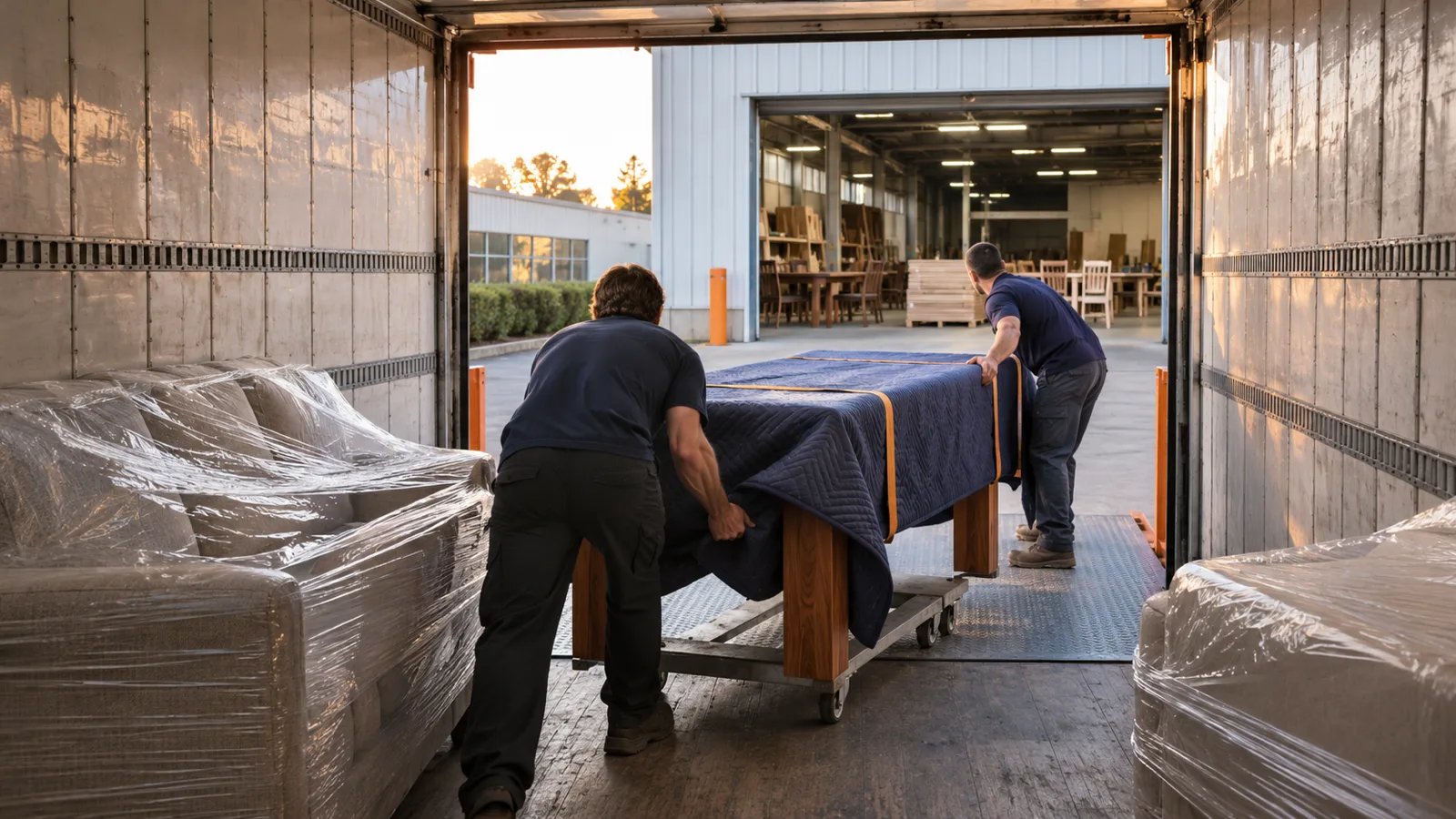
A solid maple dining set leaves a workshop in Waterloo Region on a Tuesday. By Friday it is sitting in a customer's front hall in Kingston with a cracked leg, a gouged tabletop and a carrier claim form that will take six weeks to resolve. The maker eats the cost of a replacement build, the retailer who sold it is irritated, and the customer posts about it. Nothing went "wrong" in the factory. The problem started at the loading dock.
Furniture is one of the hardest product categories to move well. It is bulky but often light for its size, it has finished surfaces that scuff at a glance, and it frequently ends its journey at a house rather than a dock. Ontario has a deep furniture-making tradition, from the old case-goods plants in the Kitchener and Stratford area to upholstery shops in the GTA and custom woodworkers in Grey-Bruce and the Ottawa Valley, and every one of them eventually runs into the same question: how do we get this to the buyer without losing the margin in transit?
This guide walks through the decisions that matter most for furniture manufacturers shipping in Ontario and beyond, from packaging and freight class to choosing between LTL, dedicated trucks and pooled deliveries.
Why furniture freight behaves differently
Most freight pricing assumes a dense, rectangular, stackable pallet. Furniture rarely fits that picture. A three-seat sofa might weigh 70 kilograms but take up the floor space of a pallet and a half, and nothing can be stacked on it. A flat-packed bookcase, on the other hand, is dense and stackable but long enough to overhang a standard 48 x 40 pallet. Carriers price both of these situations differently, and if your bill of lading does not describe them correctly you will see it on the invoice.
Three characteristics drive most of the cost and risk:
- Low density. Upholstered pieces and assembled case goods are mostly air. Under the freight classification system used by most North American LTL carriers, low-density shipments fall into higher classes, which means higher rates per hundredweight.
- Fragile finishes. Lacquered tops, glass inserts, stone surfaces and exposed corners are easily damaged by forklift tines, strapping and other freight shifting against them.
- Non-stackable shapes. When nothing can sit on top of your shipment, the carrier loses cube in the trailer. Expect to pay for that lost space, either through a higher class or a linear-foot charge.
Understanding these three issues is the starting point for every other decision, because almost every shipping improvement a furniture maker can make is about increasing density, protecting finishes or making the load easier to handle.
Packaging that survives an Ontario freight network
A piece of furniture going from a plant near London to a store in Ottawa will likely be handled several times: loaded at your dock, unloaded and cross-docked at a terminal, reloaded onto a linehaul trailer running the 401, cross-docked again, then placed on a city delivery truck. Each touch is a chance for damage. Good packaging assumes all of those touches will happen.
Case goods and tables
Dressers, sideboards and tables benefit from corner protectors on every exposed corner, edge board along long runs, and a full corrugated carton or wooden crate for high-value pieces. Drawers should be secured so they cannot slide open, and hardware should be removed and bagged where possible. Legs that can be removed should be shipped detached; a table that ships with legs attached is a cracked leg waiting to happen.
Upholstered pieces
Sofas and chairs usually ship in a polybag with a corrugated cap on each end and a full carton or a "skeleton" crate. Polybags alone protect from dust but not from punctures. If your upholstered goods go LTL, a carton plus a pallet or skid underneath is worth the cost, because it gives the forklift operator something to lift other than the frame of your sofa.
Glass, mirrors and stone
These should be crated and marked clearly with orientation arrows. Mirrors and glass are usually shipped on edge rather than flat. For stone or quartz tops, consider shipping them separately from the base in their own crate so a dropped base does not take the top with it.
One practical rule: if you would not be comfortable watching your packaged piece be lifted by a forklift with the tines a few centimetres off-centre, it is not packaged well enough for LTL.
Getting freight class and description right
Many furniture makers in Ontario first discover freight class when an invoice arrives with a "reclass" or "reweigh" adjustment. Carriers inspect shipments at their terminals, and if the actual dimensions or weight differ from what is on the bill of lading, they adjust the charge.
For furniture, the class is commonly determined by density (pounds per cubic foot). To calculate it, measure the shipment as packaged, including the pallet, multiply length by width by height in inches, divide by 1,728 to get cubic feet, and divide the weight in pounds by that number. A packed armchair at 90 pounds measuring 36 x 36 x 40 inches works out to 30 cubic feet and a density of 3 pounds per cubic foot, which falls into a high class. The same chair flat-packed into a 36 x 30 x 16 inch carton would be denser and cheaper per pound to move.
A few habits help avoid nasty surprises:
- Measure every SKU as packed and record the dimensions in your product master, not just the product dimensions.
- Weigh representative shipments on a certified scale rather than estimating.
- Describe goods accurately on the bill of lading ("upholstered sofa, cartoned, on skid") instead of a generic "furniture".
- Flag non-stackable freight up front so the carrier plans for it rather than charging after the fact.
If package dimensions are new territory for your team, our guide on how package dimensions impact shipping costs covers the basics of dimensional pricing for smaller cartons as well.
Choosing the right mode for each order
Furniture manufacturers usually ship in three patterns: full loads to retailers or distribution centres, partial loads of a few pallets to stores, and single pieces to consumers. Each needs a different approach.
Full truckload to retailers
When a national or regional retailer orders a seasonal program, you may fill a 53-foot trailer. Full truckload shipping is the safest option for furniture because the trailer is loaded once at your dock and unloaded once at the destination. No terminals, no cross-docking. Load it with load bars and air bags or dunnage between stacks, and put the heaviest, most robust pieces on the floor. Many Ontario makers ship to big-box DCs in Brampton, Vaughan or Ajax, and those receivers usually require appointments, so build those windows into your production schedule.
LTL for multi-store and dealer orders
For orders of one to six pallets, LTL freight is usually the cost-effective choice. It is also where most damage happens, because the freight goes through terminals. Ask carriers whether they offer "protect from freight" or "do not stack" service, and consider volume LTL quotes for larger multi-pallet shipments, which may be priced on space rather than class. An LTL shipment from Kitchener to Sudbury, for example, will often route through a GTA terminal before heading up Highway 400 and 69, so allow extra transit time and extra protection.
Direct-to-consumer and residential delivery
Online sales mean more furniture makers ship single pieces to homes. Residential LTL delivery generally comes with accessorial charges: residential surcharge, liftgate, appointment call-ahead and sometimes inside delivery. A curbside drop at a Mississauga townhouse is one thing; carrying a sideboard up to a third-floor walk-up in Ottawa's Glebe is another. Be clear in your checkout terms about what level of delivery the customer is buying, and price accordingly. Our explainer on delivery appointments in freight is useful background here.
A quick comparison of delivery options
- Full truckload: lowest damage risk, best price per unit at volume, needs enough product to fill or nearly fill a trailer.
- Volume or space-based LTL: good for 6 to 12 pallets of bulky goods, fewer reclass headaches, moderate handling.
- Standard LTL: flexible and widely available across Ontario, higher handling and damage exposure, class-based pricing.
- Pooled regional delivery: consolidating multiple retailer or consumer orders onto a scheduled run (for example a weekly GTA-to-Eastern Ontario route), lower cost per stop, less flexible timing.
- White-glove home delivery: two-person crews, inside placement, packaging removal, highest cost but best customer experience for premium pieces.
Warehousing finished goods closer to demand
Many Ontario furniture makers build to order and ship directly from the plant. That works when the plant is near customers, but a shop in Huron County serving buyers across the GTA and Ottawa pays for long, partly empty runs. Holding a stock of popular finished pieces in a distribution warehouse closer to the 401/400 corridor can shorten delivery times and let you consolidate shipments.
A distribution warehousing partner can receive full truckloads from your plant, store the inventory, then release orders to retailers or consumers as they come in. That also lets you move from many expensive single-piece LTL shipments to a few full loads plus local deliveries. For makers who sell online, pairing this with a connected order management system means orders from your website flow straight to the warehouse without manual re-keying.
Furniture also benefits from value-added services in the warehouse: light assembly such as attaching legs, inspection before shipment, repackaging returned items, and kitting hardware packs. Doing that work in the warehouse rather than the plant keeps your production floor focused on building.
Cross-border considerations for Ontario makers
Ontario furniture manufacturers have a natural market just across the border, and the Ambassador Bridge at Windsor, the Blue Water Bridge at Sarnia and the Peace Bridge at Fort Erie carry a steady flow of furniture freight into Michigan, Ohio and New York. Under NAFTA, furniture made in Canada that meets the rules of origin can enter the US duty-free, but you still need correct paperwork: a commercial invoice, a NAFTA certificate of origin where appropriate, and the right tariff classification. Solid wood furniture can also attract questions about wood packaging; crates and pallets must meet the ISPM 15 heat-treatment standard and carry the stamp.
The CUSMA agreement signed in late 2018 has now been ratified by Canada but has not yet entered into force, so for now NAFTA rules apply. It is sensible to keep an eye on how rules of origin may change once the new agreement takes effect in the coming months. Our cross-border shipping team can help you get documentation and customs brokerage lined up before the first load reaches the bridge.
Reducing damage claims: a practical checklist
Damage is the single biggest hidden cost in furniture shipping, because the freight charge is only part of the loss. Use this checklist with your shipping team:
- Photograph every outbound shipment, packed and labelled, before it leaves the dock. Photos are your best evidence in a claim.
- Use skids or pallets under anything that could be lifted by its frame.
- Label orientation and "do not stack" clearly on at least two sides.
- Train receivers (retailers and consumers) to note any visible damage on the delivery receipt before signing. Under most carrier terms, a clean signature makes concealed-damage claims much harder.
- Track damage by lane, carrier and SKU. If one product line or one route keeps showing up, change the packaging or the routing rather than filing claims indefinitely.
- Review carrier liability limits. Standard LTL liability is often far below the value of a finished piece of furniture, so consider freight insurance for high-value shipments.
Seasonality and capacity in Ontario
Furniture demand in Ontario has noticeable peaks: spring moving season, back-to-school for dorm and student apartment furniture, and the run-up to the holidays. Freight capacity also tightens in late spring and autumn when produce and construction materials are moving. Booking capacity early, smoothing out shipments where possible and having a warehouse buffer all help.
Winter is its own challenge. Highway 11 and 17 through Northern Ontario can close in storms, and delivery to cottage country around Muskoka or the Kawarthas can be unpredictable once the snow arrives. If you ship to these areas, build realistic transit times into your promises and make sure packaging is moisture resistant, since furniture can sit on a cold dock or in a damp trailer longer than expected.
Getting visibility without adding headcount
Smaller manufacturers often manage shipping through a mix of emails, carrier websites and spreadsheets. As volume grows, that becomes a full-time job. A single shipping platform that rates carriers, books shipments, produces bills of lading and tracks freight in one place reduces the time your team spends chasing information. It also gives you data: cost per piece by region, damage rate by carrier, average transit time to Ottawa versus Windsor. That data is what lets you negotiate better rates and fix recurring problems.
Talk to ShipCarte about your furniture freight
Whether you build solid wood tables in a small shop or run a production line supplying retailers across the province, shipping should not be the part of the business that eats your margin. ShipCarte works with manufacturers across Ontario on LTL and truckload freight, warehousing near major highway corridors and delivery programs that protect finished goods. Request a quote for your next shipment, or schedule a consultation to review how your furniture is packed, rated and routed today.