
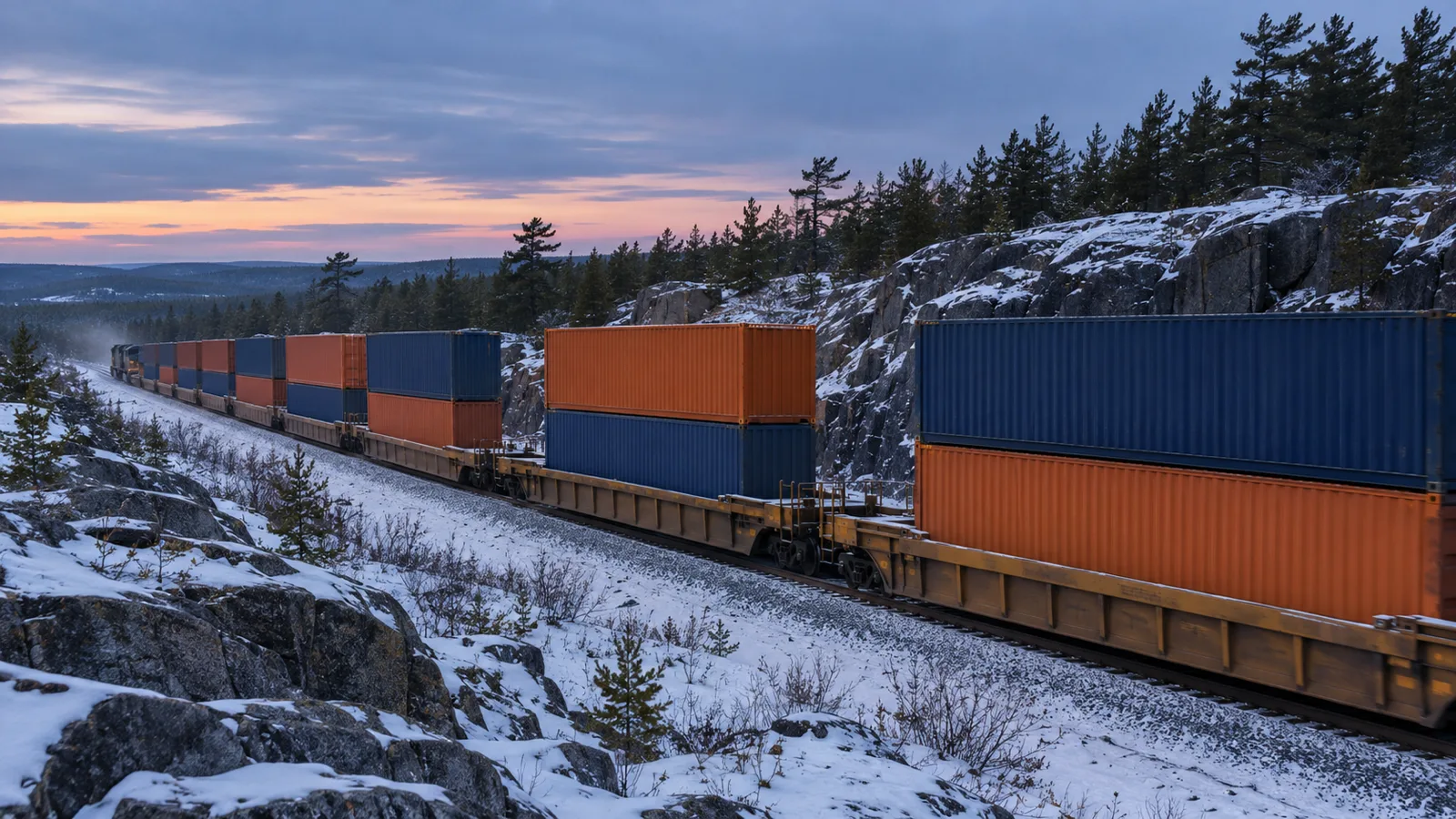
A housewares importer in Markham books a 40-foot container from Ningbo in early January, hoping to have stock on the shelves for spring. The supplier ships on time, but the box sits at a rail terminal in Vancouver for days during a stretch of heavy snow in the mountains, then waits again at an intermodal yard north of Toronto because nobody arranged a truck to pull it. By the time it reaches the warehouse, the spring promotion is half over and the storage charges have eaten into the margin.
Nearly every Ontario business that buys from China, Vietnam, South Korea, Taiwan or India faces the same basic question: should goods come through the West Coast and cross the country by rail, or travel the long way by sea to an eastern port and come into Ontario by truck or rail from there? There is no single right answer. The best route depends on what you are importing, when you need it, how much you are moving, and how much variability your business can absorb.
This article compares the main routes side by side and then covers the practical steps that decide whether a container arrives in Ontario on schedule.
The main routes from Asia to Ontario
Vancouver, then rail east
The Port of Vancouver is Canada's largest port and the default gateway for Asian containers bound for Ontario. Ocean transit from major Chinese ports is commonly in the range of two to three weeks, depending on the service and the number of port calls. From there, containers are loaded onto CN or CP intermodal trains to terminals in the Toronto area, with CN's main facility in Brampton and CP's in Vaughan. Rail transit across the country is often around five to seven days, plus time at each end for unloading and handling.
The total door-to-door time from a factory in southern China to a warehouse in the GTA is frequently four to six weeks, with longer times when rail terminals are congested.
Prince Rupert, then rail east
Prince Rupert, on the north coast of British Columbia, is closer to Asia by sea than any other major North American container port. Its terminal is served by CN, which runs containers directly to central Canada and the US Midwest. For some services, Prince Rupert offers a faster ocean leg and less port congestion than Vancouver, though it has fewer sailings and a narrower choice of carriers.
US West Coast, then rail or truck
Some importers route through Seattle, Tacoma or even Los Angeles and Long Beach, then rail to Chicago or Detroit and truck into Ontario across the Ambassador or Blue Water bridge. This can make sense when a carrier offers a better rate or when the goods are partly destined for US customers. For goods going only to Ontario, the extra border crossing usually adds complexity without much benefit.
All-water to the East Coast
The alternative is to keep the container on the ship. Services from Asia reach the US East Coast through the Panama Canal, which was expanded in 2016 to take larger vessels, or travel west through the Suez Canal to Halifax and US ports such as New York and New Jersey. From New York and New Jersey, containers are usually trucked or railed into Ontario via the Peace Bridge, Lewiston-Queenston or the Thousand Islands. From Halifax, CN carries containers inland to Montreal and Toronto.
All-water services from China to the East Coast typically take five to six weeks on the water alone, so door-to-door times are longer than through Vancouver. The trade-off is that a container on a ship is generally less exposed to inland rail congestion and winter weather in the mountains.
What about Montreal and Hamilton?
Montreal is a major container port, but most of its services are transatlantic, so Asian cargo usually arrives there only through transshipment. The Port of Hamilton and the St. Lawrence Seaway are vital for bulk goods such as steel, grain and salt, but they do not handle regular container services from Asia. For containerized imports, Ontario importers are almost always choosing between the West Coast and the eastern seaboard.
Comparing the routes
- Speed: West Coast routing via Vancouver or Prince Rupert is usually fastest from East Asia. From South Asia and Southeast Asia, Suez routings to the East Coast can be competitive.
- Reliability: the West Coast route depends on two railways crossing the Rockies. Winter storms, avalanches and terminal congestion in Vancouver can add days or weeks. East Coast routes have fewer of these choke points but more ocean days.
- Cost: ocean-plus-rail through Vancouver is often the cheapest option on a per-container basis for East Asian origins, but rates shift with the season and the market. Always compare total landed cost, including rail, drayage and terminal charges.
- Customs: routing through Canadian ports keeps the container in Canada from the moment it lands. Routing through US ports means the container moves in bond through the United States before clearing at the Ontario border.
- Inventory carrying: a longer route means more inventory in transit. For high-value goods, that cost can outweigh freight savings.
Full container or shared space?
If you cannot fill a 20-foot or 40-foot container, less than container load (LCL) shipping lets you share space with other importers. LCL cargo is consolidated at a warehouse in Asia, shipped, then deconsolidated at a warehouse in Canada, often in the GTA. It is more economical for small volumes but adds handling and a few days at each end. Our post on FCL versus LCL walks through where the break-even usually falls.
Getting the container off the rail and into your warehouse
The final kilometres are where many Ontario importers lose time and money. When a container arrives at the Brampton or Vaughan intermodal terminal, you usually have a short free-time window, often just a couple of days, before storage charges begin. Steamship lines also charge for keeping their container past a set number of days.
To avoid those charges:
- Book drayage in advance. A drayage carrier picks up the container at the terminal and delivers it to your warehouse. Arrange this before the container arrives, not after you get an arrival notice.
- Make sure customs is cleared. Your customs broker needs the commercial invoice, packing list and bill of lading early so the CBSA release is in place when the box lands.
- Plan your unloading. A floor-loaded 40-foot container can take a crew several hours to unload by hand. Decide whether your warehouse will live unload or drop the container and unload later.
- Return the empty promptly. The empty container goes back to a designated depot, and delays add per diem charges.
If your warehouse cannot handle container receiving, a third-party facility can. ShipCarte's distribution warehousing receives containers from the GTA rail terminals, unloads, palletizes and puts stock away, so your inventory is available for orders rather than sitting on a chassis.
Customs and compliance for Asian imports
Every commercial import into Ontario must be released by the CBSA. In practice, that means working with a licensed customs broker who files the release and accounting documents and pays duty and GST on your behalf. A few points matter especially for Asian goods:
- Tariff treatment: goods from China generally pay Most-Favoured-Nation rates. Goods from countries in the CPTPP, which took effect for Canada at the end of December 2018 and includes Vietnam, Japan and Singapore among others, may qualify for reduced duty with the right origin documentation.
- Wood packaging: pallets and crates must be heat-treated or fumigated and stamped to the ISPM 15 standard. The CFIA can order non-compliant packaging removed or the shipment re-exported. See our guide to heat-treated wood packaging.
- Product regulations: children's products, cosmetics, electrical items and food all have specific Canadian requirements, enforced by Health Canada, the CFIA and others. Confirm compliance before you place the order, not when the goods land.
- Valuation: declare the full transaction value, including any assists or royalties. Undervaluation is a common audit target.
Plan around the Asian and Canadian calendars
Lunar New Year, which usually falls between late January and mid-February, shuts many Chinese factories for two weeks or more, and production can be slow to restart. Orders that miss the pre-holiday window can be delayed by a month. China's National Day holiday in early October has a similar, smaller effect.
On the Canadian side, mountain weather from December to March is the main risk for West Coast rail routes. Ontario retailers who need goods for back-to-school or the Christmas season should aim to have containers on the water well before late summer, when peak-season volumes push up rates and congest terminals.
Choosing your route: a quick guide
- Fast-moving consumer goods from China, Korea or Japan: Vancouver or Prince Rupert, with drayage booked into the GTA.
- Bulky, low-value goods with flexible timing: compare all-water East Coast pricing in quiet seasons.
- Goods from India, Bangladesh or Southeast Asia: get quotes for both Suez to the East Coast and transpacific routes.
- Mixed Canadian and US distribution: consider a US port only if a meaningful share of the cargo stays in the United States.
- Small, frequent orders: LCL via Vancouver, or air freight into Pearson for urgent stock.
From port to your customers
ShipCarte helps importers across Ontario take containers from the rail terminal to stocked shelves and outbound orders. We can receive, store and manage inventory, then ship to retailers or consumers anywhere in Canada. Request a quote to see how your next Asian shipment could flow through Ontario more smoothly.