
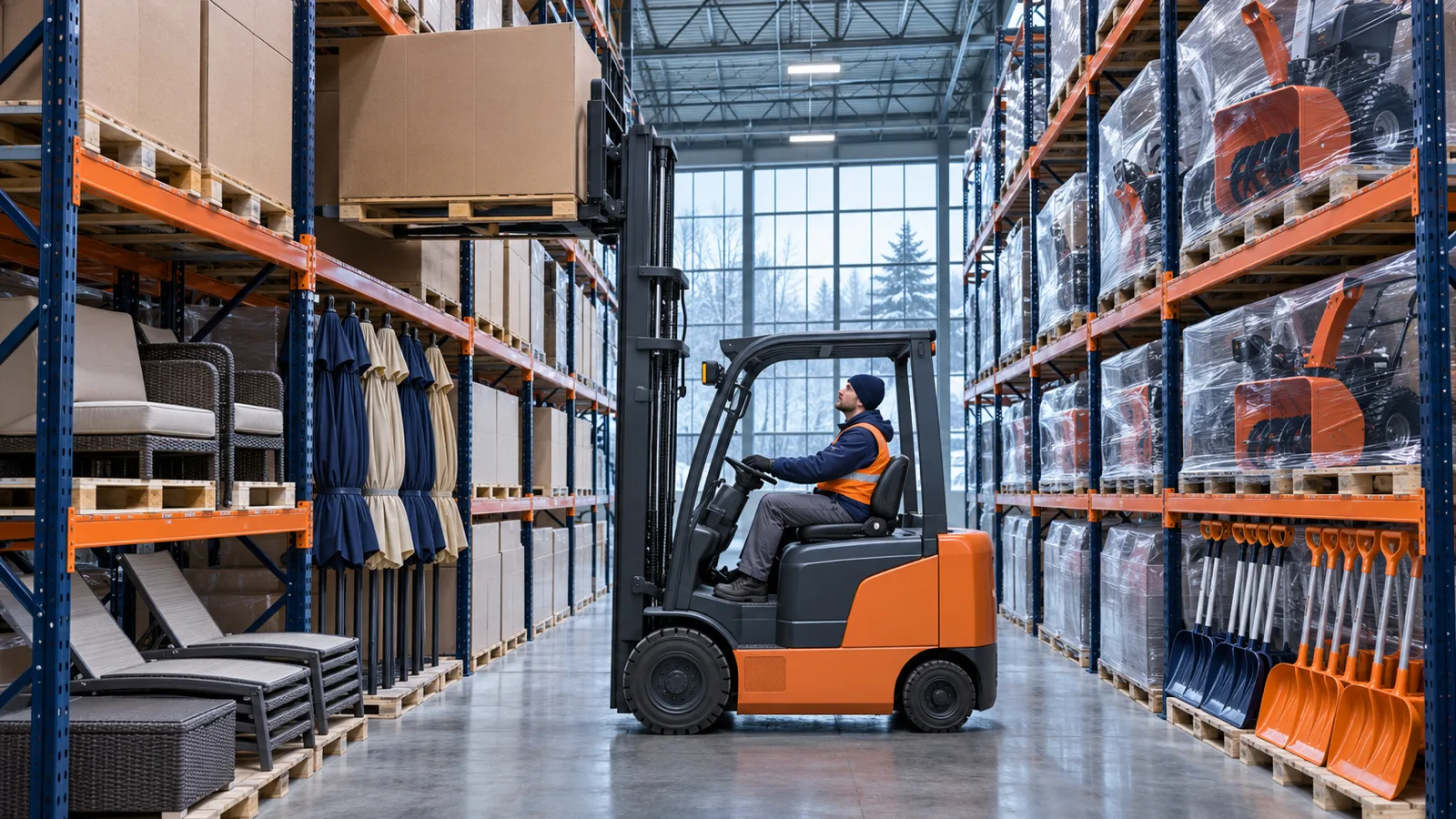
Walk into almost any Ontario hardware store in February and you can see the seasons colliding. Snow shovels and ice melt are still near the door, while the first patio sets and barbecues are being unboxed at the back. That changeover on the sales floor is the visible end of a much bigger logistics puzzle: where all that seasonal stock lives during the months it is not being sold.
Businesses that sell seasonal goods in Ontario, whether they are distributors, retailers, importers or online stores, face the same problem every year. Patio furniture arrives in containers in late winter and has to be held until the May long weekend. Snow blowers and winter tires arrive in late summer and wait for the first flurries. Christmas decorations, lights and gift sets land in September and are gone by mid-December. In between, that inventory takes up space you are paying for whether it is full or not.
This guide looks at the Ontario seasonal calendar, the storage needs of the main product categories, and how to structure warehouse space so you are not paying peak rent for off-season air.
The Ontario Seasonal Calendar
Ontario's climate creates sharp selling seasons, and each one has a lead time that pushes inbound inventory months ahead of demand.
- Spring and summer goods such as patio furniture, barbecues, gardening supplies, pool chemicals and outdoor toys typically arrive between January and April. Retail demand starts in late April, peaks around Victoria Day and continues through Canada Day, then drops sharply after the August civic holiday.
- Cottage and camping products follow a similar curve, with strong demand from Muskoka, the Kawarthas and Prince Edward County regions in late spring.
- Back-to-school goods arrive in July and sell through August.
- Winter goods including snow blowers, shovels, ice melt, winter tires, outerwear and space heaters arrive from July through October. Demand often spikes on the first serious snowfall, which can come in November in the Ottawa Valley or not until December in Windsor.
- Holiday goods such as decorations, lights, gift sets and seasonal food items arrive from August to October and sell from early November until Christmas Eve, with Boxing Day clearance after.
Plot your own products on this calendar and you will see your storage curve: when space requirements rise, peak and fall. Most seasonal businesses in Ontario find that they need two or three times more space at peak than in their slowest month.
Storage Needs by Product Category
Patio and Outdoor Furniture
Patio sets are bulky, often light for their size, and arrive in large cartons that cannot be stacked high without crushing. Cushions and umbrellas are vulnerable to moisture and mould. Store them in a dry, clean building with good ventilation, on pallets rather than directly on the floor, and avoid stacking heavy cartons on top of fabric items. Selective pallet racking with decks works better than floor stacking for this category, because it protects lower cartons and allows first-in, first-out rotation.
Snow Equipment and Winter Hardware
Snow blowers, generators and other small-engine equipment are heavy and usually shipped on pallets. If they have ever contained fuel or have batteries installed, they may be subject to Transportation of Dangerous Goods rules when shipped onward, and the warehouse should know this before it accepts them. Ice melt and road salt products are corrosive and absorb moisture, so keep them away from metal racking where possible and away from other goods that could be damaged by a broken bag.
Holiday Decorations and Lights
Decorations tend to be a large number of small, fragile SKUs with high pick counts during a short window. They need shelving or carton flow racks rather than pallet positions, and accurate bin locations, because pickers will be pulling thousands of different items in November. Glass ornaments and ceramic pieces benefit from a dedicated area with careful handling rules.
Seasonal Food and Gift Sets
Chocolate, baked goods, specialty teas and food gift baskets are sensitive to heat and humidity. Ontario's late-summer heat can push temperatures in an uninsulated building well above what chocolate can tolerate. If your holiday program includes food, look at temperature-controlled warehousing for at least the arrival period in August and September, and make sure the facility follows food safety practices for lot tracking and rotation.
Four Ways to Handle Seasonal Space
1. Lease for Peak
Some businesses lease enough space to hold their maximum inventory all year. It is simple, but it means paying for empty space for six or more months. With industrial vacancy rates in the GTA and Golden Horseshoe at historic lows and rents rising, this has become an expensive option, especially along the 401 and 400 corridors.
2. Lease for Average and Rent Trailers or Containers
Storing overflow in trailers or containers in the yard is common, but it creates problems. Goods are harder to access and count, trailers can be expensive to rent through the winter, and municipal bylaws or landlord rules may limit how long they can sit on site. Cardboard and fabric in an unheated trailer can also suffer from condensation.
3. Use a 3PL for Overflow
Keeping a core inventory in your own space and moving seasonal overflow to a third-party warehouse lets you pay for pallet positions only when you use them. Many Ontario 3PLs charge storage per pallet per month, so your costs rise and fall with your inventory. The trade-off is that moving goods between buildings adds transportation and handling costs, so plan the flow carefully.
4. Outsource All Storage and Distribution
For importers and online sellers, sending all inventory to a 3PL that also handles order fulfillment and outbound freight can be the most efficient model. Seasonal goods arrive, are stored, and ship to customers or stores from one building, with space that flexes with the season. This works particularly well when combined with distribution warehousing that serves retail store replenishment across Ontario.
How Seasonal Storage Is Usually Priced
When comparing options, break costs into their components so you are comparing like with like:
- Receiving: charged per container, per pallet or per carton, depending on whether goods arrive palletised or floor loaded.
- Storage: per pallet per month, per square foot, or per cubic foot for shelving. Ask whether partial months are prorated.
- Handling out: per pallet or per carton when goods leave storage.
- Value-added work: labelling, assembly, kitting or repacking for retail.
- Minimums: some warehouses have monthly minimum charges, which matter in your quiet season.
A container of floor-loaded patio sets, for example, may cost more to receive than one arriving on pallets, because staff have to unload and palletise each carton. Negotiating with your supplier to palletise at origin can save money on every inbound load.
Planning the Flow, Not Just the Space
Seasonal storage goes wrong less often because of space than because of timing. A few practices help keep the flow smooth:
- Stagger inbound containers. Instead of bringing all your patio stock in during February, split it across February, March and April. You hold less inventory at once and reduce receiving bottlenecks.
- Book outbound capacity early. Shipping dozens of truckloads to retail stores in the two weeks before Victoria Day competes with everyone else doing the same. Reserve full truckload or LTL capacity well ahead.
- Plan the end of season. Decide before the season starts what happens to leftover stock. Will it be held for next year, returned to the vendor, sold at a discount or moved to an outlet? Holding a snow blower for twelve months costs storage, and models can change.
- Count regularly. Cycle counting during the off-season, when stock is static, is far easier than finding discrepancies in the middle of peak.
Location Matters for Seasonal Goods
Where your seasonal stock sits affects how quickly it can reach customers when demand finally arrives. A warehouse along Highway 401 near the GTA or Kitchener-Waterloo can reach most of Southern Ontario's population in a day by truck, while access to Highway 400 and Highway 11 serves Barrie, Muskoka and the north. Ottawa and Eastern Ontario are reached via Highway 401 and Highway 416.
For importers bringing goods through the Port of Montreal or by rail from Vancouver, an Ontario warehouse close to a rail intermodal terminal in Brampton, Vaughan or Milton can cut drayage costs. Our article on the role of a 3PL in seasonal inventory management goes into more detail on planning across seasons.
A Seasonal Storage Checklist
- Map each product line's arrival, selling peak and end-of-season dates
- Calculate pallet positions needed month by month for the coming year
- Identify which products need dry, ventilated, heated or temperature-controlled space
- Flag any items with batteries, fuel or chemicals for dangerous goods review
- Get quotes broken down by receiving, storage, handling and minimums
- Agree on palletising requirements with overseas suppliers
- Reserve outbound truck capacity for the busiest weeks
- Write the end-of-season plan before the season starts
Store the Season, Not the Empty Space
ShipCarte offers flexible warehousing across Ontario for seasonal goods, with pallet and shelf storage, inventory management and outbound shipping that scales with your calendar. To find out what your seasonal program could look like, request a quote and tell us about your patio, winter or holiday lines.