
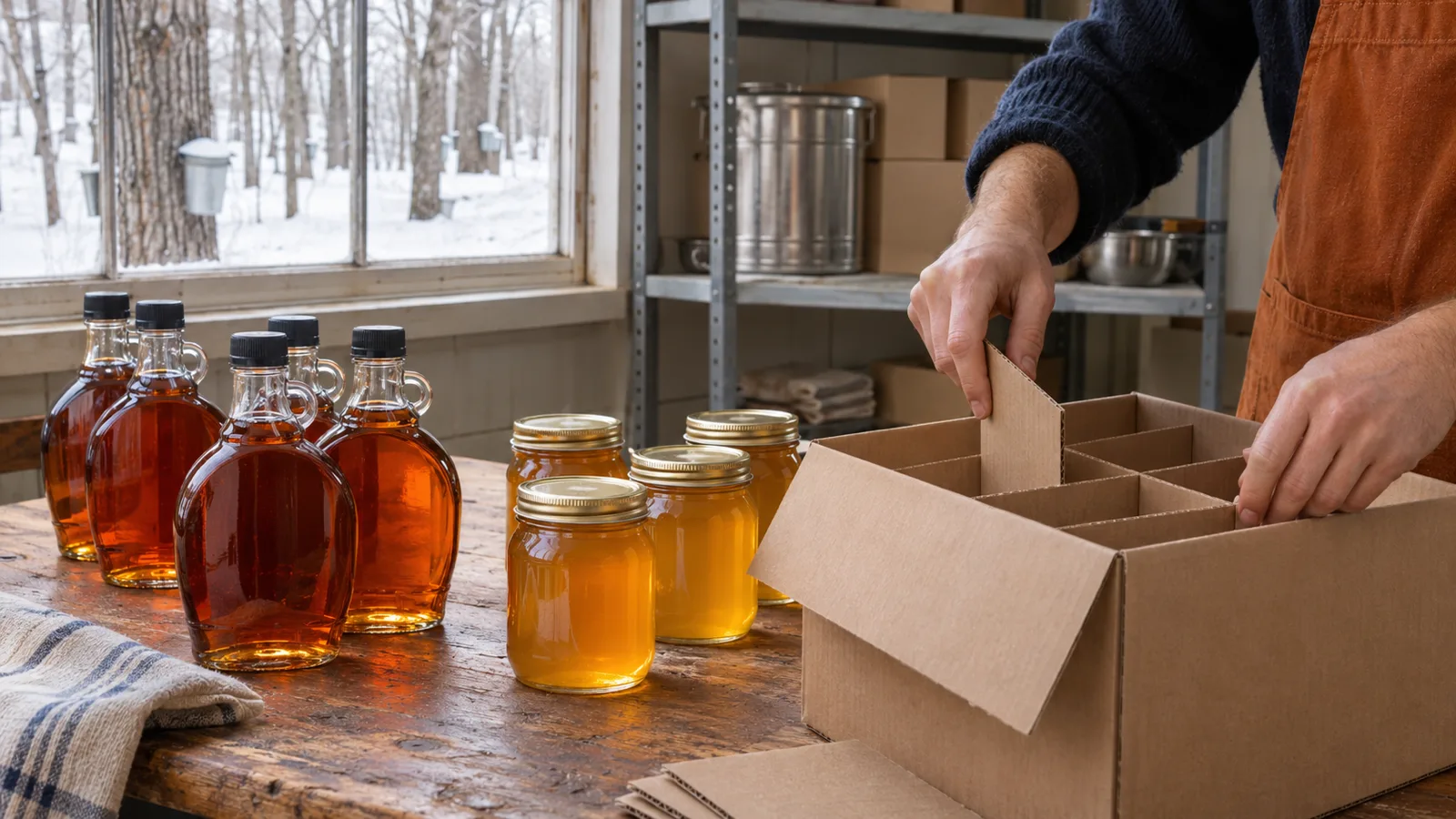
Sugar season in Ontario is over by April. The sap has been boiled down, the syrup is bottled, and the stock sitting in the barn has to carry the business until next spring. Meanwhile, down the road, a beekeeper is lifting summer supers off the hives and preparing for the fall honey extraction. Both producers face the same question once the farm-gate and farmers' market customers are served: how do you sell the rest to people who live in Ottawa, Windsor, Thunder Bay or Vancouver?
Shipping syrup and honey looks easy on paper. They are shelf-stable, they do not need refrigeration, and customers love receiving them. In practice, small producers run into broken glass, sticky leaks, shipping costs that eat the margin on a 500 ml bottle, and confused customers who open a jar of crystallised honey in January and think something has gone wrong.
This guide is for maple syrup and honey producers across Ontario who want to sell beyond their local area, whether through their own website, an online marketplace or wholesale to stores. It covers packaging, carrier choices, rules worth knowing and when to hand fulfillment to a partner.
Know Which Rules Apply to You
Regulation is not the most exciting part of selling syrup or honey, but it decides where you can ship, so it comes first.
Selling within Ontario
Producers selling only within Ontario deal mainly with provincial rules and federal labelling requirements. Beekeepers in Ontario must register their hives with the Ontario Ministry of Agriculture, Food and Rural Affairs under the Bees Act. Honey and syrup sold at retail still need proper labels: common name, net quantity in metric units, your name and address, and bilingual labelling where federal rules require it.
Selling to other provinces or exporting
Once your products cross a provincial border or leave Canada, the federal Safe Food for Canadians Regulations come into play. Since January 2019, many businesses that send food across provincial lines need a Safe Food for Canadians licence from the CFIA, along with preventive controls and traceability records. Honey and maple products also carry federal grading requirements when sold interprovincially. Maple syrup is graded as Canada Grade A with a colour class (Golden, Delicate Taste; Amber, Rich Taste; Dark, Robust Taste; Very Dark, Strong Taste), and honey has its own grade and colour classes.
If your online store accepts orders from Manitoba or Nova Scotia, check with the CFIA whether your volumes and sales model require a licence. Our article on the Safe Food for Canadians licence explains the basics.
Packaging That Survives the Parcel Network
Parcels are sorted on conveyors, dropped from chutes and stacked under heavier boxes. Assume your package will take at least one fall of a metre or more, and pack for it.
Glass bottles and jars
- Seal the cap. Induction seals or shrink bands stop slow leaks if a cap loosens. A sticky box contaminates other parcels and can be pulled from the network.
- Bag each bottle. A sealed poly bag around each bottle or jar contains leaks if glass cracks.
- Use dividers or moulded inserts. Glass should never touch glass. Cardboard dividers, moulded pulp trays or foam inserts sized for your bottles are faster to pack than loose bubble wrap and protect better.
- Leave cushioning space. At least 5 cm between the product and every wall of the box.
- Choose double-wall cartons for multi-bottle orders and gift sets.
Plastic jugs and tins
Plastic jugs and traditional maple tins are far more forgiving and lighter, which keeps shipping costs down. Many producers offer plastic or tin formats for online orders and keep the glass leaf bottles for in-person sales and premium gifts. It is worth testing whether your online customers care about the glass as much as you think.
Honey's special challenge
Raw honey crystallises over time, faster in cool conditions. A jar that ships in January through a cold sort facility in Northern Ontario may arrive set solid. That is natural, but many customers do not know it. A small insert card explaining crystallisation and how to gently warm the jar saves a lot of customer service emails. Our guide to package insert ideas has more ways to use that card.
Creamed honey, which is deliberately crystallised, ships well year-round. Comb honey is fragile and is best sent in rigid containers with plenty of cushioning, and preferably not during heat waves.
Weight, Size and the Cost of Shipping Liquids
Syrup and honey are dense. A litre of maple syrup weighs about 1.3 kg before the bottle, and honey is heavier still. Add glass and packaging and a modest three-bottle order can push past 4 kg.
Carriers price on the greater of actual weight and dimensional weight. For dense products like these, actual weight usually wins, so cutting box size alone will not help much. What helps:
- Offering lighter packaging formats for online orders.
- Pricing bundles so customers buy more per shipment, spreading the base rate across several units.
- Setting a free shipping threshold that reflects real costs to distant zones, or charging calculated rates to Western Canada and the North.
- Using negotiated parcel rates through a shipping platform rather than retail counter prices.
For more on how package size affects your bill, see how package dimensions impact shipping costs.
Storing Inventory Between Seasons
A syrup producer bottles most of the year's crop in a few weeks of spring, then sells it over twelve months. That makes storage conditions part of product quality, not just a space problem.
- Bulk syrup in barrels keeps best in a cool, clean space and is often bottled in smaller runs through the year to match demand, so the product on the shelf is freshly packed.
- Syrup in plastic jugs slowly darkens over long storage because the plastic lets in a little oxygen. Rotate stock so older jugs sell first, and avoid storing them in warm lofts over the summer.
- Glass bottles hold colour and flavour better but are heavier and more fragile, so store cases on pallets, not stacked loose on shelving.
- Honey crystallises faster at around 10°C to 15°C, a typical cool basement temperature. Warmer, stable storage slows that down, while freezer storage stops it almost entirely for producers who want to keep liquid honey for later bottling.
Whatever you store, track it by lot and bottling date. If a customer reports a problem, you want to know exactly which batch it came from and who else received it.
Seasonal Rhythm: When Orders Arrive
Syrup and honey producers share a sales calendar that rewards planning.
- March and April: maple season, sugar shack visits and festivals like the one in Elmira bring a burst of local syrup sales and online interest.
- Late summer and fall: new-crop honey arrives and farmers' markets are busiest.
- November and December: the biggest online period for both products, driven by gift boxes, corporate orders and holiday baking.
The holiday peak is when small producers get stretched thin. Packing 40 gift boxes a night at the kitchen table works until it does not. If last December left you exhausted and behind on shipments, plan this year's approach now.
Getting Wholesale Orders to Stores
Selling to specialty food shops, gift stores and grocery chains in Toronto, Ottawa, Kitchener-Waterloo or cottage country towns in Muskoka is a different kind of shipping. Instead of single parcels, you are sending cases or pallets.
- For a few cases, parcel shipping with sturdy master cartons is often still cheapest.
- For a pallet or more, LTL freight usually costs less per unit and reduces handling.
- Grocery chains may require barcodes on each unit and case, specific case labels and delivery appointments at a distribution centre. Our article on becoming a grocery supplier in Ontario walks through those requirements.
When to Use a Fulfillment Partner
Many syrup and honey producers start by shipping from the farm and stay that way for years. A fulfillment partner starts to make sense when:
- Online orders regularly exceed what you can pack in an evening.
- Your farm is in a rural area where carrier pickup is unreliable or expensive.
- Holiday volume forces you to hire temporary help you then have to train.
- You want to sell on Amazon or another marketplace with strict shipping time requirements.
- You want inventory closer to the GTA so most Ontario customers get next-day delivery.
With e-commerce fulfillment, you send stock by the pallet to a warehouse, your online store passes orders automatically, and trained staff pick, pack and ship each one. Producers selling through Shopify can connect directly through Shopify fulfillment. Gift sets that combine syrup, honey, maple candy and a card can be assembled in advance through kitting and assembly, so December orders ship as quickly as single bottles.
Shipping to the United States
American customers are a natural market for Canadian maple syrup. Food shipments to the US require FDA prior notice, and commercial food facilities generally need FDA registration. Duties on maple syrup and honey under NAFTA are generally zero for Canadian-origin product, but proper customs paperwork still matters. For small direct-to-consumer orders, US low-value import thresholds make parcel shipping workable, though carriers' brokerage fees can surprise your customers if you do not plan for them. ShipCarte's cross-border shipping service can help simplify this.
A Short Packing Checklist
- Caps sealed and banded.
- Each container in its own sealed bag.
- Dividers or inserts so no glass touches glass.
- 5 cm cushioning on all sides.
- Box passes a drop test from waist height.
- Insert card explaining crystallisation (honey) and storage after opening (syrup).
- Labels meet federal requirements if shipping outside Ontario.
Let ShipCarte Handle the Shipping
You make the syrup and tend the hives. ShipCarte can store your stock, pack every order carefully and get it to customers across Ontario, Canada and the US. Request a quote to see what fulfillment would cost for your volumes before the holiday season begins.