
Selling pet supplies online should be a dream business model. Dogs and cats eat every day, owners are loyal to the foods that work for their pets, and a customer who buys a bag of kibble in March will almost certainly need another in April. Many Ontario pet retailers, from independent shops in Ottawa and London to online-only brands in the GTA, have seen that loyalty turn into a steady base of repeat orders.
Then they look at the shipping bills. A 13-kilogram bag of dry dog food, a 15-kilogram box of clay litter or a case of canned cat food costs far more to ship than a T-shirt or a phone case, and the margins on pet food are not generous to begin with. Free shipping, which customers have come to expect from large online retailers, can turn a profitable order into a loss. Torn bags, dented cans and expired treats add to the damage.
This article looks at the specific problems of shipping pet supplies in Ontario and the practical ways to solve each one, from carrier selection to autoship planning.
Problem 1: Actual weight drives every cost
Most ecommerce businesses worry about dimensional weight, where a large, light box is billed as if it were heavier. Pet supply sellers have the opposite problem. Their products are dense, so they are billed on actual weight, and there is no clever box trick that reduces it.
Weight also triggers extra charges. Parcels above certain weight thresholds attract additional handling fees from couriers, and most parcel services have maximum weight limits, often around 30 kilograms. An order of two large food bags may need to ship as two parcels or move to a different service entirely.
What helps
- Rate-shop every order. The cheapest carrier for a 2-kilogram order of treats is often not the cheapest for a 15-kilogram bag of food. A multi-carrier shipping platform can pick the best option automatically.
- Use regional carriers where they make sense. Several regional couriers serve the GTA, Golden Horseshoe and Ottawa areas at lower rates for heavy parcels than national services.
- Ship from close to your customers. Ground rates rise with distance. If most of your orders go to southern Ontario, a fulfillment location within the province keeps most heavy parcels in the lowest-cost zones.
- Know your limits. Set rules in your store so orders above a certain weight automatically split or route to an appropriate service.
Problem 2: Free shipping thresholds that do not fit heavy goods
A free shipping threshold that works for a clothing store can be disastrous for pet supplies. If your threshold is $50 and a customer buys one large bag of premium food for $70, you may be shipping 13 kilograms for free.
Some approaches Ontario pet sellers use:
- Set separate free shipping thresholds by region, with a lower threshold within your local delivery zone and a higher one for the rest of Canada.
- Exclude the heaviest items, such as litter, from free shipping, or charge a modest flat fee for them.
- Offer free shipping only on autoship orders, which rewards repeat customers and gives you predictable volume.
- Offer local delivery or in-store pickup in cities where you have a physical presence.
Be transparent about the reasons. Pet owners know that litter is heavy, and most accept a fair shipping charge if it is presented clearly at the start rather than as a surprise at checkout.
Problem 3: Bags tear and cans dent
Large pet food bags are designed for store shelves, not for conveyor belts and courier trucks. A bag that slides around inside a box, or is shipped with just a label stuck on it, can split at the seams. Kibble spilled across a delivery truck is an unhappy experience for everyone. Canned food has the opposite problem: cans are tough individually, but a case that shifts inside a box can dent badly, and dented cans may be refused by the customer.
Packaging that works
- Ship large bags in snug corrugated boxes or heavy-duty poly overwrap rather than with a bare label.
- Use boxes rated for the weight. A box that is fine for 5 kilograms may burst at 15.
- Keep cans in their original trays where possible and fill any gaps so they cannot move.
- Separate liquids, such as shampoos and dental rinses, in sealed bags so a leak does not ruin the rest of the order.
- Use tape strong enough for the load and seal with an H-pattern.
Problem 4: Expiry dates and lot control
Pet food and treats have best-before dates, and customers notice them. Sending a bag that expires in six weeks to a customer who uses one bag every two months is a recipe for a complaint. Recalls are also a reality in pet food, so knowing which customers received which production lot can matter a great deal.
Warehouse practices that help:
- Use first-expired, first-out picking, so the oldest stock leaves first.
- Record lot numbers and best-before dates on receipt, not later.
- Set a minimum remaining shelf life for shipped orders, and flag stock that is getting close to it for promotion or donation.
- Keep order history linked to lot numbers so you can contact affected customers quickly in a recall.
A warehouse management system with lot and date tracking does this automatically and removes the guesswork.
Problem 5: Repeat orders that are predictable, if you plan for them
The best thing about the pet supply business is predictability. A customer feeding a 30-kilogram dog goes through food at a fairly steady rate. Autoship, or subscribe-and-save programs, turn that predictability into scheduled orders, which helps you forecast inventory and smooth out workload.
To get the most out of autoship:
- Let customers choose their interval and change it easily, so orders arrive when food is running low, not when the pantry is still full.
- Send a reminder a few days before each autoship order processes, so customers can skip or adjust.
- Forecast from autoship data. If 600 customers are scheduled to receive a particular food next month, order it from your supplier now.
- Batch processing. Autoship orders can be processed in a planned wave each day, which makes picking and packing more efficient.
- Protect stock for subscribers. When a popular food is in short supply, prioritize autoship customers who are counting on it.
Consider how this plays out for a seller with a few thousand customers across southern Ontario. If a third of them are on autoship, the business knows weeks ahead roughly how many bags of each food will leave the warehouse. That lets it order full pallets from the manufacturer instead of topping up with small, expensive deliveries, negotiate better carrier rates based on reliable daily volume, and staff the packing line correctly. The one-off orders become the variable part of the business, rather than everything.
Problem 6: Seasonal swings and Ontario weather
Pet supplies are less seasonal than many categories, but there are still peaks. Holiday gifts, toys and treats spike before Christmas. Flea and tick products sell from spring through fall. Winter brings demand for paw balms, coats and ice-melt that is safe for pets, which is a significant category in Ontario after a cold snap.
Weather affects shipping too. Canned and wet foods can freeze on the way to northern Ontario in January, and some supplements and treats can soften in summer heat. Note which products need protection and plan seasonal shipping methods for them.
Problem 7: Regulations on imported products
Many pet treats and foods are imported. Products containing animal-derived ingredients can be subject to import requirements from the Canadian Food Inspection Agency, which manages animal health risks, and may need permits or certificates depending on the ingredients and the country of origin. Natural chews, such as dried animal parts, are a common area of scrutiny. If you source products from outside Canada, confirm the requirements with your supplier and customs broker before ordering. Labelling rules, including bilingual requirements for prepackaged products, also apply to pet foods sold in Canada.
A note on warehouse safety
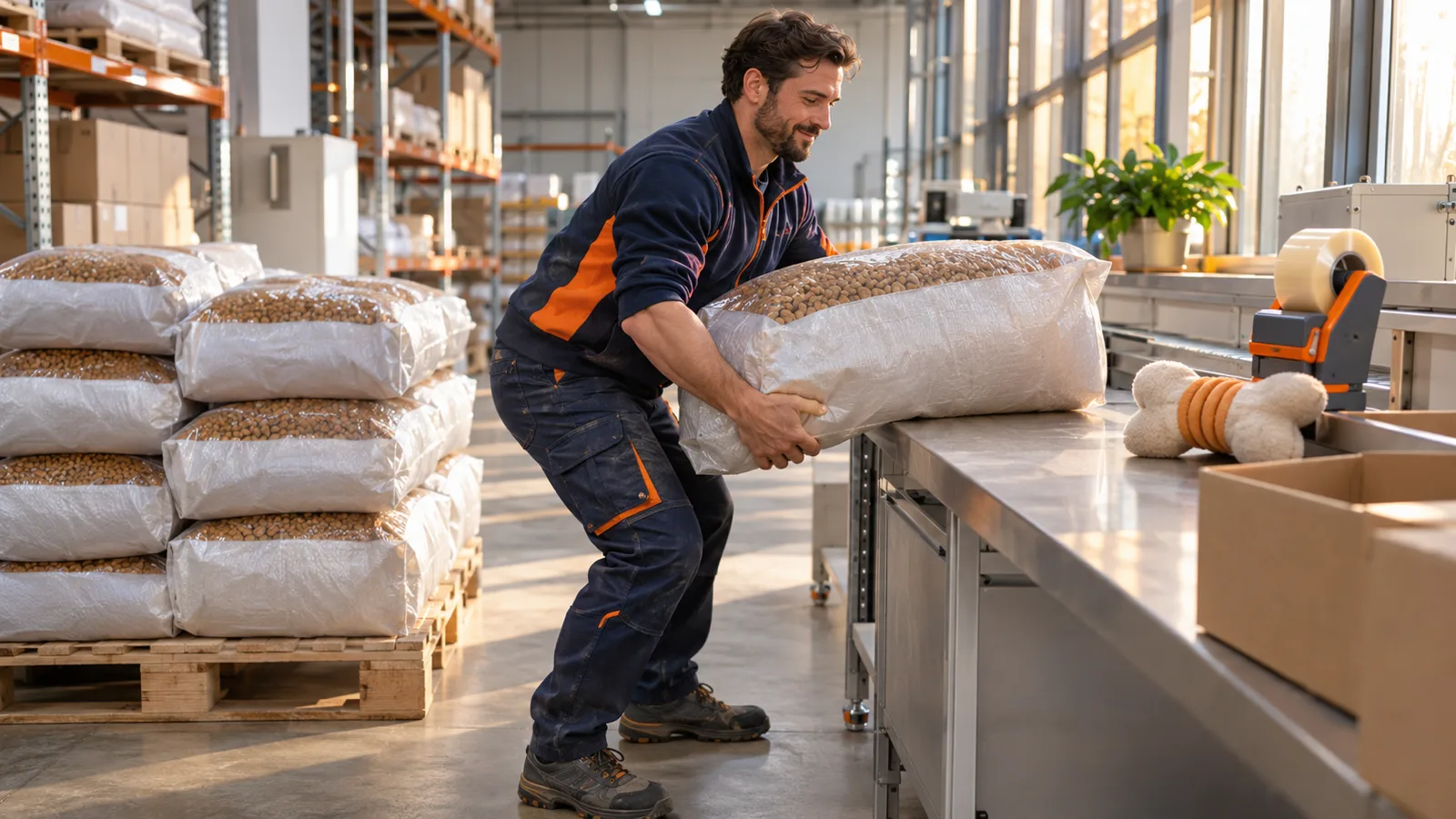
Heavy bags and boxes are a workplace safety issue. Repetitive lifting of 15-kilogram items is a common source of strain injuries, and Ontario employers have obligations under the Occupational Health and Safety Act to address manual handling hazards. Good warehouse layouts keep the heaviest items at waist height, use pallet jacks and lift aids, and rotate staff between heavy and light tasks. If you handle heavy pet products yourself, plan your workspace with this in mind. If you outsource, ask how your fulfillment partner handles it.
When outsourcing makes sense
Pet supply businesses often move to a third-party fulfillment partner when heavy orders start dominating their staff's time, when they need better carrier rates on weighty parcels, or when they add autoship and need reliable daily processing. A partner with ecommerce fulfillment infrastructure can receive full pallets from manufacturers, manage lot and date control, and ship heavy orders at volume rates. For brands that also sell into pet stores, retail fulfillment handles case and pallet orders from the same inventory. If you are also distributing pet food wholesale, our post on pet food distribution in Canada covers the B2B side.
Keep tails wagging and margins healthy
ShipCarte helps pet supply brands and retailers across Ontario ship heavy, repeat orders efficiently, with date-coded inventory, autoship-friendly processing and multi-carrier rates. Request a quote to compare your current shipping costs, or schedule a consultation to talk about your setup.