
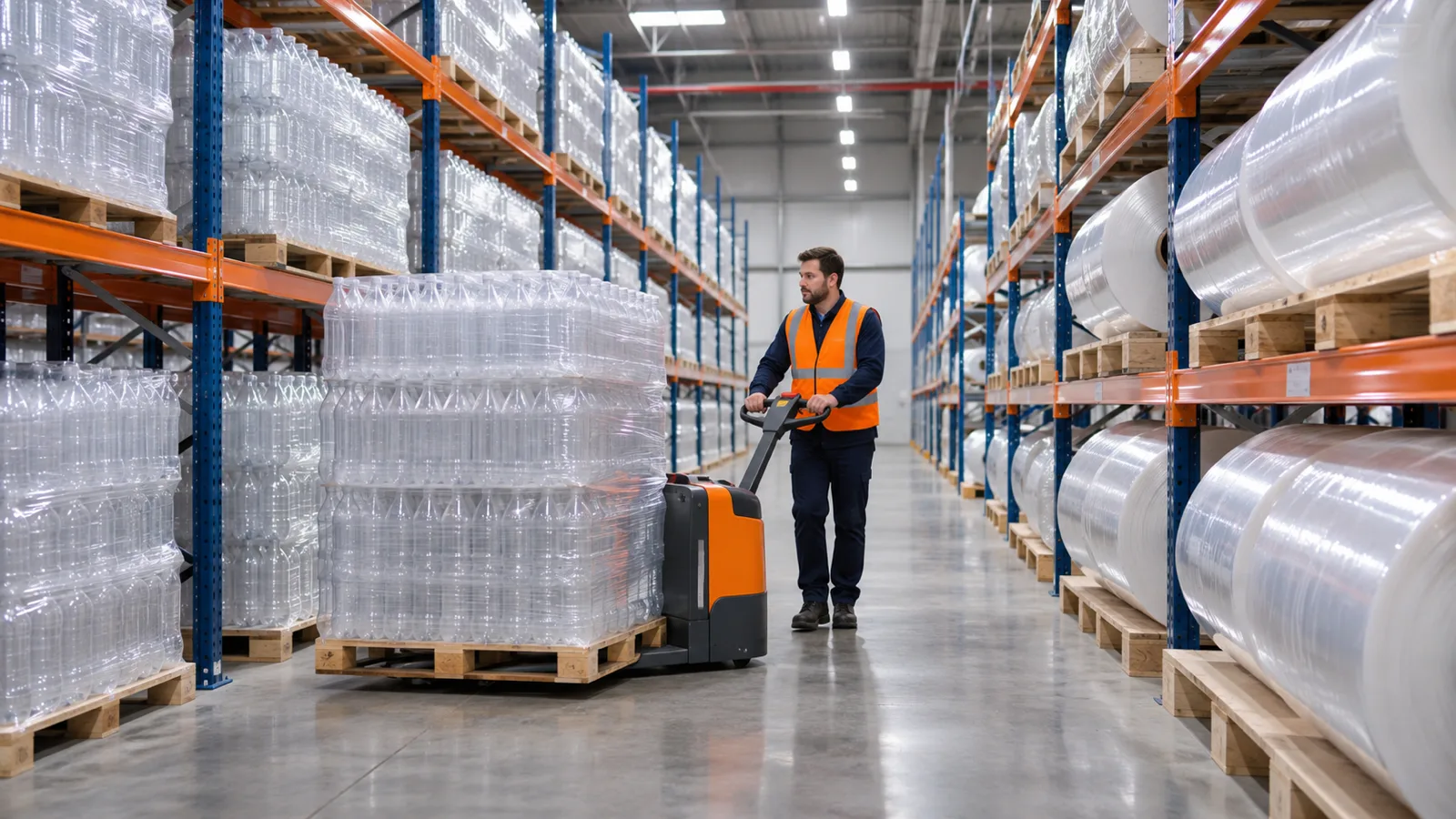
A blow moulder in Vaughan runs its lines around the clock making bottles for beverage and household chemical brands. Every pallet of empty bottles is mostly air, and the plant fills its warehouse within days during the spring build-up to summer drink season. By June, finished pallets are stacked in the parking lot under tarps, the shipping team is calling for trailers at the last minute, and a large customer has started asking why its orders arrive with crushed corners.
Plastics and packaging manufacturing is one of Ontario's largest industrial sectors, with a heavy concentration in the GTA and York Region and significant operations in Kitchener-Waterloo, Guelph, London, Windsor, Hamilton and the Ottawa area. Ontario plants make bottles, containers, closures, film, bags, trays, foam, corrugated boxes, folding cartons, labels and automotive plastic parts. They supply food and beverage companies, consumer goods brands, retailers, pharmaceutical firms and the auto sector.
Their logistics problems are distinctive. Products are light and bulky, demand is seasonal, customers expect fast replenishment, and raw materials arrive in bulk. This article works through the most common challenges one by one, with practical solutions for each.
Challenge 1: You ship air
An empty plastic bottle or a nested stack of trays weighs very little but takes up a lot of space. A 53-foot trailer of empty containers will fill up long before it gets anywhere near its weight limit. In freight terms, you "cube out" rather than "weigh out." That changes how you should buy and plan transportation.
What helps
- Maximize trailer cube. Use pallet heights that make full use of trailer interior height. A pallet that is a few centimetres too tall to double-stack wastes nearly half the trailer.
- Consider high-cube equipment. Some carriers run high-cube 53-foot vans with extra interior height, which can add meaningful capacity for light products.
- Price freight by the trailer, not the kilogram. LTL rates based on weight and class can be expensive for low-density freight. Full truckload or volume LTL quotes often work out better.
- Design for nesting. Where products can nest or stack inside each other, work with customers to ship nested and reduce trips.
For a broader look at how dimensions drive cost, see our article on how package dimensions impact shipping costs.
Challenge 2: Production runs do not match customer demand
Moulding and extrusion lines are most efficient when they run long, uninterrupted batches. Changeovers to a new mould or a new colour cost time and scrap. Customers, however, order in smaller quantities and expect frequent deliveries. The gap between how you produce and how customers buy is filled by inventory, and inventory needs space.
What helps
- Overflow warehousing. Rather than leasing a larger plant, many Ontario manufacturers move finished goods to a nearby third-party warehouse and keep their own floor for production. Flexible distribution warehousing can scale up for a peak season and back down afterward.
- Shuttle runs. A dedicated truck shuttling between plant and warehouse several times a day keeps production flowing without stacking pallets in aisles.
- Clear inventory ownership. When stock sits in more than one building, everyone must see the same numbers. A shared inventory management platform prevents double-promising stock.
Challenge 3: Seasonal peaks
Many plastics and packaging products follow their customers' seasons. Beverage bottles and closures peak ahead of summer. Lawn and garden containers peak in late winter and spring. Retail packaging and gift boxes surge in the months before the holidays. Food packaging follows harvest and processing seasons in Ontario's agricultural regions, such as the Niagara fruit belt and the vegetable processors of southwestern Ontario.
What helps
- Build inventory ahead of the peak and store it close to the customer.
- Agree a forecast with key customers and update it monthly.
- Lock in trucking capacity for peak months rather than relying on the spot market, which tightens every spring and fall.
- Track demand history by SKU and customer so the next season's build is based on data, not memory.
Challenge 4: Customers want vendor-managed inventory
Large food, beverage and consumer goods customers increasingly ask packaging suppliers to manage inventory on their behalf. Under a vendor-managed inventory (VMI) or consignment arrangement, the supplier keeps stock near the customer's plant, monitors usage and replenishes automatically. The customer pays only when it consumes the packaging.
VMI can lock in a customer relationship for years, but it requires logistics capability many manufacturers do not have in-house. You need a warehouse near the customer, accurate usage data, and the ability to deliver on short notice, sometimes several times a day. A 3PL with a network of warehouses across Ontario can host VMI stock and run the deliveries, while the manufacturer keeps control of the commercial relationship.
Challenge 5: Damage and cleanliness
Packaging is supposed to protect products, but it also needs protecting. Bottles crush, film rolls get flat spots, cartons get scuffed, and printed labels get scratched. For food-contact and pharmaceutical packaging, cleanliness matters as much as physical condition. Customers in these sectors audit their packaging suppliers against food safety standards, and many expect suppliers to hold certification under a GFSI-recognized scheme for packaging.
What helps
- Use stretch wrap, top caps and corner boards consistently.
- Avoid overhanging pallets, which crush in trailers and racking.
- Store food-contact packaging in clean, enclosed, pest-controlled areas away from chemicals.
- Inspect trailers for cleanliness and odour before loading.
- Track lot numbers so a quality problem can be traced to a specific production run.
Challenge 6: Bulk raw materials
Plastic resin arrives as pellets, usually in bulk. Large plants receive resin by rail hopper car, emptied directly into silos. Smaller plants receive bulk trucks or one-tonne bulk bags (gaylords and super sacks) on pallets. Additives, colourants and masterbatch arrive in bags and drums.
Plants without a rail siding often rely on transload facilities, where hopper cars are unloaded into bulk trucks for delivery. Holding an inventory of bagged resin in a nearby warehouse protects against supply interruptions, especially in winter when rail service can slow. For more on transload and rail-served warehousing, see our guide to rail freight in Ontario.
Challenge 7: Fire safety and storage rules
Stored plastics are classed as a higher fire hazard than many other commodities, especially expanded foam and products stored in large volumes. Warehouses storing them must have sprinkler systems designed for the commodity and storage height, under the Ontario Fire Code and the Building Code. This is one reason some general warehouses cannot accept large volumes of plastic products, and why manufacturers should confirm that any outside warehouse is equipped and approved for their goods. Ask the warehouse about its commodity classification and sprinkler design before you sign.
Challenge 8: Changing rules on packaging waste
Packaging producers in Ontario are watching policy closely. The province's Resource Recovery and Circular Economy Act, 2016 set the direction for moving waste programs, including the Blue Box, toward full producer responsibility, and this year the province asked a special advisor to recommend how the Blue Box transition could work. At the federal level, the government announced in June 2019 its intention to ban certain harmful single-use plastics as early as 2021.
For logistics, these changes point toward more interest in recycled content, reusable packaging systems and reverse logistics. Manufacturers who build the ability to collect, sort and return packaging, or to track recycled content by lot, will be better prepared for whatever rules emerge.
Shipping finished goods across Ontario and beyond
Ontario packaging plants typically ship to customers in Ontario, Quebec and the US Northeast and Midwest within a day or two by truck. For regular customers, scheduled full truckload deliveries work best. For smaller customers and samples, consolidated LTL or parcel service keeps costs reasonable. Cross-border shipments under NAFTA generally move duty-free when rules of origin are met, but customs paperwork must be accurate. Our carrier management service helps manufacturers compare carriers and modes lane by lane.
Challenge 9: Samples, small orders and short runs
Packaging manufacturers ship a steady stream of samples, prototypes and small trial orders to brand owners and designers who are evaluating new containers or printed cartons. These shipments are small but important, because they often decide whether a large contract follows. They are also awkward for a plant set up to load full trailers. A sample of printed cartons sent by the shipping clerk in a reused box, with no tracking, does not make the best impression.
A simple fix is to separate small-order shipping from production shipping. Keep sample stock in a defined location, pack it in clean, branded or neutral cartons, and ship it through a small parcel program with tracking shared with the sales team. For short production runs going to smaller customers across Ontario and Quebec, consolidated LTL from a central warehouse usually beats a dedicated truck.
A quick self-assessment
If you run logistics for a plastics or packaging plant in Ontario, ask yourself:
- Are we using the full height of every trailer we load?
- Is any finished inventory stored outside or in production aisles?
- Do we know our true cost per pallet shipped, by customer?
- Can we offer VMI to a key customer if they ask tomorrow?
- Can we trace any pallet back to its production lot within minutes?
- Do we have trucking capacity locked in for our peak season?
If more than two answers are "no" or "not sure," there is money to be found in your logistics. Our consumer packaged goods customers often see quick wins simply from consolidating storage and freight with one partner.
Free your floor and fill your trailers
ShipCarte provides overflow and distribution warehousing, VMI support and freight management for manufacturers across Ontario. If your plant is running out of space or your freight bills are full of half-empty trailers, schedule a consultation and we will help you plan a better flow.