
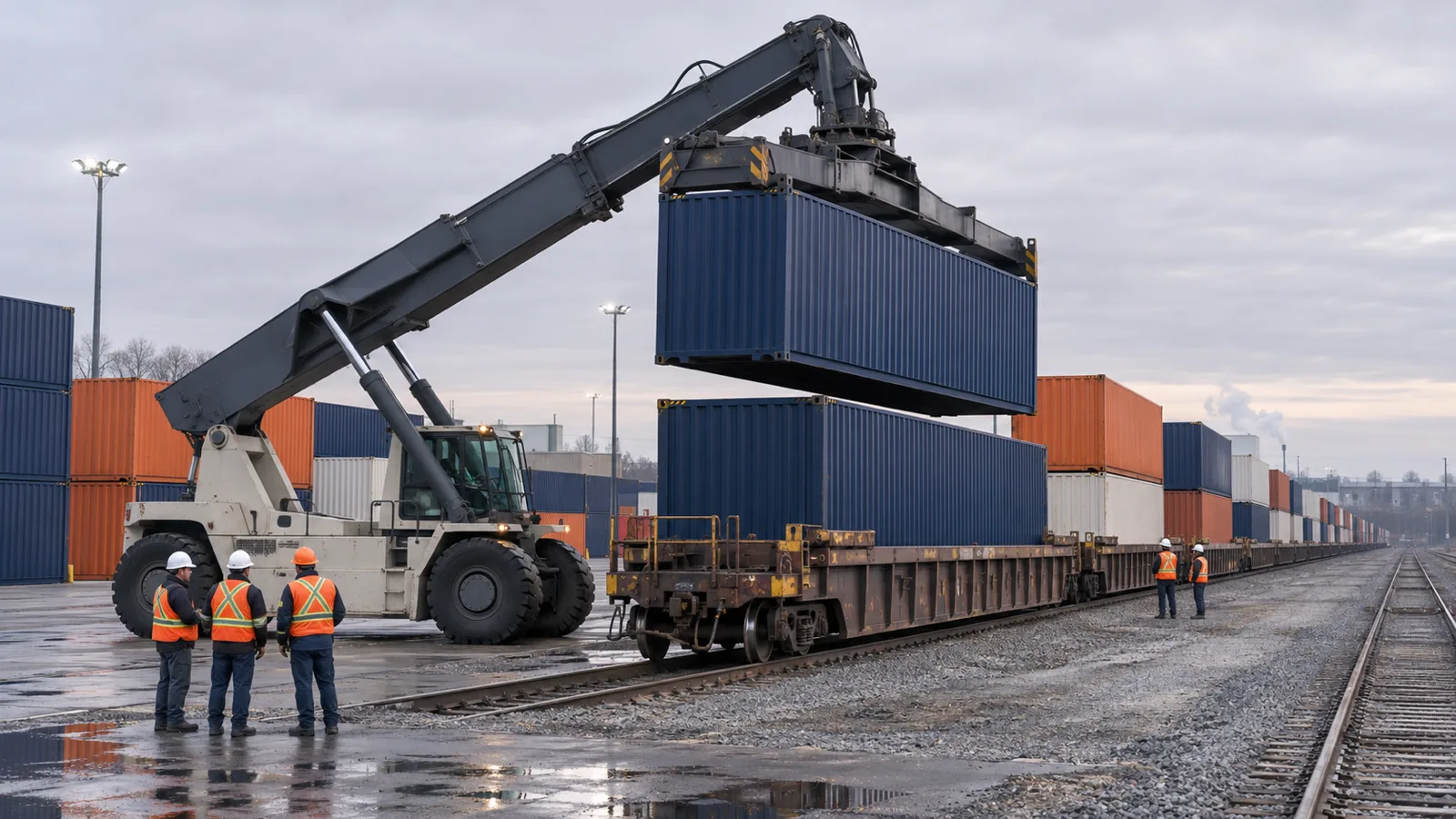
A building products distributor in the Greater Toronto Area brings in forty containers a month from overseas. For years every one of those boxes came off a ship in Vancouver or Montreal, rode the rails to a terminal north of Toronto, and then sat for days while the company scrambled for a drayage truck. Storage charges piled up, the warehouse got slammed with six containers on a Friday and none on Monday, and nobody could say with confidence when a given purchase order would actually be on the shelf.
That story is common across Ontario. Rail moves an enormous share of the province's freight, yet many shippers only touch it indirectly, as the invisible middle leg of an import. Used deliberately, rail can lower line-haul costs, take trucks off a congested Highway 401, and give heavy or bulky products a cheaper path to market. Used carelessly, it adds days and fees that wipe out the savings.
This guide explains how rail freight actually works in Ontario today: the main intermodal terminals, the difference between intermodal and carload service, what a rail-served warehouse can and cannot do for you, and how to decide whether your freight belongs on a train at all.
The two kinds of rail freight
When people say "ship by rail," they usually mean one of two very different services. Mixing them up is the first mistake most shippers make.
Intermodal: containers and trailers on flatcars
Intermodal freight travels in a standard box, either an international 20- or 40-foot ISO container or a 53-foot domestic container, that moves between a truck chassis and a rail car without the goods inside being handled. A truck (the drayage carrier) picks up the box at your dock, delivers it to a rail terminal, the railway hauls it hundreds or thousands of kilometres, and another dray truck delivers it at the far end. You never deal with rail cars directly. You deal with a container, a terminal cut-off time, and a pair of truck moves at either end.
Intermodal is the natural fit for consumer goods, retail replenishment, imported products and anything that is already palletized or floor-loaded into containers.
Carload: your own rail car to a rail siding
Carload service means a full rail car (a boxcar, covered hopper, centre-beam flatcar, tank car or gondola) is loaded at a facility with its own rail spur and delivered to another facility with a spur. Lumber, steel, grain, plastic resin pellets, paper, chemicals and building materials move this way. A single boxcar can hold roughly three to four truckloads by weight, which is where the economics shine for dense, heavy products.
If you do not have a siding, carload is still possible through a transload facility: a rail-served warehouse or yard where the car is unloaded and the goods are stored or reloaded onto trucks for final delivery.
Ontario's main intermodal terminals
Ontario's intermodal network is concentrated around the GTA, which is where most of the province's container volume ends up. Knowing which railway serves which terminal matters, because your ocean carrier or rail contract decides where your container lands, and that in turn decides your drayage distance.
- CN Brampton Intermodal Terminal is CN's main Ontario hub, close to Highway 407 and Highway 410, and handles both international containers from Halifax, Montreal, Prince Rupert and Vancouver and domestic 53-foot boxes.
- CP Vaughan Intermodal Terminal is Canadian Pacific's principal GTA facility near Highway 427 and Highway 50, receiving containers from the Port of Montreal and the West Coast.
- CN MacMillan Yard in Vaughan is a classification yard rather than a customer terminal, but it is the heart of carload traffic in southern Ontario, sorting cars destined for sidings and transload sites across the province.
- Smaller terminals and ramps serve other markets, and both railways run domestic intermodal service connecting the GTA to Montreal, Winnipeg, Calgary, Edmonton and Vancouver.
CN has also proposed a new logistics hub in Milton, which as of late 2020 is still awaiting a federal decision following its environmental review. Whether or not it proceeds, the GTA's terminals are under pressure, and congestion at peak periods is a real factor in planning.
Outside the GTA, Ontario's short-line railways connect industries to the CN and CP main lines. Operators such as the Essex Terminal Railway in Windsor, the Southern Ontario Railway around Hamilton and Nanticoke, the Goderich-Exeter Railway in southwestern Ontario and the Ottawa Valley Railway give carload shippers in smaller centres access to the national network.
Rail versus truck: a practical comparison
There is no universal answer, but the trade-offs follow a predictable pattern. Here is how the two modes compare for typical Ontario lanes.
Distance
For moves inside southern Ontario, such as Toronto to London, Kitchener or Ottawa, trucking almost always wins. The drayage at each end and terminal handling cost more than the rail haul saves, and a truck can do the trip same day. Rail starts to become competitive at roughly 800 to 1,000 kilometres and is usually the cheaper option for Toronto to Winnipeg, Calgary or Vancouver. Toronto to Montreal is a grey zone where the answer depends on volume and service needs.
Transit time and reliability
A team truck can run Toronto to Calgary in under three days. Intermodal on the same lane typically takes four to six days door to door once you include terminal dwell. Rail is reliable enough for planned replenishment, but it is not the mode for a rush order.
Weight
Ontario's weight rules are among the more generous in North America for multi-axle trucks, but a highway trailer is still limited by weight per axle and gross vehicle weight. A rail car is not. Dense freight like steel, paper rolls, beverages, tile and stone gets more value from rail because you can load far more per unit.
Fuel and emissions
Rail is markedly more fuel-efficient per tonne-kilometre than trucking. For companies reporting on emissions or responding to retail customers' sustainability questionnaires, shifting long-haul lanes to rail is one of the easiest measurable improvements.
Seasonality
Winter affects both modes. Railways reduce train lengths in extreme cold, which slows the network in January and February, while trucks deal with closures on Highway 11 and Highway 17 in the north. Build extra days into rail transit times between December and March.
What a rail-served warehouse does for you
A rail-served warehouse is a building with a spur track and doors aligned to rail cars, usually alongside conventional truck docks. In Ontario these are concentrated in the GTA, Hamilton, the Kitchener-Cambridge corridor, London, Windsor and the Ottawa area. They are valuable for several kinds of shippers.
- Inbound bulk with outbound small loads. A boxcar of flooring or a hopper of resin arrives, is unloaded into the warehouse, and leaves over weeks as LTL shipments or local deliveries.
- Manufacturers without their own siding. Instead of investing in track, they use a nearby transload site as their rail door.
- Western Canada lanes. Ontario manufacturers shipping to Alberta or BC load cars here for the long haul, then transload again at the western end.
- Buffer storage. Products that arrive in large lots can be held near the market and released as orders come in, rather than paying for a full container's dwell time at a terminal.
The catch is that rail cars come with their own clock. Railways charge demurrage when a car is held at your facility beyond the free time allowed for loading or unloading, typically one or two days. A good transload operator schedules labour so cars are turned quickly and the charges never appear on your invoice.
The hidden cost centre: drayage and free time
For intermodal shippers, the biggest controllable costs in Ontario are not on the rail freight bill. They sit in the gap between the terminal and your dock.
When a container arrives at a GTA terminal, you get a limited number of free days to pick it up. After that, storage charges accrue daily. Once the box leaves the terminal, a separate clock for the container and chassis starts, and if you hold it too long before returning it empty, you pay per diem to the steamship line or railway. Add a congested 401, an appointment system at the terminal, and a dray carrier with limited capacity during peak season, and the charges multiply.
Some practical habits keep these costs in check:
- Get arrival notices directly from the railway or ocean carrier, not second-hand days later.
- Book drayage before the container is available, not after.
- Use a warehouse that can receive containers on short notice, including weekends during peak.
- Consider "drop and pick" arrangements where the container is left at the dock and unloaded when labour is available, instead of live unloading with a truck waiting.
- Track demurrage and per diem as a monthly line item so you can see trends.
For background on the trucking side, our explainer on what drayage is in shipping covers the basics.
When rail is the wrong answer
Rail is not a universal cost saver. It is usually a poor fit when:
- Your freight is light and bulky, so you cube out a container long before you weigh out.
- Your customers expect delivery within one or two days anywhere in Ontario.
- Volumes are irregular, and you would be paying minimum charges on half-empty boxes.
- Products are fragile and will not tolerate the slack action and coupling impacts of rail cars without heavy blocking and bracing.
- The destination is a short haul inside the Windsor-Quebec City corridor, where trucking is faster and often cheaper.
For those shipments, LTL freight or a dedicated full truckload usually makes more sense.
Building a mixed-mode network in Ontario
The most efficient Ontario shippers do not pick one mode. They match the mode to the lane and the urgency. A typical pattern looks like this:
- Imports arrive by rail from Montreal, Halifax or the West Coast to a GTA terminal, then dray to a distribution centre.
- Replenishment to Western Canada moves by domestic intermodal, with a safety stock held in a warehouse near the destination.
- Ontario and Quebec orders move by truck from the distribution centre, using full truckload for big retail accounts and LTL or parcel for smaller customers.
- Urgent orders anywhere bypass rail entirely and go by expedited truck or air.
This blend only works if your inventory data is accurate enough to know where stock is and when the next rail arrival will land. Container-level visibility tied to your inventory management system lets you promise realistic dates to customers rather than guessing. If your national network spans several provinces, our overview of rail intermodal across Canada goes into the long-haul lanes in more depth.
Questions to ask before moving a lane to rail
Before you switch, run through these questions with your logistics partner:
- What is the full door-to-door cost, including both drays, fuel surcharges, terminal fees and expected storage?
- What is the realistic door-to-door transit time in winter, not just the published schedule?
- Can the receiving end unload containers or cars inside free time, every time?
- How will freight be secured to survive rail handling, and who pays if it shifts?
- Is there a trucking fallback if a train is delayed or a terminal is congested?
- Does the lane have enough steady volume to secure a reliable rate?
If the answers hold up, rail can take a meaningful bite out of long-haul freight costs. If they do not, you have learned that cheaply, on paper, rather than through a season of demurrage invoices.
Talk to ShipCarte about rail and multimodal freight
ShipCarte helps businesses across Ontario design freight networks that use the right mode for each lane, coordinating drayage, warehousing and outbound distribution services so containers move promptly and stock lands where your customers need it. If you are weighing rail against trucking, or you are tired of paying storage on containers stuck at a terminal, request a quote and we will look at your lanes with you.