
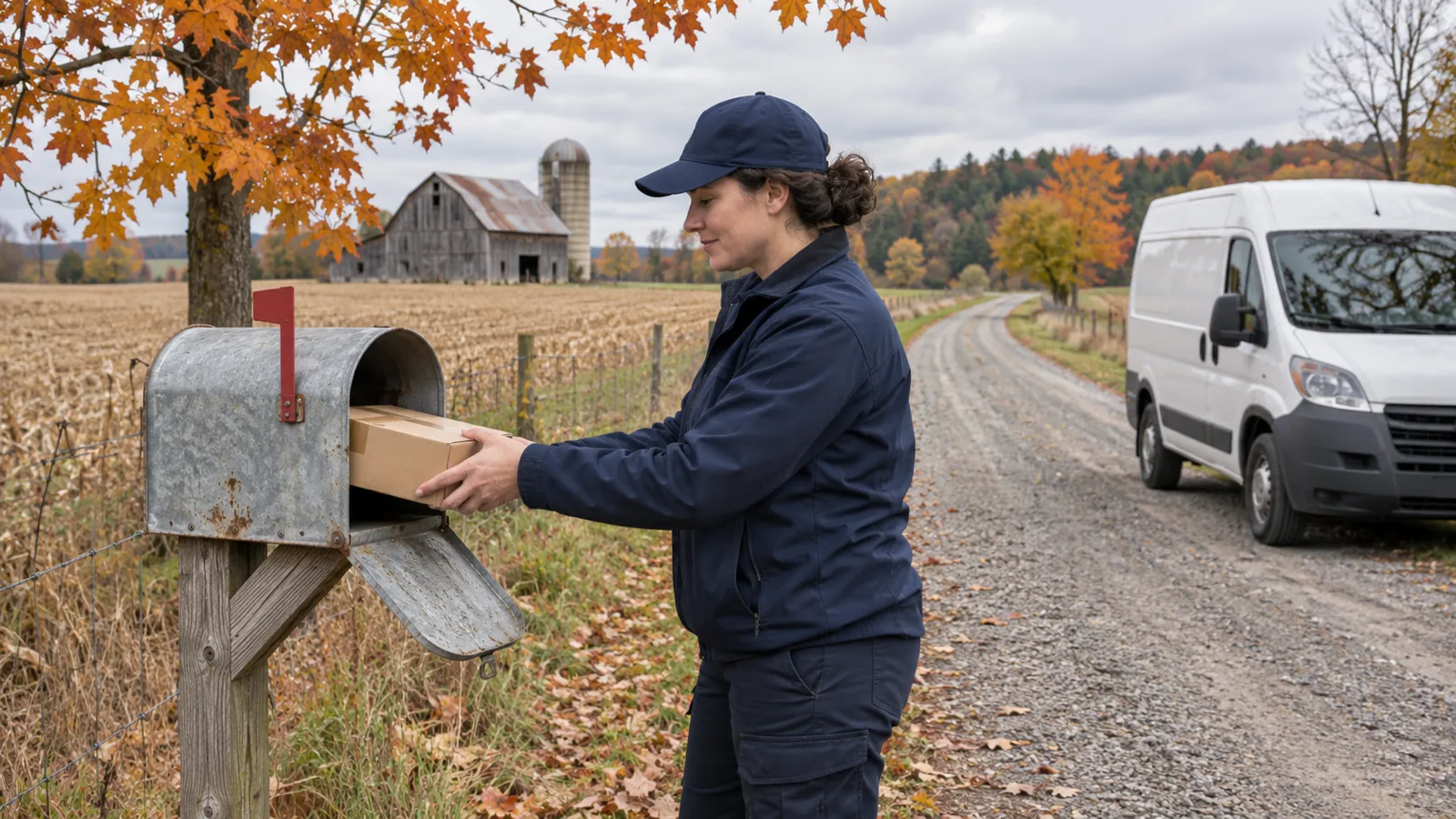
A farm equipment parts supplier ships a gearbox to a dairy farm in Perth County. The label says "RR 3, Mitchell." The courier driver, new to the route, finds a dozen farms on RR 3 and no name on any mailbox. After forty minutes he marks the package undeliverable and takes it back to the depot in Stratford. The farmer, who needed the part before planting, phones the supplier in a fury.
A few hundred kilometres north, a home goods brand ships a set of patio cushions to a cottage on a private lane off a township road near Haliburton. The road isn't plowed until May, the lane has a weight-restricted bridge, and the cottage owners won't be up until Victoria Day weekend. The package spends two weeks bouncing between the depot and a locked gate.
Rural Ontario is a big part of the market. Well over a million people live in townships, villages and on farms, and many more spend summers at cottages across Muskoka, the Kawarthas, Haliburton, Georgian Bay and the Ottawa Valley. Shipping to them reliably takes a bit more care than shipping to a condo in Toronto. This article covers what goes wrong and how to fix it.
Why Rural Addresses Cause Trouble
Old rural route addresses
For decades, rural Ontario addresses used rural route numbers: "RR 2, Smithville" or "RR 5, Lindsay." A rural route identified a mail carrier's route, not a specific property, and it could cover dozens or hundreds of homes. Over the past few decades, Ontario municipalities assigned civic numbers to rural properties for 911 emergency response, so most rural homes now have a proper street address, such as "4523 Concession Road 7." Many people still use the old RR address out of habit, and some online forms and databases still have it on file.
A courier needs a civic address to find a property. Canada Post can still deliver using rural route information because its rural mail carriers know their routes, but private couriers often can't.
Lots and concessions
Some rural Ontario residents, especially farmers, describe their location by lot and concession, the survey system used to lay out townships. "Lot 22, Concession 4" is precise for a land surveyor but meaningless to a delivery app. It helps as a backup, but always ask for the civic number too.
Seasonal and private roads
Cottage roads are often private lanes maintained by an association, with no winter maintenance. Some cottages are water-access only and have no road at all. Many township roads are gravel, narrow, and subject to load restrictions in spring.
Distance from the depot
Rural addresses can be an hour or more from the nearest courier terminal. Carriers may serve them on fewer days of the week, hand them off to a local agent, or pass them to Canada Post for the final leg. That adds time and sometimes extra cost.
How Different Carriers Handle Rural Ontario
Canada Post delivers to every address in the country, rural ones included. In rural Ontario it uses rural mailboxes at the roadside, community mailboxes, and post offices in villages and towns. Parcels that don't fit in a rural mailbox are often left at the door if accessible, or held at the local post office with a notice card. Canada Post is often the most dependable choice for small parcels to deep rural and cottage addresses.
Private couriers have excellent coverage in towns and on main rural roads, but some remote or seasonal areas are served through partner agents, on reduced frequency, or with extended area surcharges. Some couriers hand off rural parcels to Canada Post for final delivery. For larger shipments, couriers are often better equipped than the post office.
The right approach is to use more than one carrier and choose by postal code and parcel size. A carrier management setup lets you do that without juggling separate accounts and manual decisions.
Seasonal Realities in Ontario
Rural delivery in Ontario follows the seasons more than any calendar.
- Winter. Snowfall in the snowbelt east of Lake Huron and Georgian Bay, and across cottage country, closes or slows roads. Private lanes may be impassable until spring. Northern highways such as 11 and 17 can close during storms.
- Spring thaw. Many municipalities impose reduced load restrictions on township roads from roughly March to May to prevent damage while the ground thaws. Heavy trucks may not be allowed on certain roads, which matters for LTL deliveries of building materials, equipment and furniture.
- Summer. Cottage season brings a surge in deliveries to Muskoka, Haliburton, the Kawarthas and Prince Edward County, with long weekends particularly busy. Seasonal addresses that were empty all winter suddenly need deliveries.
- Fall. Harvest is the busiest time on farms. Farmers may be in the field from dawn to dark and unable to receive a delivery, so a safe drop location matters.
Capturing Better Rural Addresses at Checkout
Most rural delivery failures can be fixed before the order ships, by asking the customer for the right information.
- Require a civic number. If someone enters "RR" without a civic number, prompt them to add their 911 address.
- Offer a delivery instructions field. "Blue barn, second lane past the church, leave in the machine shed" helps a driver enormously.
- Ask for a phone number and make it clear it will be shared with the carrier. Drivers in rural areas often call ahead.
- Allow an alternate delivery address. Cottagers might prefer delivery to their city address, a marina, or a local general store that accepts parcels.
- Offer post office pickup. For cottage and remote addresses, shipping to a village post office for pickup is often the most reliable option.
- Validate postal codes. Rural postal codes have a zero as the second character, such as K0K or N0G. Flag mismatches between postal code and town.
Shipping Larger Items to Farms and Cottages
When the shipment is too big for a parcel carrier, such as a generator, a dock section, a pallet of feed supplements or a skid of shingles, it moves as LTL freight. Rural LTL deliveries need extra planning:
- Liftgate. Most rural homes and cottages have no loading dock. Book a truck with a liftgate.
- Equipment on site. Farms often have tractors with forks or a skid steer that can unload a pallet. Cottages almost never do. Ask.
- Truck access. A 53-foot trailer can't get down a cottage lane. Many carriers will use a straight truck for rural residential deliveries, but confirm in advance.
- Appointments. Book a delivery appointment so someone is there.
- Load restrictions. In spring, confirm the route isn't affected by reduced load periods.
- Accessorial charges. Residential delivery, liftgate, appointment and limited access charges all apply. Quote them upfront to avoid surprise invoices.
Frequently Asked Questions
Do couriers deliver to rural route addresses in Ontario?
Yes, but they need a civic address to find the property. An "RR" address on its own will often lead to a failed delivery with a private courier. Canada Post handles RR addresses better because its rural carriers know the routes.
How long does delivery to rural Ontario take?
Rural addresses in southern Ontario are often reached within one or two business days from the GTA by ground. Remote rural addresses in the north and parts of the Ottawa Valley can take several days. We break this down by postal code in our guide to next-day ground coverage in Ontario.
What about water-access cottages?
Ship to a marina, a local store, or the post office that serves the area, or to the customer's home address. Couriers won't deliver by boat.
Are there extra charges for rural delivery?
Many carriers add a delivery area or extended area surcharge for certain rural and remote postal codes. These vary by carrier and change from time to time. A multi-carrier platform can show you the all-in cost before you book.
Will packages be left at the roadside mailbox?
Small parcels may fit in a rural mailbox. Larger ones are usually taken to the door if the driver can reach it, or held at a post office or depot for pickup.
Does Canada Post deliver on weekends in rural areas?
Generally not for regular parcel service. Our article on whether Canada Post delivers on weekends explains the options.
Communicating With Rural Customers
Rural customers are used to deliveries taking a bit longer, and most appreciate honesty. Give them an accurate delivery window, share tracking promptly, and let them know if the shipment will be held at a post office or depot. ShipCarte customers and their buyers can follow parcels on our tracking page. A rural customer who knows the parcel will be at the Huntsville post office on Thursday is happy. One who expected it at the door on Tuesday and hears nothing is not.
If your business serves a lot of rural customers, such as agricultural suppliers, outdoor brands, building suppliers or cottage furnishing retailers, consider adding a small FAQ on your site about rural shipping, explaining how long it takes and what address details you need.
How ShipCarte Helps
ShipCarte's small parcel shipping gives you access to multiple carriers so each rural order can go with the one best suited to that postal code, and our freight team arranges liftgate and appointment deliveries for larger items. If you're interested in how the last stretch of delivery fits into your overall shipping, our article on first-mile and last-mile delivery explains the basics.
Reach Rural Ontario With Confidence
If deliveries to farms, small towns or cottage roads are causing headaches, we'd like to help. Request a quote and tell us where your rural customers are.