
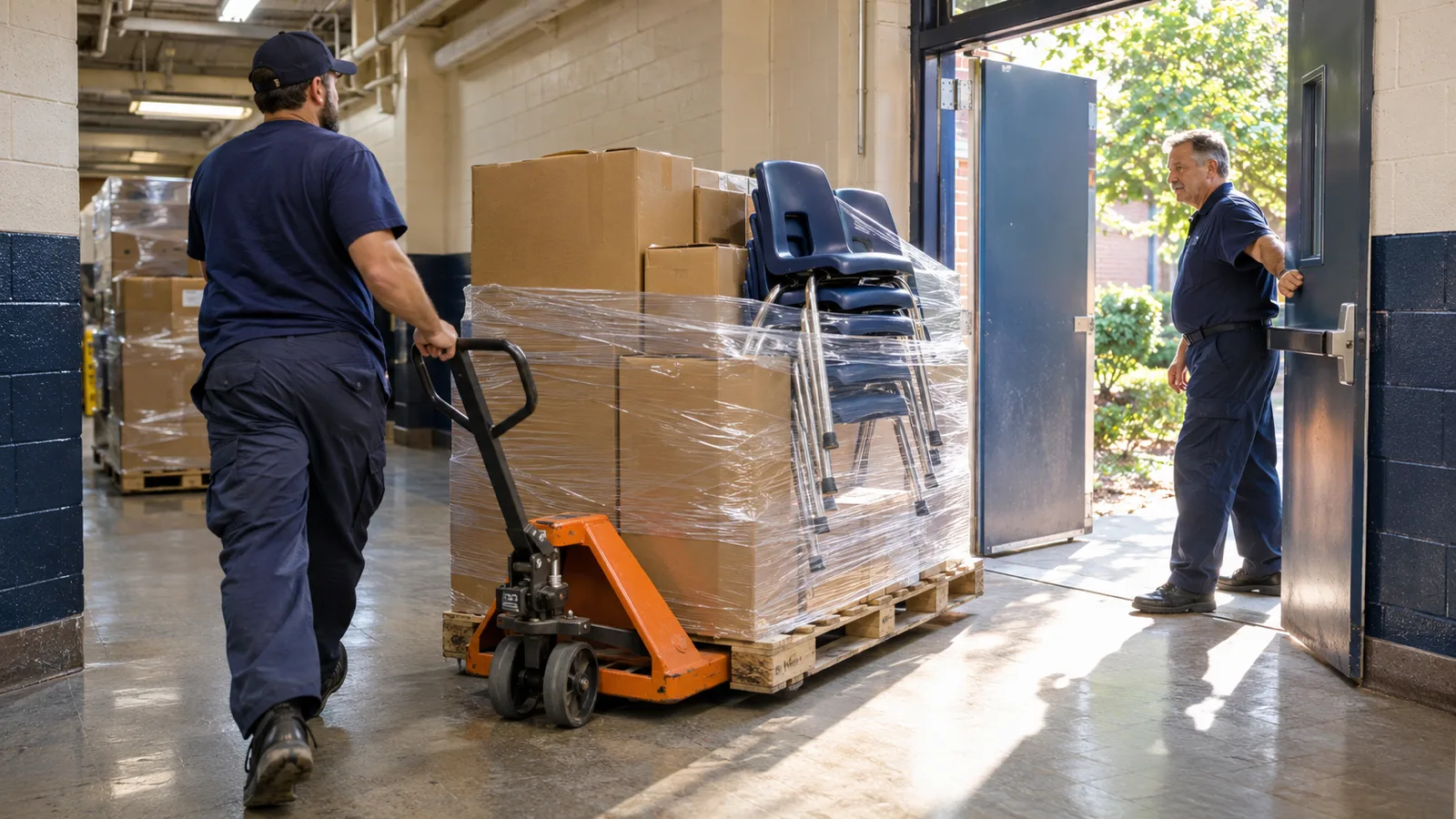
It is the third week of August. A supplier has won a contract to deliver new classroom furniture to 38 elementary schools across a school board that stretches from the edge of the GTA into rural Simcoe County. The furniture is coming by truckload from a plant in Southwestern Ontario. Each school needs a different mix of desks, chairs and tables, delivered to specific rooms, assembled, with packaging removed, before teachers arrive to set up classrooms. Several schools have only one custodian on summer hours. Two have construction fencing blocking their loading areas. There are eleven working days left.
Delivering to Ontario school boards is a logistics puzzle shaped by the school calendar. Boards buy everything from textbooks and science kits to furniture, technology, custodial supplies, gym equipment and portable classroom fittings. Much of it needs to arrive in a narrow window when schools are closed but staff are available to receive it, and much of it must go to dozens or hundreds of separate locations rather than one dock.
This article is written for manufacturers, distributors and contractors who supply Ontario's school boards, and for board facilities and purchasing staff who coordinate deliveries.
How Ontario's school system shapes logistics
Ontario has 72 district school boards, divided into English public, English Catholic, French public and French Catholic systems, plus a small number of school authorities. Together they run nearly 5,000 schools. Boards vary enormously in size and geography. The largest urban boards in Toronto, Peel, York and Ottawa have hundreds of schools within relatively compact areas. Northern boards, and the French-language boards in particular, can cover vast territories with schools hours apart.
That variety means there is no single delivery model. A supplier serving a compact urban board may run its own trucks school to school. One serving a northern board may ship to a board warehouse in Sudbury or Thunder Bay and let the board distribute from there. Many boards also buy through collaborative purchasing arrangements, such as those offered through the Ontario Education Collaborative Marketplace, so a single supplier might serve many boards under one agreement.
Two delivery models compared
Delivery to a board warehouse
Many boards operate a central warehouse or distribution centre. Suppliers deliver in bulk, typically by full truckload or LTL freight, and the board's own trucks or contracted couriers handle internal distribution to schools.
- Advantages: one delivery point for the supplier, lower freight cost, board controls the final mile and timing.
- Challenges: board warehouses fill up quickly in summer, receiving appointments can be scarce, and the board's internal fleet may not keep up with peak demand.
- Best for: consumables, custodial supplies, standard textbooks and items the board stocks centrally.
Direct-to-school delivery
For furniture, large equipment and items packed per school, the board may require the supplier to deliver to each school, sometimes to the specific room.
- Advantages: fewer touches, items go straight to where they are used, the board's warehouse is not overloaded.
- Challenges: many stops, limited receiving staff at schools, varied access conditions and tight timelines.
- Best for: furniture, large technology rollouts, gym and playground equipment, and anything requiring installation.
Many suppliers end up combining the two: shipping full truckloads to a regional distribution warehouse, sorting by school, then running multi-stop routes to each location.
The school-year calendar drives everything
School deliveries follow a predictable yearly cycle. Planning around it is the single biggest factor in success.
- January to April: boards plan budgets and tender for the coming year. Suppliers should be confirming capacity, warehouse space and freight for the summer.
- May and June: purchase orders arrive. Schools are still in session, so deliveries are limited to small items and anything that can be received without disruption. This is the time to pre-stage inventory.
- Late June to mid-July: schools close for summer. Custodial staff begin summer cleaning and maintenance, and renovation projects start. Large deliveries can begin, but some schools are fully closed for floor refinishing.
- Late July to late August: the main delivery window. Furniture, technology and classroom supplies flood in. Freight capacity is tight across Ontario because retailers are also moving back-to-school stock.
- September: catch-up deliveries, missing items and adjustments as enrolment numbers settle. Delays here are highly visible to parents and teachers.
- Winter break and March break: short windows for smaller projects and replacements.
A planning checklist for suppliers
Use this list to prepare for a school board delivery program:
- Get the ship-to list early. Confirm every school's address, receiving contact, summer hours and any construction or access restrictions.
- Confirm the board's receiving rules. Some boards require all deliveries through their warehouse; others want direct delivery with specific documentation.
- Book freight capacity in spring. Late-summer truck capacity in Ontario is tight. Reserve full truckloads and secure regular LTL commitments well ahead.
- Pre-stage inventory. Bring product into a warehouse near the board's territory in May or June, sorted and labelled by school, so August is about delivery rather than receiving.
- Label by school and room. Clear, large labels with school name, room number and contents let custodians direct items without opening boxes.
- Plan for installation and debris. If assembly is required, schedule crews and plan for cardboard removal. Schools do not want a mountain of packaging in their recycling bins.
- Follow site safety rules. Schools under renovation are construction sites under Ontario's Occupational Health and Safety Act. Delivery crews need appropriate PPE and must follow the contractor's site rules.
- Respect child safety policies. If deliveries happen while children are present, such as summer camps or during the school year, crews should sign in at the office and follow the board's visitor procedures.
- Track every stop. Electronic proof of delivery with photos and signatures makes it easy to answer questions from the board in September.
Furniture and large equipment
School furniture is bulky and often shipped assembled or partly assembled. A truckload of student chairs takes far more space than its weight suggests, and desks with steel frames are prone to scratches. Shipping by full truckload from the manufacturer to a staging warehouse protects the product and lowers the cost per unit, compared with sending dozens of separate LTL shipments to individual schools.
From the staging warehouse, straight trucks with liftgates suit most schools better than a 53-foot trailer, especially older urban schools with narrow driveways and no proper dock. Two-person crews with dollies and pallet jacks can bring furniture inside and place it in rooms, which many boards now expect.
Technology rollouts
Boards regularly roll out laptops, tablets, interactive displays and networking equipment. These shipments are high-value, attractive to thieves and often require configuration before delivery. A common approach is to receive devices at a secure warehouse, image or configure them, apply asset tags, pack them per school and deliver with serial-number manifests. Value-added services such as asset tagging and kitting keep this work out of the school.
Lithium batteries in laptops and tablets are regulated for transport, but devices with installed batteries generally move through standard ground networks with the right packaging and documentation. Large rollouts benefit from a careful chain of custody: count at dispatch, count at delivery, signature from an authorised person.
Classroom kits and consumables
Science kits, art supplies, math manipulatives and literacy resources are often packed per classroom or per grade. This is classic kitting and assembly work: assembling identical kits in volume, labelling them and shipping them to schools. Doing it in a warehouse ahead of the rush keeps August clear for delivery.
Custodial and cleaning supplies, paper and general consumables tend to move through board warehouses or on regular replenishment schedules during the year. Suppliers can reduce emergency orders by offering scheduled monthly deliveries matched to each board's consumption.
Serving northern and rural boards
Rural and northern boards present their own challenges. Schools in the Kenora, Rainy River, Timmins or Algoma districts may be several hours apart, and some remote communities have very limited road access. Shipping to a regional hub and letting the board or a local carrier handle final delivery is often more practical than running routes from southern Ontario. Leaving extra time is essential: a shipment to Thunder Bay can take two to three days by LTL from the GTA, and longer to smaller communities. Our post on shipping to Northern Ontario covers typical routes and transit times in more depth.
When things go wrong in September
Even the best-planned summer program ends with a few loose ends: a school that received the wrong desk height, a missing box of science kits, a chair with a cracked shell. How quickly these are resolved shapes the board's view of the whole program. Keep a small reserve of common items in the staging warehouse into early October, assign one coordinator to handle every school's issues, and commit to a turnaround time for replacements. A same-week fix for a missing classroom set is remembered far longer than the hundreds of deliveries that went smoothly.
Paperwork boards care about
School boards are public institutions accountable for how they spend money. Deliveries should match the purchase order exactly, with packing slips that reference the PO number and the school. Invoices should break out the 13% HST correctly. Damaged or short shipments should be reported quickly with photos. Suppliers who make reconciliation easy for board finance teams tend to be invited back.
Let ShipCarte handle your school delivery season
ShipCarte helps suppliers to Ontario school boards stage inventory, kit classroom materials, book truckload and LTL capacity, and run multi-school delivery programs during the busy summer window. To plan your next back-to-school program, request a quote or schedule a consultation with our team.