
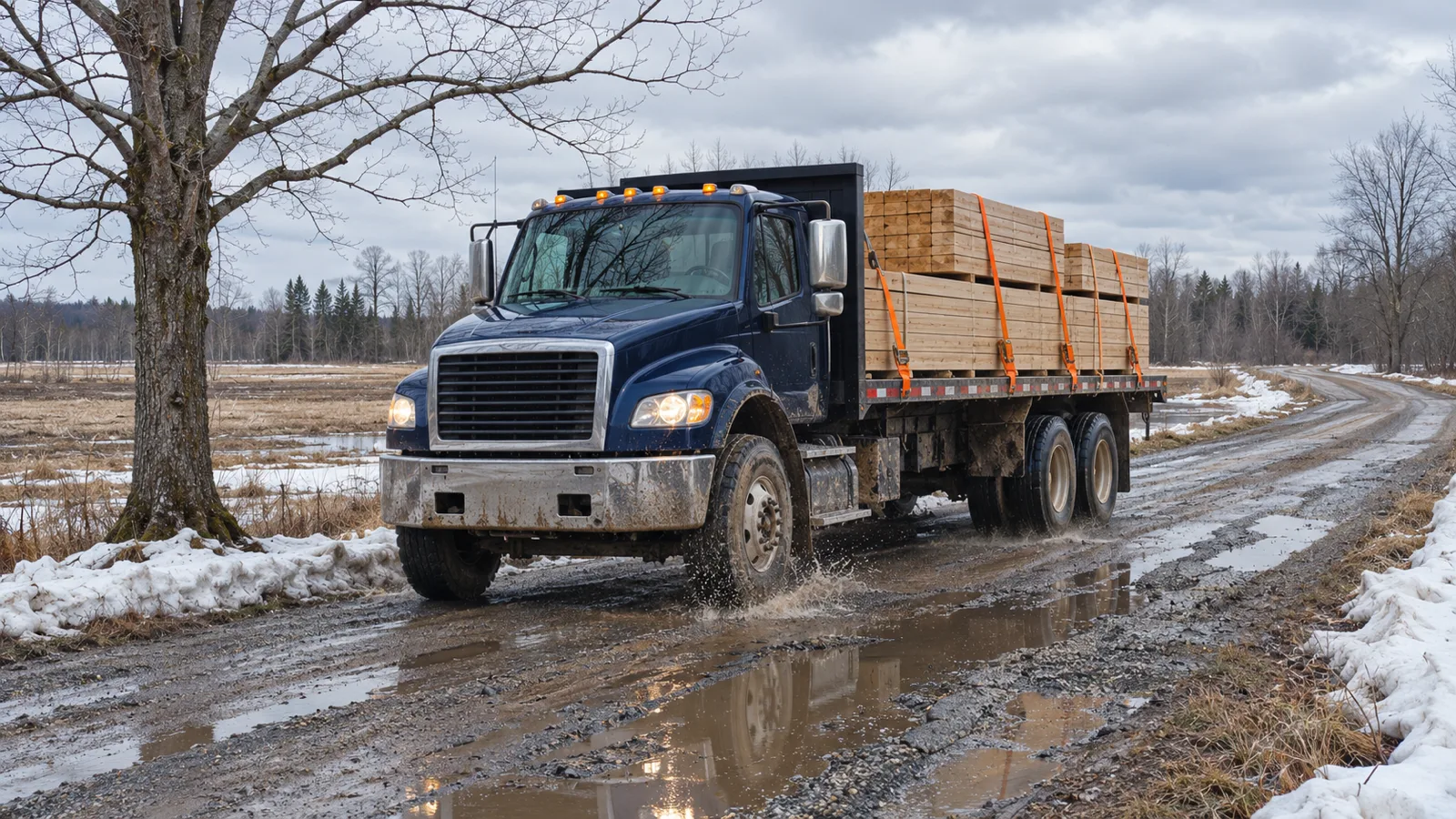
Every spring, a farm supply dealer in Grey County gets the same phone call. A customer on a concession road needs a full load of fertilizer or feed, and the dealer has to explain that the delivery will need two trips with a lighter truck, or wait a few weeks. The road is signed for reduced loads until the frost comes out of the ground, and a fully loaded truck would be breaking the law and damaging the road. The customer is not happy, and the dealer's delivery costs climb for six weeks.
Spring load restrictions are one of the least understood parts of freight in Ontario. They do not affect busy 400-series highways in the south, so many shippers in the GTA never encounter them. But for anyone delivering to rural customers, building sites, farms, cottages, mines or small communities across the province, the reduced load period can quietly double delivery costs and stretch lead times every year.
With the reduced load season under way across much of the province, now is a good time to understand how these restrictions work, manage the weeks ahead and start planning for next spring. This guide explains the rules in practical terms, shows which businesses feel them most, and lays out a planning approach to keep customers supplied.
Why Roads Get Weaker in Spring
Over the winter, moisture in the ground beneath a road freezes. In spring, the surface thaws first while the ground below is still frozen. Meltwater gets trapped in the upper layers because it cannot drain downward, leaving the road base saturated and soft. Heavy trucks passing over a road in this state can cause cracking, rutting and potholes that would never happen in summer. Roads built to lower standards, such as rural township roads, gravel roads and older secondary highways, are especially vulnerable.
Restricting axle weights for a few weeks protects roads that would otherwise need expensive repairs. For businesses, it means accepting lighter loads or planning around the period.
How the Reduced Load Period Works in Ontario
The legal basis
Ontario's Highway Traffic Act allows the province and municipalities to set a reduced load period on designated roads. During that period, the allowable weight per axle is reduced on signed roads, commonly to 5,000 kilograms per axle. That is far below what a loaded truck normally carries on each axle, which effectively limits many trucks to a fraction of their usual payload.
Provincial highways
The Ministry of Transportation designates certain provincial highways as reduced load highways, mostly in Northern Ontario. These tend to be secondary highways serving smaller communities, rather than primary routes such as Highways 11 and 17. Start and end dates vary by region and can shift from year to year depending on conditions, with northern zones generally starting and ending later than southern ones.
Municipal roads
Counties, townships and other municipalities set their own restrictions through local by-laws. Many rural municipalities across Ontario post a fixed period, often around March through April or into May, on some or all of their roads. Others adjust dates based on weather. You will see signs at road entrances announcing the reduced load period and the axle limit.
Exemptions and permits
Rules vary considerably. Some municipalities exempt certain vehicles or offer permits for essential deliveries, such as fuel, milk pickup or livestock feed. Others offer no exemptions at all. The only reliable approach is to check with each municipality you deliver into, or work with carriers who already know the local rules.
Who Feels It Most
Almost any business delivering outside urban centres can be affected, but some feel it more than others.
- Agriculture. Spring is planting season. Seed, fertilizer, feed and equipment deliveries peak just as rural roads are restricted.
- Building materials. Lumber, concrete, aggregates and roofing for spring construction projects, especially cottage and rural home builds in Muskoka, Haliburton and the Kawarthas. Our post on lumber and building products freight covers this sector in more depth.
- Fuel and propane. Heating fuel demand continues into spring while access is restricted.
- Forestry and mining. Operations in Northern Ontario often schedule shutdowns or adjust hauling around the thaw.
- Rural retailers. Hardware stores, garden centres and general stores in small towns may receive restocking deliveries on restricted roads.
- Appliance and furniture delivery. Usually less affected, since loads are lighter, but large trucks with heavy single items can still exceed axle limits.
What It Costs
The cost of spring restrictions shows up in several ways:
- More trips. A truck that normally carries 20,000 kilograms might be limited to a much smaller load. Moving the same total quantity takes several trips.
- Smaller equipment. Carriers may switch to lighter trucks with more axles, which may cost more per kilogram moved.
- Transloading. Freight may be delivered to a staging point on an unrestricted road, then moved the final distance on smaller vehicles.
- Delays. Some deliveries are simply postponed until restrictions lift, delaying projects and sales.
- Fines. Trucks caught exceeding axle limits face fines based on the amount of overweight, along with convictions on the carrier's record.
A Planning Calendar for the Reduced Load Season
Late fall: Map your exposure
List the customers and delivery locations on roads likely to be restricted. Look at last spring's deliveries: which locations required split loads or delays? Note the municipalities involved so you can check their by-laws and typical dates.
January and February: Talk to customers
Let rural customers know the restrictions are coming and offer options: an early delivery before restrictions begin, smaller split deliveries during the period, or a delivery after restrictions lift. Many customers are happy to take product early if you give them notice, especially if it avoids a premium.
Before the thaw: Pre-position stock
Deliver larger quantities while the ground is still frozen and roads are at full capacity. Frozen roads can actually carry full loads safely. For customers who do not have room to store extra stock, consider holding inventory at a warehouse closer to them. Our distribution warehousing can act as a staging point.
During the period: Adapt
- Plan split loads with carriers who have appropriate equipment.
- Combine partial deliveries for several customers in the same area onto one route where axle limits allow.
- Check municipal websites and road signs regularly, since dates can change with the weather.
- Keep customers informed about delivery schedules.
After restrictions lift: Catch up
Expect a surge in demand for trucks immediately after restrictions end, as everyone tries to deliver postponed loads. Book capacity in advance to avoid getting stuck in the queue.
A Worked Example: Supplying a Spring Cottage Build
Consider a building-supply distributor in the Barrie area that has sold the framing package for a new cottage on a township road near Haliburton. The builder wants to start in mid-April, right in the middle of the local reduced load period. The full package, including lumber, sheathing, trusses and roofing, would normally go out on two flatbed loads.
Under a 5,000-kilogram-per-axle limit, those same materials might need five or six trips on lighter equipment, each one with its own driver time and fuel cost from Simcoe County. The distributor has three realistic choices:
- Deliver early. Ship both full loads in late February or early March while the ground is still frozen, and have the builder store and cover the material on site. This is usually the cheapest option if the site has room and security is not a concern.
- Stage nearby. Deliver full loads to a yard or warehouse on an unrestricted highway, then shuttle smaller quantities the last few kilometres as the builder needs them. This adds handling but keeps the trips short.
- Wait. Start the build after the restrictions lift. This avoids extra freight costs but delays the project and competes with every other postponed delivery in the area.
The distributor that raises these options with the builder in January looks organized and saves everyone money. The one that discovers the signs in April ends up absorbing extra trips or explaining a delay. The difference is entirely in the planning.
Questions Shippers Often Ask
Do spring restrictions apply to the 400-series highways?
No. Major freeways and primary provincial highways are built to carry full loads year-round. The restrictions apply to designated secondary highways, mostly in the north, and to municipal roads that post them.
How do I know when restrictions start and end?
Check the Ministry of Transportation for provincial highways and the relevant county or township for local roads. Dates are often announced on municipal websites and posted on signs at road entrances. Carriers who serve the area regularly are also a good source.
Can a carrier get a permit to exceed the limit?
Sometimes, depending on the municipality and the type of delivery. Do not assume a permit will be available, and do not plan on carriers ignoring the signs; the fines and the damage to their safety record make most reputable carriers unwilling to take the risk.
Does it affect parcel deliveries?
Rarely. Courier vans are light enough that axle limits are not usually an issue. The impact falls mostly on freight deliveries and heavy trucks.
What about deliveries to the far north?
Communities served by winter roads face a different challenge: the roads simply disappear when the ice melts. Spring is the end of the trucking season for those communities, and the rest of the year depends on air or barge service.
Turning a Seasonal Problem Into a Planning Habit
Businesses that handle spring restrictions well treat them like any other predictable season, similar to the holiday peak or winter weather. They know which customers are affected, they communicate early, they ship heavy before the thaw, and they hold inventory where it can reach customers on short, light runs. That approach requires good data on where stock is and what customers will need, which is where reliable inventory management earns its keep.
It also pairs well with broader seasonal planning. The same customers affected by spring restrictions are often the ones most exposed to winter closures, so the inventory and communication habits you build for one season help with the other. See our guide to cold weather freight protection for the winter side of the calendar.
Plan Your Spring Freight With ShipCarte
ShipCarte helps businesses across Ontario plan freight around seasonal challenges, from pre-thaw stocking runs to split LTL shipments and staged distribution for rural customers. Our team can review your delivery locations and help you get through this season and build a plan for next spring before the signs go up again. Request a quote or schedule a consultation to get started.