
A metal fabricator in Barrie orders twenty tonnes of hot-rolled coil from a Hamilton service centre. The coil arrives on time, but one of the coils has shifted on the trailer and its outer wraps are damaged, which means scrap and a quality claim. A week later, a load of stainless sheet from the same supplier sits outside in the rain at a cross-dock because nobody booked a tarped trailer. Neither problem had anything to do with the steel itself. Both were freight decisions.
Steel and metal products are among the heaviest, densest and least forgiving freight moving on Ontario's roads, rails and waterways. Hamilton remains the centre of Canadian steelmaking, Sault Ste. Marie and Nanticoke add major mills, and hundreds of service centres, fabricators, stampers, pipe and tube makers and machine shops across the province turn that steel into products. Every step involves moving loads that can weigh twenty tonnes or more and that can kill someone if they are secured badly.
This guide covers the practical side of moving steel and metals in Ontario: which equipment suits which products, the securement rules carriers follow, weight and season considerations, the role of ports and rail, and how warehousing fits in.
Ontario's metal freight landscape
The main flows of steel and metal freight in the province include:
- Mill to service centre. Integrated mills in Hamilton, Nanticoke and Sault Ste. Marie ship coil, plate and bar to service centres, which cut, slit and level material for customers.
- Service centre to manufacturer. Processed steel moves to automotive stampers, appliance makers, fabricators, equipment manufacturers and construction contractors across southern Ontario.
- Imports. Steel and aluminium arrive from the United States by truck over the border crossings at Windsor, Sarnia, Fort Erie and Niagara Falls, and from overseas by ship through the St. Lawrence Seaway to the Port of Hamilton and other Great Lakes ports.
- Scrap. Scrap metal moves from collectors and processors to mills and to export, often by gondola rail car, roll-off bin or bulk ship.
- Finished metal products. Structural steel, pipe, racking, fabricated assemblies and metal building components move to construction sites and customers throughout Ontario and beyond.
Matching the equipment to the product
Choosing the wrong trailer is the most common cause of avoidable damage and delay in metal freight. Here is how the main options line up.
Steel coil
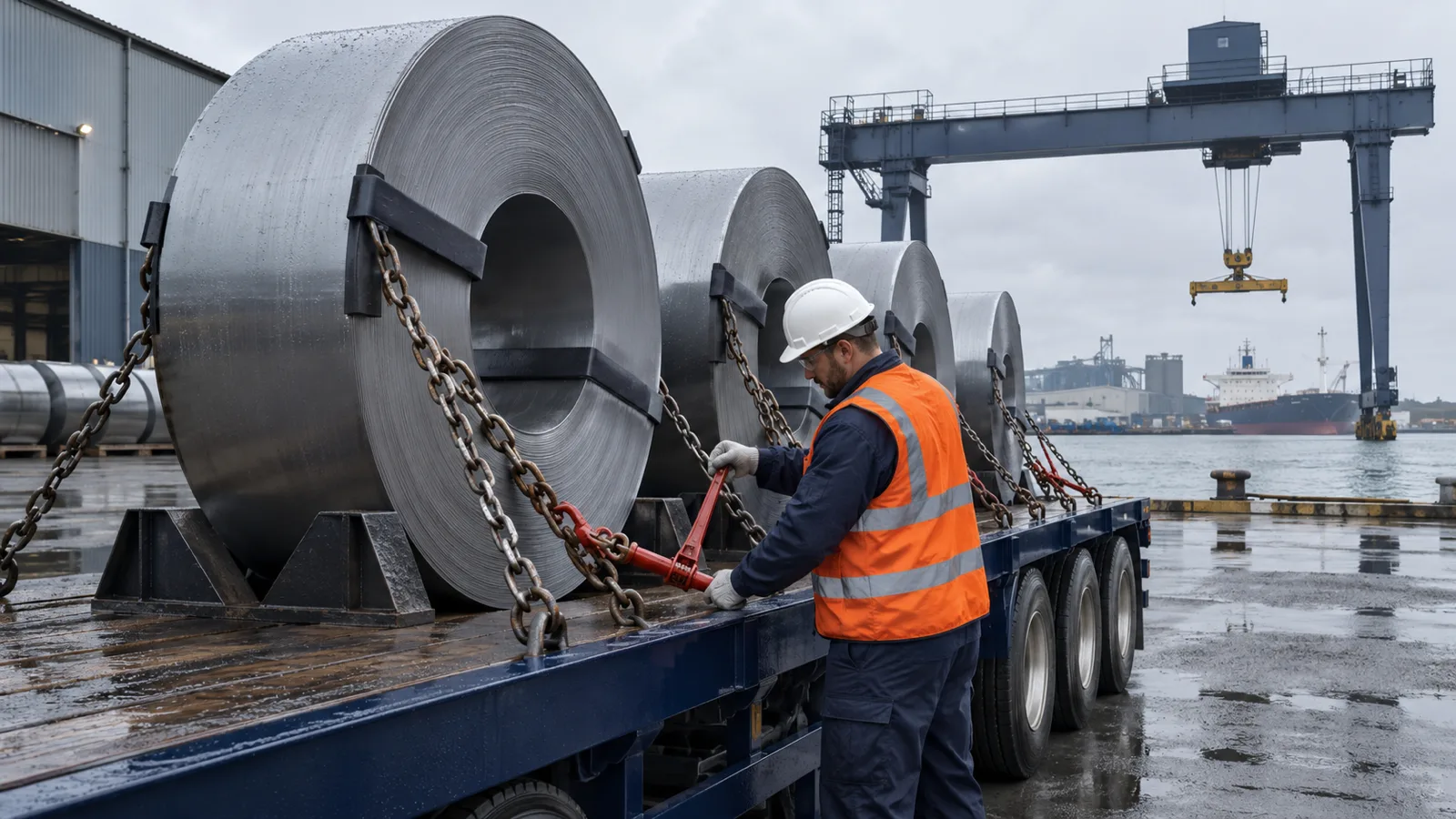
Coils are heavy for their size, which concentrates weight on a small area of the trailer deck. They are typically moved on flatbeds or specialized coil trailers with a recessed coil well or bunks that cradle the coil. Coils may be loaded "eye to the sky" (axis vertical) or with the eye facing forward or sideways, depending on size and the customer's handling equipment. Narrow slit coils often travel on skids, eye vertical. Cold-rolled, coated and stainless coils need weather protection and usually travel tarped or in a covered trailer.
Plate and sheet
Plate travels on flatbeds with dunnage between layers so forklifts can get under it. Finished sheet, especially galvanized, pre-painted or stainless, is moisture-sensitive and should travel in enclosed vans or Conestoga-style rolling-tarp trailers, which allow side loading by forklift or overhead crane while keeping the load dry.
Long products
Bar, rebar, structural beams, pipe and tube often exceed standard trailer lengths. Extendable flatbeds handle long loads within legal limits, and loads beyond those limits need oversize permits from the Ontario Ministry of Transportation, along with escort vehicles and travel-time restrictions in some cases.
Aluminium and non-ferrous metals
Aluminium is lighter but easily scratched and dented. Extrusions and sheet usually move in enclosed equipment with careful dunnage and edge protection. Copper and brass carry high value per kilogram, so security and tracking become as important as securement.
Scrap
Scrap moves in dump trailers, roll-off containers, walking-floor trailers and gondola rail cars. Loads must be contained to prevent pieces from falling onto the highway.
Cargo securement: the rules carriers follow
Ontario enforces cargo securement through Ontario Regulation 363/04 under the Highway Traffic Act, which adopts National Safety Code Standard 10. The standard sets out minimum requirements for tiedowns, working load limits and blocking, with specific provisions for metal coils and other heavy commodities.
Shippers are not exempt from responsibility here. Even when the carrier secures the load, the shipper often loads it, and the way material is placed, blocked and dunnaged determines whether it can be secured properly. Key points include:
- The aggregate working load limit of tiedowns must meet minimum ratios relative to the cargo weight.
- Coils have specific requirements depending on orientation, including chains through the eye, chocks or cradles, and blocking to prevent rolling.
- Edge protectors prevent chains and straps from cutting into the product and keep them from losing tension.
- Drivers must inspect securement within the first 80 kilometres and periodically during the trip.
MTO enforcement officers and inspection stations along Highway 401, the QEW and Highway 400 check securement regularly, and a failed inspection can put a truck out of service until the load is corrected.
Weight limits and seasonal restrictions
Because metals are so dense, steel trucks almost always weigh out before they cube out. Ontario allows relatively high gross weights for multi-axle configurations that meet its Safe, Productive and Infrastructure-Friendly (SPIF) vehicle standards, which is one reason you will see so many multi-axle flatbeds hauling steel in the province. Still, every configuration has axle and gross limits, and loading must distribute weight correctly across axles.
In spring, reduced load periods apply on many roads in northern Ontario and on some municipal roads in the south, as frost leaves the ground and roadbeds weaken. Shippers delivering steel to job sites or plants on affected roads need to plan smaller loads or schedule around the restrictions.
Ports, rail and water
Steel has always been tied to the Great Lakes. The Port of Hamilton handles iron ore, coal and finished steel, and the St. Lawrence Seaway connects it and other Ontario ports to Atlantic shipping from roughly late March until late December. Imported steel arriving by ship can be discharged at Hamilton, stored in port warehouses or laydown areas, and trucked to customers across southern Ontario.
Rail is also important. Coil moves in covered coil cars, plate and structural steel on flatcars and gondolas, and scrap in gondolas. Rail makes sense for long hauls to Western Canada or the US Midwest, and for very heavy loads that would require multiple trucks. Shippers without a siding can use transload facilities, which we cover in our article on rail freight in Ontario.
Trade and the border in 2020
The past two years have been turbulent for steel trade. The United States imposed tariffs on Canadian steel and aluminium in June 2018, and Canada responded with countermeasures. Those tariffs were lifted in May 2019 under an agreement between the two governments, which has eased cross-border steel flows. CUSMA, which replaced NAFTA on July 1 this year, also brings updated rules of origin, so check how your products qualify under the new agreement. Canada has also introduced safeguard measures on certain imported steel products to prevent diversion of foreign steel into the Canadian market. Importers should confirm the current status of any safeguard or trade remedy affecting their products before booking shipments, and keep mill certificates and origin documentation ready for the CBSA.
For cross-border freight, carriers with steel experience and border programs such as FAST can save hours at the crossings. ShipCarte's cross-border shipping team coordinates documentation and carriers for metal shipments in both directions.
Storing steel and metals
Metal products have particular storage needs, and a general-purpose warehouse is not always equipped for them.
- Floor loading. Coils and plate concentrate weight, so floors must be rated accordingly.
- Handling equipment. Heavy forklifts with coil rams, overhead cranes or vacuum lifters are needed for many products.
- Climate. Condensation causes rust and staining, especially when cold steel enters a warm building. Ventilation and controlled temperature help protect finished material.
- Racking. Cantilever racking stores long products safely. Coils need cradles or chocks.
- Traceability. Heat numbers and mill certificates must follow the material so customers can trace quality issues.
For manufacturers that receive steel in large lots but consume it gradually, holding inventory in a nearby warehouse and drawing it down with frequent smaller deliveries frees plant floor space and reduces handling damage. Inventory management that tracks heat numbers and lot sizes makes that model work.
A pre-shipment checklist for metal loads
- Specify the product, weight, dimensions and number of pieces accurately when booking.
- Request the right trailer type, including tarping or enclosed equipment for finished surfaces.
- Confirm the receiver's unloading equipment: forklift capacity, crane, or side unloading needs.
- Use proper dunnage, skids and edge protection.
- Check that the load is distributed for legal axle weights.
- Confirm oversize permits for long or wide loads.
- Send mill certificates and packing lists with the shipment or electronically ahead of it.
- Photograph the load before departure in case of a damage claim.
Choosing between LTL and full truckload
Smaller metal orders, such as a few bundles of tube or a skid of sheet, can travel by LTL freight, but they need careful packaging and a carrier that is comfortable handling heavy, awkward pieces. Many LTL carriers have restrictions on long or very heavy items. Larger orders and anything requiring specialized securement are better on a dedicated full truckload flatbed or van. For guidance on the paperwork that accompanies these loads, our explainer on the bill of lading is a useful refresher.
Move metal with confidence
ShipCarte helps fabricators, service centres and manufacturers across Ontario book the right equipment, coordinate securement and storage, and keep heavy freight moving on schedule. If damaged coils, missing tarps or overweight surprises are eating into your margins, request a quote and we will help you plan your metal freight properly.