
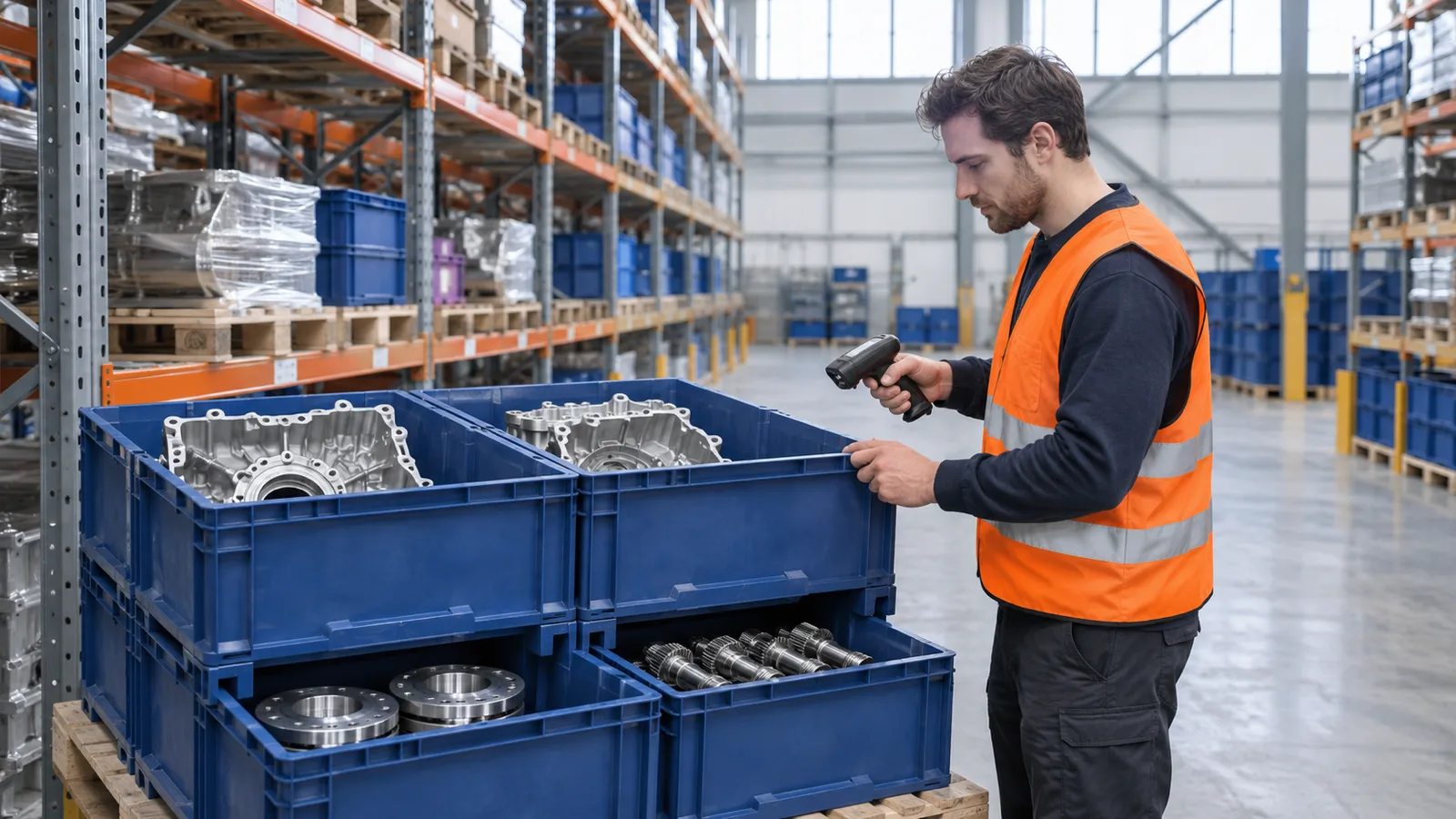
A tier two supplier in Guelph machines precision components for a tier one customer in Windsor, which assembles them into modules for an assembly plant in Michigan. Some of the raw steel comes from Hamilton, some castings come from Ohio, and the finished modules cross the Ambassador Bridge before they reach the vehicle. When the tier one customer changes its delivery schedule on short notice, the Guelph plant has to react within a day, and its logistics manager spends half the week chasing trucks and counting plastic totes.
Supplier logistics in Ontario's automotive sector is a web, not a line. Tier one suppliers sell directly to the automakers. Tier two suppliers sell to tier ones. Tier threes supply raw materials and basic components further upstream. Each tier inherits the timing pressure of the assembly plant at the top while dealing with its own suppliers below. The result is a network where a delay at one link can ripple up to a vehicle line within hours.
This article focuses on the warehousing and distribution decisions that tier one and tier two suppliers in Ontario make, rather than the line-side delivery process itself. If you are mainly interested in delivery windows at the plant, our companion piece on just-in-time logistics for Ontario's auto sector covers that ground.
Where Ontario's suppliers cluster
The province's parts makers are concentrated in a handful of regions, each with its own logistics character:
- Windsor-Essex, with deep links to Detroit and heavy cross-border traffic over the Ambassador Bridge and through the Detroit-Windsor Tunnel.
- Kitchener, Cambridge, Waterloo and Guelph, home to many machining, stamping and assembly operations within easy reach of the Toyota plants in Cambridge and Woodstock.
- London, Woodstock, Ingersoll and St. Thomas, close to the CAMI plant in Ingersoll and the Toyota Woodstock plant.
- The GTA and York Region, including Brampton, Vaughan, Concord and Markham, close to the Brampton and Oakville assembly plants.
- Barrie, Alliston and Simcoe County, serving the Honda plant in Alliston.
- Durham Region, historically tied to the Oshawa plant and now adjusting to the end of vehicle assembly there.
Because Highway 401 and the 400-series highways connect all of these clusters, many suppliers serve multiple assembly plants from a single factory. That flexibility is a strength, but it also means the supplier's warehouse strategy has to cover several customers with different schedules, packaging rules and delivery expectations.
Three warehouse models, compared
Most Ontario suppliers use one of three models, or a blend of them, to hold finished goods.
Model 1: Inventory at the plant
Finished parts stay in the supplier's own building and ship directly to customers.
- Works well when the plant is close to the customer, volumes are steady, and there is floor space to spare.
- Struggles when the plant needs that floor space for production, when customers are several hours away, or when the supplier ships to several customers with different timing.
Model 2: A third-party buffer warehouse near the customer
A 3PL holds a few days of finished goods close to the assembly plant or tier one customer and makes frequent short deliveries.
- Works well when the supplier's plant is far from the customer, when the customer wants several deliveries a day, or when the border sits between the plant and the customer.
- Struggles when volumes are too small to justify the extra handling, or when inventory data between the plant and the warehouse is not tightly integrated.
Model 3: A regional distribution centre
One central warehouse, often in the GTA or Kitchener-Cambridge area, receives from multiple plants and ships to multiple customers, including service parts and aftermarket channels.
- Works well when the supplier has several plants or product lines, sells service and aftermarket parts as well as production parts, or needs consolidation for export.
- Struggles when customers need very short delivery windows that a central location cannot reliably hit.
Many suppliers end up with a mix: production parts for nearby customers shipped from the plant, buffer stock near distant or cross-border customers, and a regional DC for service and aftermarket parts.
Inbound is half the battle
Suppliers tend to focus logistics attention on delivering to their customers, because that is where the chargebacks come from. But inbound material is where many problems start. A stamping plant that runs out of steel coil, or an injection moulder that runs short of resin, misses its outbound shipments no matter how good its outbound carriers are.
Common inbound flows for Ontario suppliers include:
- Steel coil and sheet from mills and service centres in Hamilton, Nanticoke and the US Midwest. Our article on moving steel and metal products around Ontario goes into the handling side.
- Plastic resin by bulk truck or rail hopper car, often through transload facilities.
- Castings, forgings and purchased components from the United States and Mexico.
- Electronics and specialty components from Asia, arriving by ocean container through Montreal, Halifax or Vancouver and moving by rail to the GTA.
A 3PL can help by holding safety stock of critical inputs close to the plant, consolidating inbound LTL shipments, and managing milk runs that collect parts from several local suppliers on a fixed route. Milk runs are especially effective in dense clusters like Kitchener-Cambridge, where a single truck can visit several tier two and tier three suppliers in a morning.
Packaging and returnable containers
Automotive customers specify how parts must be packed, down to the container type, dunnage, quantity per container and label format. Tier ones then often impose similar requirements on their tier twos. Getting packaging right is a logistics task as much as an engineering one.
Returnable container management checklist
- Track every container by ID or at least by type and count, at every location.
- Reconcile container counts weekly with each customer.
- Plan return trips so empties come back in time to be refilled.
- Budget for cleaning, repair and replacement.
- Agree expendable packaging backup rules with the customer for when returnables run short.
- Keep dunnage clean and in good condition, because damaged dunnage damages parts.
Lost or stranded containers are one of the most persistent, least visible costs in supplier logistics. A warehouse partner that scans containers in and out, and reports balances, removes a lot of guesswork. Our value-added services include repacking from expendable to returnable packaging and vice versa.
Service and aftermarket parts
Production parts are only part of the picture. Automakers require suppliers to provide service parts for vehicles for years after a model goes out of production. Aftermarket channels such as parts distributors and retailers add more demand. These flows look very different from production logistics:
- Smaller, irregular orders rather than steady daily releases.
- Individual retail packaging, sometimes with labelling for multiple brands.
- Long-tail inventory of slow-moving part numbers.
- Parcel and LTL shipping to distribution centres and dealers across Canada and the US.
Many suppliers move service and aftermarket parts to a 3PL so their plant can focus on production. A warehouse that offers pick and pack services, kitting and assembly and parcel shipping is a good fit, since service kits often combine several parts and hardware in one package.
Quality and traceability requirements
Automotive suppliers work under quality management standards such as IATF 16949, and their customers expect traceability from raw material lot through to shipment. That expectation extends to any warehouse handling their parts. A 3PL serving auto suppliers in Ontario should be able to:
- Track inventory by part number, revision level and lot or heat number.
- Enforce first-in, first-out rotation, especially for parts with shelf-life limits such as adhesives or rubber components.
- Quarantine suspect material immediately when a quality hold is issued.
- Support sorting and containment activities, so a supplier can inspect stock at the warehouse rather than recalling it to the plant.
- Produce shipment history quickly if a customer needs to trace which lots went where.
A capable warehouse management system is the backbone of all five.
Controlling premium freight
Premium freight, meaning expedited trucks, hot-shot deliveries and air freight used to recover from a problem, is the line item that most often surprises supplier finance teams. A few practices help bring it down:
- Log every premium shipment with a root cause, whether production delay, inbound shortage, carrier failure or customer schedule change.
- Review the log monthly and fix the top causes rather than accepting them as routine.
- Hold buffer stock for parts with frequent schedule changes or long inbound lead times.
- Negotiate standing rates with expedite carriers rather than paying spot prices in a crisis.
- Push back, with data, when customer schedule changes are driving the premium cost.
Getting ready for change
2019 is a year of change for Ontario suppliers. Vehicle assembly in Oshawa is scheduled to end this year, the replacement for NAFTA is awaiting ratification with tougher auto rules of origin, and the shift toward electrified powertrains is beginning to change which parts are in demand. Suppliers that keep their logistics flexible, with warehouse capacity that can grow or shrink and data that shows exactly where inventory sits, will be better placed to win new programs as the industry shifts.
Build a stronger supplier network with ShipCarte
ShipCarte works with manufacturers across Ontario to place inventory in the right spot, manage returnable containers and service parts, and keep premium freight under control. If your logistics team is spending more time firefighting than planning, request a quote and let us look at your network.