
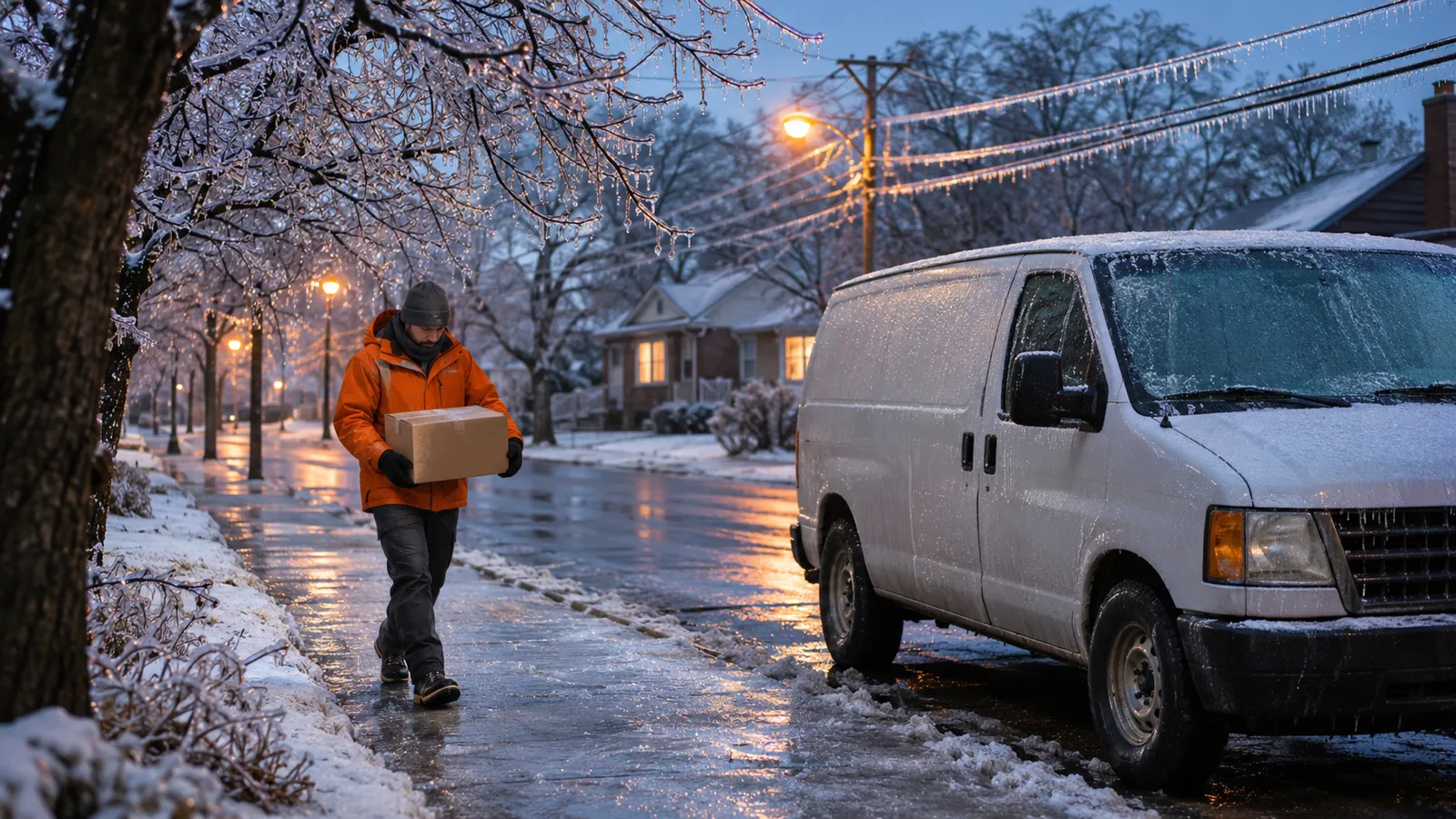
You open your order dashboard on a Tuesday morning in February and see a wall of yellow. Dozens of parcels that were "out for delivery" yesterday now read "delivery exception" or "delayed due to weather". Your inbox already has customers asking where their orders are, and one of them needed the item for a birthday this weekend. Outside, freezing rain is still coating the parking lot.
Every Ontario business that ships parcels lives through some version of this every winter. The province's weather is varied and sometimes violent: lake-effect snow squalls off Lake Huron and Georgian Bay, freezing rain that coats the Golden Horseshoe, deep cold snaps in the north, and the occasional full ice storm that takes down power lines across whole regions. Carriers do their best, but some days trucks simply cannot run safely.
This article explains what a weather-related delivery exception actually means, how Ontario's specific weather patterns affect different routes, and what you can do as a shipper to protect your customers and your reputation when the forecast turns ugly.
What a Delivery Exception Really Means
A delivery exception is any event that interrupts a parcel's normal path to the customer. It is a status, not a verdict. Weather is one of the most common causes, but exceptions can also be triggered by an incorrect address, a business that was closed on delivery, a damaged label, a customs hold or a missed connection at a sorting terminal.
When weather is the cause, carriers typically use language such as "severe weather conditions have delayed delivery" or "delivery attempted, unable to access location". The important points for a shipper are:
- A weather exception rarely means the parcel is lost. It usually means it is sitting in a terminal or on a truck that could not complete its route.
- Most carriers suspend their money-back service guarantees during weather events, so you generally cannot claim a refund on a late express shipment caused by a declared storm.
- The delay often compounds. If a terminal in the GTA closes its outbound docks for a day, the next day has double the volume to move, and the backlog can take several days to clear.
How Ontario Weather Hits Different Routes
Ontario is too big to treat as one weather zone. A storm that barely registers in Windsor can paralyse travel north of Barrie. Understanding the patterns helps you set expectations by region.
Snow Belts and Lake-Effect Squalls
Areas downwind of the Great Lakes, including Owen Sound, Collingwood, Wasaga Beach, parts of Grey and Bruce counties, the London area and the region east of Lake Ontario around Kingston, regularly get intense, localised squalls. Visibility can drop to near zero on Highway 400, Highway 402 and Highway 401 within minutes. The OPP often closes sections of highway during these events, and parcels bound for these areas can be held for a day or two even when the rest of the province is clear.
Freezing Rain in the South
Freezing rain is the quiet disrupter of the Golden Horseshoe. Toronto, Hamilton, Niagara and Kitchener-Waterloo see several freezing rain events most winters. The 2013 ice storm that knocked out power for hundreds of thousands of Toronto residents just before Christmas is still remembered by anyone who was shipping holiday orders that week. Even a modest ice event makes sidewalks, steps and driveways treacherous, so couriers may skip residential stops where they cannot safely reach a door.
Northern Ontario Cold and Distance
In Sudbury, Timmins, Thunder Bay and Sault Ste. Marie, the challenge is often extreme cold combined with long distances. Highway 11 and Highway 17, the main routes linking the north to the south and west, can close for collisions or whiteouts, and there are few alternative roads. A closure between North Bay and Sudbury, or along the Lake Superior shoreline, can delay every truck heading in that direction. Parcels for remote communities that rely on air service can be delayed further when flights are grounded.
Eastern Ontario and the Ottawa Valley
Ottawa and the Ottawa Valley receive heavy snowfall and some of the coldest temperatures in Southern Ontario. Ottawa's 1998 ice storm remains a reference point for how severe freezing rain can get. Shipments between Toronto and Ottawa usually move along Highway 401 and Highway 416, and a closure near Kingston or Brockville can slow the whole corridor.
Three Scenarios and How to Handle Them
Scenario 1: A Forecast Storm Two Days Out
Environment Canada has issued a winter storm watch for most of Southern Ontario starting Thursday night. It is Tuesday. This is the best case, because you have time.
- Push to ship all open orders by Wednesday afternoon, even if it means overtime in the warehouse.
- Put a notice on your website and in order confirmation emails stating that deliveries on Friday may be delayed by weather.
- For urgent or perishable orders, offer customers the option to hold shipment until after the storm.
- Check that your carriers' terminals and pickup schedules are confirmed for Wednesday.
Scenario 2: An Ice Storm Hits Mid-Route
Freezing rain arrives earlier than expected on a Monday morning. Your parcels are already on trucks. You cannot change what happens on the road, but you can control the conversation.
- Pull a list of all in-transit shipments to the affected region from your shipping platform.
- Send a proactive email to those customers before they contact you, explaining the delay and pointing them to tracking.
- Brief your customer service team with a standard response and a clear rule on when to offer a refund or reshipment.
- Pause any promotions promising next-day delivery to the affected region until the backlog clears.
Scenario 3: A Parcel Is Damaged by the Weather
A carton was left on a porch in Barrie during a squall, soaked through and the contents ruined. Or a liquid product froze and the bottle cracked on a trailer near Thunder Bay. These are the cases that cost money.
- Ask the customer for photos of the outer box, inner packaging and the product right away.
- File a claim with the carrier if your service level and declared value allow it, keeping in mind that many standard services exclude freezing damage.
- Decide quickly whether to reship. A fast replacement usually earns more goodwill than the cost of the product.
- Review the packaging for future shipments of the same SKU, including moisture barriers and insulation.
Packaging for Ontario Winters
Good packaging will not stop a storm, but it limits the damage when parcels are delayed or left outside.
- Waterproof the inside. Put paper products, textiles and electronics inside a poly bag before boxing them. Corrugated cardboard loses strength quickly when wet.
- Protect freeze-sensitive goods. Liquids, cosmetics, some supplements, paints and adhesives can freeze in an unheated trailer. Use insulated liners and, for high-risk products, consider holding shipments during deep cold snaps. Our guide to shipping temperature-sensitive products covers the options.
- Tape for moisture. Use water-activated tape or a high-quality pressure-sensitive tape, because cheap tape can lose adhesion in the cold.
- Protect labels. A smudged or soaked label is a common cause of further exceptions. Use thermal labels with a clear pouch or a strip of clear tape over them.
Reducing Exceptions Before They Happen
Some winter exceptions have nothing to do with the weather itself and everything to do with information. When drivers are under pressure on a stormy day, anything that slows a stop becomes a reason to skip it.
- Validate addresses at checkout, especially rural route and post office box addresses in cottage country and the north.
- Collect a phone number and delivery instructions, such as "side door" or "leave with neighbour".
- For business deliveries, confirm receiving hours. Many businesses close early during severe weather.
- Offer pickup at a carrier location or post office for customers who are rarely home.
Working with several carriers also gives you options. If one carrier's terminal in a region is backed up after a storm, a carrier management approach lets you route new orders through a carrier that is moving freely. Shipping from a centrally located Ontario warehouse also helps, because shorter routes mean fewer hours on the highway and fewer chances to be caught by weather.
Frequently Asked Questions
Can I get a refund for a late express shipment caused by a storm?
Usually not. Most carriers' service guarantees exclude delays caused by weather and other events outside their control. Read the terms of your carrier agreement, and do not promise customers a refund you will not receive yourself.
Should I stop shipping during a cold snap?
For most dry goods, no. For freeze-sensitive products, it can be wise to pause outbound shipping to Northern Ontario during extreme cold, or ship only on Monday to Wednesday so parcels are not stuck on a trailer over a weekend. Some sellers add a short "winter shipping" notice explaining the policy.
How long does it take for carriers to recover after a major storm?
For a one-day event in Southern Ontario, carriers usually catch up within two to three business days. Larger storms, or those that close major highways for an extended period, can take longer, especially for routes to Northern Ontario.
What should I tell customers?
Be honest, specific and early. Tell them which region is affected, that their parcel is safe in the carrier's network, and when you expect an update. Customers in Ontario understand winter. What frustrates them is silence.
Ship Through the Winter With ShipCarte
ShipCarte helps businesses across Ontario keep parcels moving through snow belts, ice storms and northern cold, with multi-carrier rate shopping, real-time tracking and packaging that is built for the season. If winter exceptions are costing you customers, schedule a consultation and we will review your carrier mix and shipping practices with you.