
An online candle and home fragrance brand in Churchill Meadows has a simple packing approach: everything ships in one of two box sizes, because that is what the team ordered when they started. A single 200 gram candle goes out in a box big enough to hold four, padded with a generous handful of air pillows. When the founder finally compares a few months of carrier invoices with the actual weights, a pattern jumps out. On many orders, they are paying for air, because the carrier bills the box size rather than the candle's weight.
This is one of the most common and most fixable cost problems in e-commerce. Parcel carriers in Canada bill on the greater of actual weight and dimensional weight, so a lightweight product in an oversized box can cost far more to ship than it should. Oversized boxes also use more void fill, take more time to pack, and create a worse unboxing experience. Customers notice when a small item arrives rattling around in a large box.
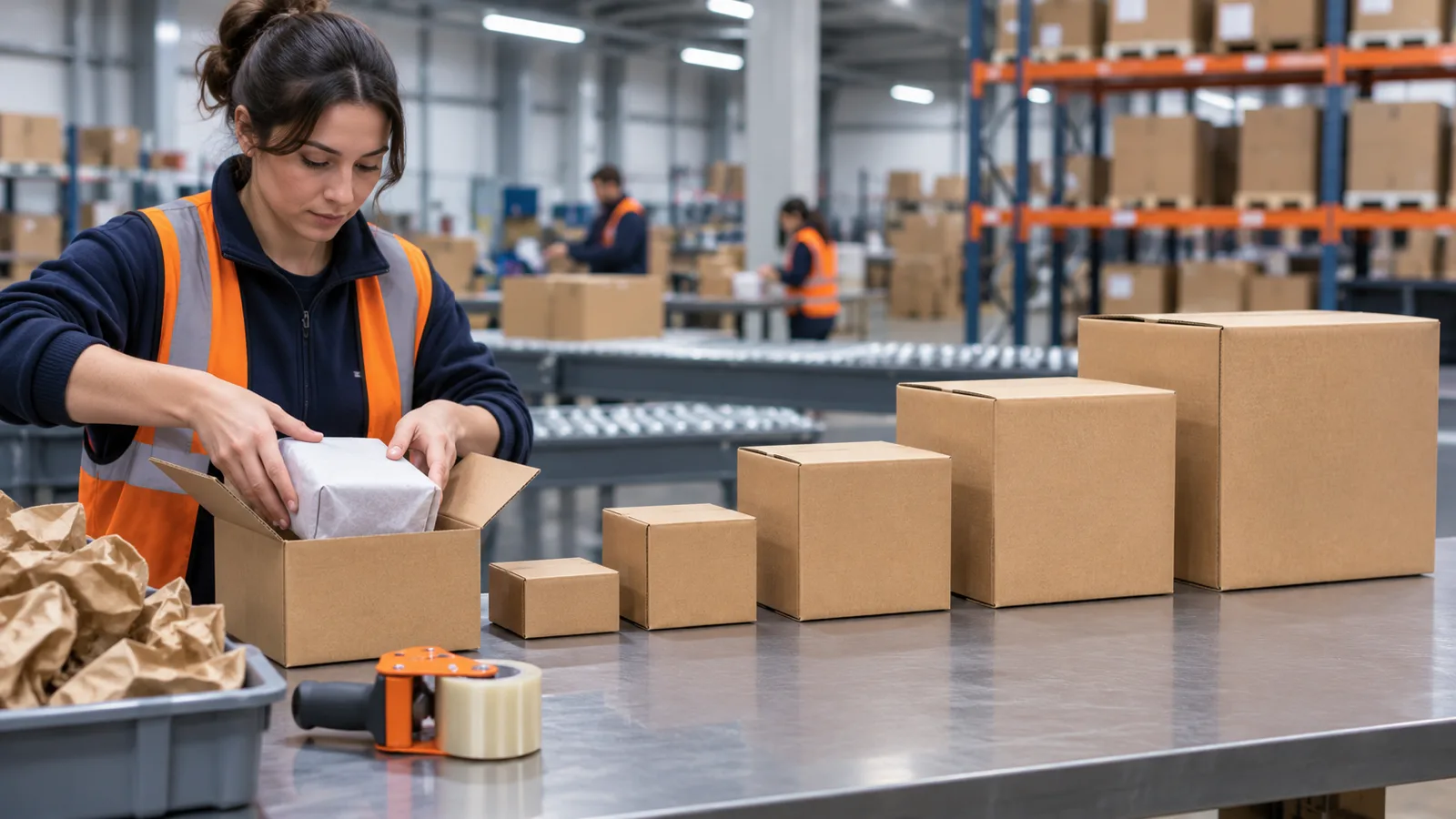
Packaging optimization means choosing the right packaging for each order: small enough to minimize dimensional weight and materials, strong enough to protect the product. This article explains how to approach it step by step, whether you pack in-house in Mississauga or work with a fulfillment partner.
How dimensional weight works
Carriers calculate dimensional (or volumetric) weight by multiplying the length, width and height of a package and dividing by a dimensional factor set by the carrier. The result is compared with the actual weight, and you pay for whichever is greater. Dimensional factors differ by carrier and service, and carriers update them from time to time, so check the current figures in your carrier agreements.
Because the calculation multiplies three dimensions, small reductions in each side make a big difference to volume. Trimming a couple of centimetres from each side of a box can reduce its volume substantially. Our guide on how package dimensions impact shipping prices walks through worked examples.
Step 1: Gather your data
Before changing anything, find out what you actually ship.
- List your SKUs with accurate dimensions and weights, measured in their retail packaging.
- Pull a few months of order history and identify the most common order profiles: single items, common pairs, typical multi-item orders.
- Pull carrier invoices and compare billed weight against actual weight. Shipments where billed weight is much higher than actual weight are your opportunities.
- Review damage claims and customer complaints related to packaging.
Often a small number of order profiles account for most of your volume. Optimize for those first.
Step 2: Build a box suite
Most businesses do not need dozens of box sizes, but two is usually too few. A well-designed set of perhaps five to ten sizes, plus mailers or poly bags for soft goods, typically covers the majority of orders with a close fit.
Tips for choosing sizes
- Design sizes around your most common order profiles, not around stock catalogue sizes alone.
- Leave enough room for the protective packaging the product genuinely needs, and no more.
- Consider padded mailers or poly mailers for non-fragile items like apparel, books and soft accessories.
- Check whether a slightly smaller box would bring a common order profile below a carrier's size threshold for additional handling or oversized surcharges. Our overview of shipping surcharges lists the common ones.
- Talk to a packaging supplier in the GTA about custom sizes. For high-volume SKUs, custom boxes can pay for themselves.
Step 3: Match protection to the product
Right-sizing does not mean under-protecting. The goal is the minimum packaging that gets the product to the customer intact. Damage is far more expensive than a slightly larger box.
- Fragile items like glass, ceramics and candles in glass jars need cushioning on all sides and protection from movement. Molded pulp inserts or paper-based cushioning can replace loose fill while keeping boxes compact. See our guide on how to pack fragile items.
- Liquids need leak-proof containment, such as a sealed bag, inside the box.
- Heavy items need stronger corrugated board and good tape, especially for parcels over a few kilograms.
- Soft goods often need only a poly or paper mailer.
Test new packaging before rolling it out. Ship samples to a few addresses across the country, including rural ones, and see how they arrive. Parcels from Mississauga to Western Canada or the Maritimes pass through several sorting facilities, so they take more handling than a local delivery.
Step 4: Use cartonization software
Even with a good box suite, packers under time pressure tend to grab whatever box is closest. Cartonization software solves this by calculating the best box for each order automatically, based on item dimensions, weights and packing rules, and showing it to the packer at the station.
Cartonization works only if your product dimensions are accurate, which is why Step 1 matters. ShipCarte's cartonization feature, part of our warehouse management system, recommends box sizes for each order based on product data. It also helps forecast how many of each box size you need, so the right boxes are always in stock.
Step 5: Train packers and review results
Packing standards should be written down and demonstrated with photos: which box for which items, how much void fill, how to tape, where the label goes. Train new staff before peak season, when temporary packers join and box selection tends to drift.
After rolling out changes, review results monthly:
- Average billed weight compared with actual weight.
- Average shipping cost per order, by carrier and zone.
- Damage rate and related customer complaints.
- Packaging material spend per order.
- Packing time per order.
Sustainability benefits
Right-sized packaging uses less corrugated board and less void fill, which lowers material cost and waste. Smaller parcels also mean more packages fit on each truck and in each delivery van. Customers increasingly notice and appreciate packaging that is not wasteful. Paper-based void fill and recyclable mailers can support your sustainability messaging, but check that alternatives still protect your products adequately. Ontario's extended producer responsibility rules for packaging may also affect some businesses that supply packaging to consumers, so it is worth understanding whether your business falls under them.
Branded packaging and the unboxing experience
Right-sizing and branding can work together. A snug custom-printed box often feels more premium than an oversized plain one. If you use branded packaging, design it around your most common order profiles so you do not end up forcing small orders into large printed boxes. Inserts and thank-you cards add a personal touch without adding volume. For ideas, see our article on package insert ideas.
Revisiting the candle brand
Go back to the Churchill Meadows candle company. After pulling its data, the team finds that most orders fall into three profiles: a single candle, two candles, or a candle with a reed diffuser. Instead of two box sizes, it moves to four: a small box sized for one candle with a molded pulp insert, a two-candle box with a divider, a slightly taller box for the diffuser combination, and the original large box kept for bigger orders.
The packers no longer decide which box to use; the packing station shows the recommended size for each order. Void fill drops because the inserts hold the jars in place. The team tests the new boxes by shipping samples to friends in Vancouver, Halifax and a rural address north of Peterborough, and checks how they arrive. After rollout, it compares billed weight against actual weight on the next few months of invoices and finds that far fewer shipments are being billed on dimensional weight.
Nothing in this example requires a big investment. It takes accurate data, a few well-chosen box sizes, a packing rule for each order profile and the discipline to follow it.
Packaging for multi-channel sellers
If you sell through your own site, Amazon and retail stores, each channel may have different packaging requirements. Amazon has its own preparation and packaging rules for inventory sent to its fulfillment centres. Retailers may require master cartons of specific sizes, case labels and pallet configurations. Direct-to-consumer orders call for the right-sized parcel packaging described above. Plan packaging by channel rather than trying to force one approach across all of them. Our Amazon FBA prep service handles marketplace preparation alongside standard e-commerce orders in the same warehouse.
Common mistakes to avoid
- Buying boxes based on price per box rather than total cost per shipped order.
- Using inaccurate product dimensions in the system.
- Over-correcting and choosing boxes so tight that products get crushed.
- Forgetting multi-item orders, which often drive the largest dimensional charges.
- Changing packaging without testing it in real shipments.
Optimize packaging with a Mississauga fulfillment partner
ShipCarte provides e-commerce fulfillment and pick and pack services from Mississauga, with cartonization built into packing and multi-carrier rate shopping through our shipping platform. If your shipping costs are creeping up or your packaging is inconsistent, our team can review your SKUs and order profiles with you. Request a quote or schedule a consultation to get started.