
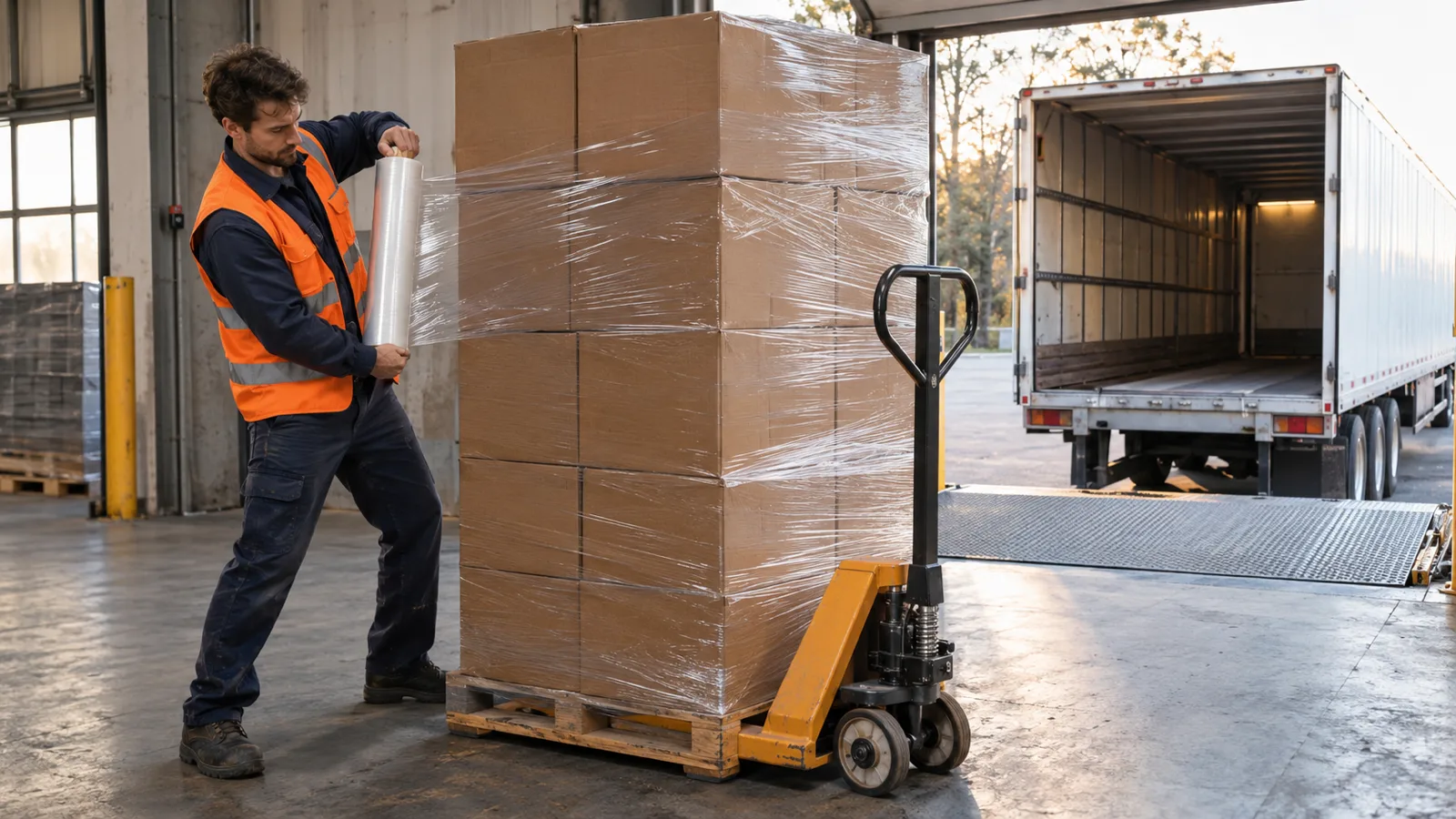
Picture a small kitchenware wholesaler in an industrial unit off Dixie Road. A grocery chain has just placed its first real purchase order: six pallets for a distribution centre in Ottawa and two more for a store cluster in Winnipeg. Until now, everything has gone out by courier in single cartons. Suddenly the owner is staring at an empty pallet, a roll of stretch wrap and a quote form that asks for freight class, accessorials and a delivery appointment window.
Pallet shipping is where a lot of growing businesses in Mississauga first meet the freight world, and it is less forgiving than parcel. A carton that is badly packed might arrive dented. A pallet that is badly built can be refused at the dock, re-weighed and reclassed, or delivered with the bottom layer crushed. The good news is that almost every pallet freight problem traces back to a handful of decisions you control before the truck ever arrives.
This guide walks through those decisions in the order you actually make them: building the pallet, measuring and documenting it, getting a quote that holds up, and booking the pickup so the driver leaves your dock on time.
Step 1: Decide whether it should be a pallet at all
Before you build anything, check that pallet freight is the right mode. As a rough guide, once a shipment to a single address goes past a handful of cartons or a couple of hundred pounds, consolidating onto a pallet and shipping it LTL (less than truckload) often becomes cheaper and safer than sending a stack of individual parcels. Parcel carriers handle each box separately through automated sortation, which means more touches, more chances of loss and more surcharges for heavy or oversized pieces.
On the other end of the scale, if you are filling most of a 53-foot trailer, or you have ten or more pallets going to one consignee, it is worth pricing a full truckload or a volume LTL quote. Our article on how freight differs from small package shipping covers the crossover points in more detail.
Step 2: Build a pallet that survives the network
An LTL pallet does not ride straight from your dock to the customer. It is picked up by a city driver, brought to a terminal (many carriers serving the region run terminals in Mississauga, Brampton or along the 401 and 407 corridors), unloaded by forklift, sorted, loaded onto a linehaul trailer, unloaded again at a destination terminal and finally loaded onto a delivery truck. Every one of those moves is a chance for something to go wrong. Build for the worst handler, not the best.
Start with a sound pallet
The standard North American pallet is 48 by 40 inches. Use one with no broken deck boards, protruding nails or cracked stringers. Four-way entry pallets are easier for forklifts and pallet jacks at terminals and at the receiving dock. If you are shipping to a retailer, check their routing guide: many large chains specify pallet type, maximum height and sometimes whether they accept only certain pallet pools.
Stack for strength
- Put the heaviest cartons on the bottom and the lightest on top.
- Stack cartons corner to corner, column style, when the cartons are strong enough. Columns carry vertical load far better than interlocked bricks, although interlocking adds stability for lighter boxes.
- Keep everything inside the pallet footprint. Overhang means the carton corners take the impact when pallets are pushed together, and an overhanging box loses much of its stacking strength.
- Aim for a flat, level top. A pyramid-shaped load cannot be safely double-stacked, and carriers may charge as if nothing can go on top of it.
Secure the load
Stretch-wrap the load to the pallet itself, not just around the cartons. Start by wrapping several times around the base, catching the deck boards, then spiral upward and back down. Corner boards (edge protectors) under the wrap stiffen the load and protect carton edges from straps. For heavy or dense freight, add banding or strapping through the pallet. A slip sheet or cardboard tier sheet between layers helps keep stacks from shifting.
If the freight genuinely cannot have anything placed on top, use a pallet cap or a cone and mark it clearly, but understand that "do not stack" usually affects how the carrier prices the space your shipment takes up.
Label it twice
Put a shipping label with consignee, address, number of pieces and your bill of lading or PRO reference on at least two adjacent sides of the pallet, ideally under the final layer of wrap so it cannot peel off. If the pallet carries goods regulated as dangerous goods under Canada's Transportation of Dangerous Goods (TDG) rules, the marking, documentation and training requirements apply in addition to normal labelling, so confirm classification before you build.
Step 3: Measure, weigh and describe accurately
This is the step that causes the most invoice surprises. LTL carriers routinely re-weigh and re-measure freight at their terminals, often with dimensioning equipment. If the numbers differ from what you declared, the bill changes, and sometimes a reclass or inspection fee is added on top.
- Weigh the finished pallet, including the pallet itself, wrap and any caps. A wood pallet alone can add a meaningful amount of weight, so do not use the carton weights only.
- Measure the full footprint and height, including any overhang or bulge. Round up to the next inch.
- Calculate density (pounds per cubic foot). Many carriers and brokers in Canada price on density or on linear feet of trailer used, while US-bound freight is often still classed using the National Motor Freight Classification system. Either way, density drives the price.
- Describe the commodity honestly and specifically. "Household goods" or "general merchandise" invites a reclass. "Stainless steel cookware, boxed" tells the carrier what it is handling.
Our explainer on how package dimensions affect shipping costs walks through the density maths if you want to run the numbers yourself.
Step 4: Get a quote that will match the invoice
A pallet quote is only as good as the information behind it. When you request one, have the following ready:
- Origin and destination postal codes, and whether each site is a business with a dock, a business without a dock, or a residence.
- Number of pallets, dimensions, weight and commodity description.
- Whether the freight is stackable.
- Any accessorial services needed: tailgate (liftgate) pickup or delivery, inside delivery, appointment delivery, limited-access location, protective service in winter, or dangerous goods handling.
- Declared value, if you want coverage beyond the carrier's standard liability.
Accessorials are where quotes and invoices most often drift apart. A delivery to a retail store in a plaza without a dock likely needs a tailgate truck. A delivery to a big-box distribution centre almost always needs an appointment. Shipping to a construction site, school, farm or military base usually triggers a limited-access charge. If you know about these conditions in advance, put them on the quote. If you leave them off, they will appear on the invoice anyway.
Winter matters too. Liquids, some adhesives, paints and certain food products can be damaged by freezing in an unheated trailer between Mississauga and the prairies. Ask for heated or protect-from-freeze service where it applies, and expect it to cost more and to have fewer carrier options.
If you are comparing quotes from several carriers, look beyond the headline number. Check transit time, terminal coverage at the destination (some carriers interline with partners for remote areas, which adds handling), liability limits and claims reputation. A carrier management partner can do that comparison across many carriers at once and keep your rate history in one place.
Step 5: Book the pickup and prepare the paperwork
Once you accept a quote, you book the pickup and generate a bill of lading (BOL). The BOL is the contract of carriage and the receipt for your goods, so it needs to match the freight on the dock exactly: number of pieces, weight, description and any special instructions. If you are new to the document, our guide on the purpose of a bill of lading explains each field.
Practical points for Mississauga shippers:
- Book early in the day. City drivers build their routes in the morning. A pickup requested late in the afternoon may roll to the next business day, especially in busy periods.
- Give a realistic ready time and close time. If your dock shuts at 4:00 p.m., say so. A driver stuck in traffic on the 401 or the 410 near the Heartland area may arrive later than planned, and a closed door means a missed pickup and sometimes a fee.
- Have the freight staged at the door, labelled and wrapped, with the BOL printed in duplicate.
- Get the driver's signature and count on your copy of the BOL. If a pallet is damaged in the carrier's hands later, this is your proof of what left your dock and in what condition.
- Take photos of each pallet from two sides before it goes on the truck. Photos make freight claims far easier to support.
Step 6: Track it and handle delivery properly
After pickup, the carrier assigns a PRO number you can use to track the shipment. (Our post on what a PRO number is explains how it differs from your own reference numbers.) Share it with your customer so they can plan receiving, and watch for exceptions such as missed appointments, address issues or terminal delays.
Coach your customers, too. Receivers should count pallets, check for visible damage and note any problems on the delivery receipt before signing. "Subject to inspection" is not enough on its own with many carriers; a specific note like "one pallet wrap torn, two cartons crushed" carries far more weight if you need to file a claim. Concealed damage found after delivery should be reported to the carrier quickly, as claim windows are limited.
Common pallet shipping mistakes we see
The same handful of issues come up again and again with businesses that are new to freight:
- Declaring the carton weight instead of the gross pallet weight.
- Forgetting that the delivery address is a residence or has no dock.
- Building pallets taller than the receiver's maximum, which can lead to refusal at retail distribution centres.
- Using a damaged pallet that fails under the forklift tines.
- Mixing products for different destinations on one pallet, which forces the carrier or the receiver to break it down.
- Vague commodity descriptions that lead to reclassification.
- Not booking an appointment when the consignee requires one, leading to redelivery charges.
None of these are exotic. They simply come from treating a pallet like a large parcel. Building a short internal checklist from the steps above, and having one person own it, prevents most of them.
Why location matters for pallet freight in Mississauga
Mississauga is one of the most freight-dense places in Canada. Highways 401, 403, 407, 410 and 427 all run through or alongside the city, Toronto Pearson sits on its northeastern edge, and major rail intermodal terminals are a short drive away in Brampton and Vaughan. That density works in your favour: there is real competition among LTL carriers for freight originating in the area, and same-day or next-day regional delivery across the Greater Toronto and Hamilton Area is common.
It also means traffic, dock congestion and appointment scarcity at large distribution centres are a daily reality. Building a little slack into ready times, and choosing carriers with strong local terminal operations, often matters more than shaving a few dollars off a rate.
For cross-border pallets, the region gives you a choice of routes to the US through the Peace Bridge, the Lewiston-Queenston Bridge or the Ambassador Bridge in Windsor, depending on destination. Cross-border LTL adds customs documentation and a customs broker to the process; see our cross-border shipping page for how that fits together.
When to hand pallet shipping to a 3PL
If you ship pallets once a month, doing it yourself with a good checklist is perfectly reasonable. If pallets are becoming a weekly or daily part of your business, especially alongside parcel orders, it may make sense to have a partner build, document and book them for you from a warehouse that already has docks, scales, wrappers and carrier relationships in place. That is the kind of work ShipCarte handles through its distribution services and shipping platform, which lets you compare carrier rates and book freight in one place.
Talk to us about your next pallet shipment
Whether you are sending your first retail order out of a unit in Mississauga or trying to tame a growing LTL bill, a clear process and the right carrier mix make a real difference. Tell us where your freight is going and what it looks like, and we will help you price it properly. Request a freight quote or book a consultation with the ShipCarte team.