
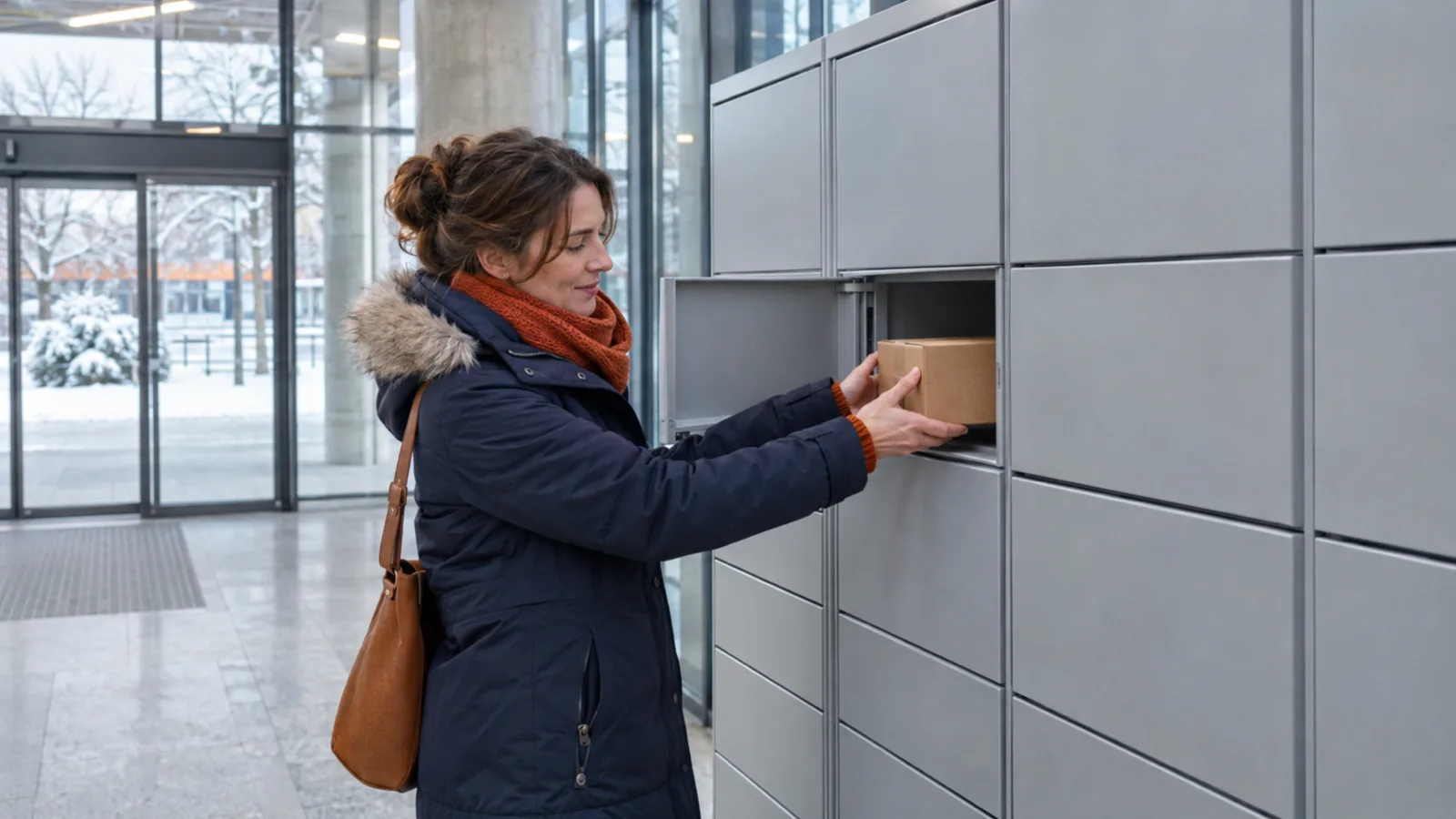
A customer in a downtown Montreal walk-up works long shifts and is never home when couriers come by. Her building has no concierge and the mailbox is too small for anything thicker than an envelope. Every order she places turns into a delivery notice card, a trip to a depot across town and, more than once, a parcel returned to the sender because she could not pick it up in time.
For millions of Canadians, doorstep delivery is not the convenient default that retailers assume. Apartment dwellers, shift workers, rural residents with long driveways and anyone worried about parcels sitting on a porch all benefit from another option. Parcel lockers and pickup points give those customers more control over when and where they collect an order, and they give retailers a way to cut failed deliveries.
This article compares the main alternatives to doorstep delivery available in Canada, looks at who they suit and explains how an online store can offer them without complicating fulfillment.
Why alternatives to the doorstep matter
Several trends make pickup options more relevant in Canada right now:
- Urban density. More households in the Greater Toronto Area, Vancouver, Montreal and other large cities live in condos and apartments, where couriers face buzzers, locked lobbies and limited parcel rooms.
- Rural geography. Many rural Canadians already collect mail from community mailboxes or the local post office.
- Weather. A parcel left outside in a January snowstorm in Winnipeg or a rainy November in Vancouver is a parcel at risk.
- Theft concerns. Porch theft is a real worry for many shoppers, especially for higher-value items.
- Changing routines. With more people ordering online this year during the pandemic, and many preferring low-contact handoffs, flexible pickup has become a selling point.
The main options compared
Post office pickup
Canada Post has the broadest retail network in the country, reaching cities, small towns and many remote communities. Customers can have parcels held at a post office of their choice through Canada Post's delivery-to-post-office options, and parcels that cannot be delivered are typically held at a nearby location for pickup.
- Strengths: national coverage, including rural and northern communities; familiar to customers; many locations inside pharmacies and grocery stores with extended hours.
- Limitations: requires shipping with Canada Post; pickup usually requires identification and a notice card or tracking information; parcels are held for a limited time.
Parcel lockers
Self-service lockers allow customers to collect parcels with a code, often at any hour. In Canada, parcel lockers are found in some apartment and condo buildings, in certain post offices and in a growing number of retail and transit locations. Some buildings install lockers from third-party providers that work with multiple carriers.
- Strengths: 24/7 or extended access at many sites; no queue or counter interaction; secure storage.
- Limitations: coverage is concentrated in urban areas; locker compartments have size and weight limits; availability depends on carrier and location.
Courier retail access points
The major courier companies operate networks of retail partners, such as convenience stores, pharmacies, print shops and shipping stores, where customers can collect parcels or have missed deliveries redirected. Customers can often choose a location in advance or redirect a parcel after it ships.
- Strengths: many locations in cities and larger towns; convenient hours; works for couriers other than Canada Post.
- Limitations: networks vary by carrier, and smaller communities may have few or no locations; holding periods apply.
In-store pickup and curbside
Retailers with physical stores can offer buy online, pick up in store. This has become far more common this year, with many shops adding curbside pickup. It works best when store inventory is visible to the online system and when stores have a clear process for staging orders.
- Strengths: no shipping cost for the customer; brings people into stores; immediate availability when stock is local.
- Limitations: requires stores and accurate store-level inventory; staff time for staging and handoff.
Hold at depot
Most carriers allow customers to collect parcels from a depot or terminal. It is a fallback rather than a feature, since depots are often in industrial areas with limited hours, but for rural customers it can be the most reliable option.
Which customers benefit most?
- Condo and apartment residents who struggle with building access: lockers and nearby access points.
- Commuters and shift workers: lockers near transit or access points with long hours.
- Rural customers: the local post office, which is often already where they collect mail.
- Customers ordering high-value items: any secure pickup option that avoids leaving a parcel unattended.
- Gift buyers who do not want a surprise delivered to a shared home.
How to offer pickup options in your store
Start with your carrier mix
Pickup options depend on the carriers you use. If your shipping is concentrated with one courier, your customers only see that courier's network. Using a multi-carrier shipping platform and carrier management can make post office and courier access point delivery available side by side.
Add the option at checkout
The best experience lets customers choose a pickup location on a map at checkout, based on their postal code. Some ecommerce platforms and shipping apps support this through carrier integrations. If that is not available yet, a simpler approach is to tell customers in your shipping policy that they can redirect parcels to a pickup location using the carrier's own tools after the order ships.
Get the labels right
A parcel bound for a pickup point still needs the customer's name exactly as it appears on their ID, plus a phone number and email so the carrier can send pickup notifications. Your fulfillment partner's systems need to pass the pickup location to the carrier correctly. Ask your provider how its integrations handle alternate delivery locations.
Mind size and weight limits
Lockers and small retail access points cannot take every parcel. Right-sized packaging improves the chance an order fits. Bulky items and heavy orders may need to be excluded from locker delivery at checkout.
Explain pickup rules
Tell customers what they need to bring, how long parcels are held and what happens if they do not collect in time. Unclaimed parcels are typically returned to the sender, which costs you a return shipment and creates a refund or reshipment decision.
Products that need extra thought
- Age-restricted products may require signature and ID verification at handoff, and some pickup points may not accept them.
- Perishable and temperature-sensitive goods generally should not sit in lockers or retail counters for days. For these, scheduled delivery is usually safer. ShipCarte's cold chain fulfillment team can advise on delivery options for chilled and frozen orders.
- Dangerous goods under Transport Canada's Transportation of Dangerous Goods rules may face restrictions on some services and locations.
Questions customers often ask
Do I need ID to collect my parcel?
At staffed counters, usually yes. Post offices and retail access points generally ask for government-issued photo identification matching the name on the label, and may ask for the notice card or tracking number. Lockers typically use a code or barcode sent by email or text instead. Make sure your checkout collects the recipient's name as it appears on their ID.
Can someone else pick it up for me?
Policies vary by carrier and location. Some allow an authorised person to collect with the notice card and their own ID, while others require the named recipient. Point customers to the carrier's rules rather than promising something you cannot control.
How long will the parcel be held?
Holding periods differ by carrier and service and are typically measured in days to a couple of weeks. Encourage customers to collect promptly, and include the deadline in pickup notifications where the carrier provides it.
Will pickup delivery be slower?
Not always. Delivery to a pickup point often takes about the same time as doorstep delivery, and sometimes avoids the delay of a missed first attempt. Rural post office deliveries can depend on how often the community is served, so give honest estimates.
Is pickup delivery cheaper?
It can be for some services, since the carrier makes one stop for many parcels. Some retailers pass part of that saving on with a lower shipping rate for pickup orders, which also nudges customers toward a more reliable option.
Measuring the results
After adding pickup options, watch:
- The share of orders using each delivery option, by region.
- Failed delivery and return-to-sender rates before and after.
- Support tickets about missing or stolen parcels.
- Unclaimed pickup returns.
- Customer feedback on the checkout experience.
Over time, this data tells you whether pickup options are reducing costs and complaints enough to justify promoting them more heavily, for example with a lower shipping rate for pickup delivery.
For more on keeping parcels safe at the door, see our related guide on preventing porch theft for ecommerce orders in Canada, and our explainer on first-mile and last-mile delivery.
Give customers more ways to receive orders
Parcel lockers and pickup points will not replace doorstep delivery in Canada, but they solve real problems for customers in apartments, rural communities and busy households. ShipCarte helps businesses ship through a range of carriers and services with small parcel shipping and ecommerce fulfillment. Schedule a consultation to explore delivery options for your customers.